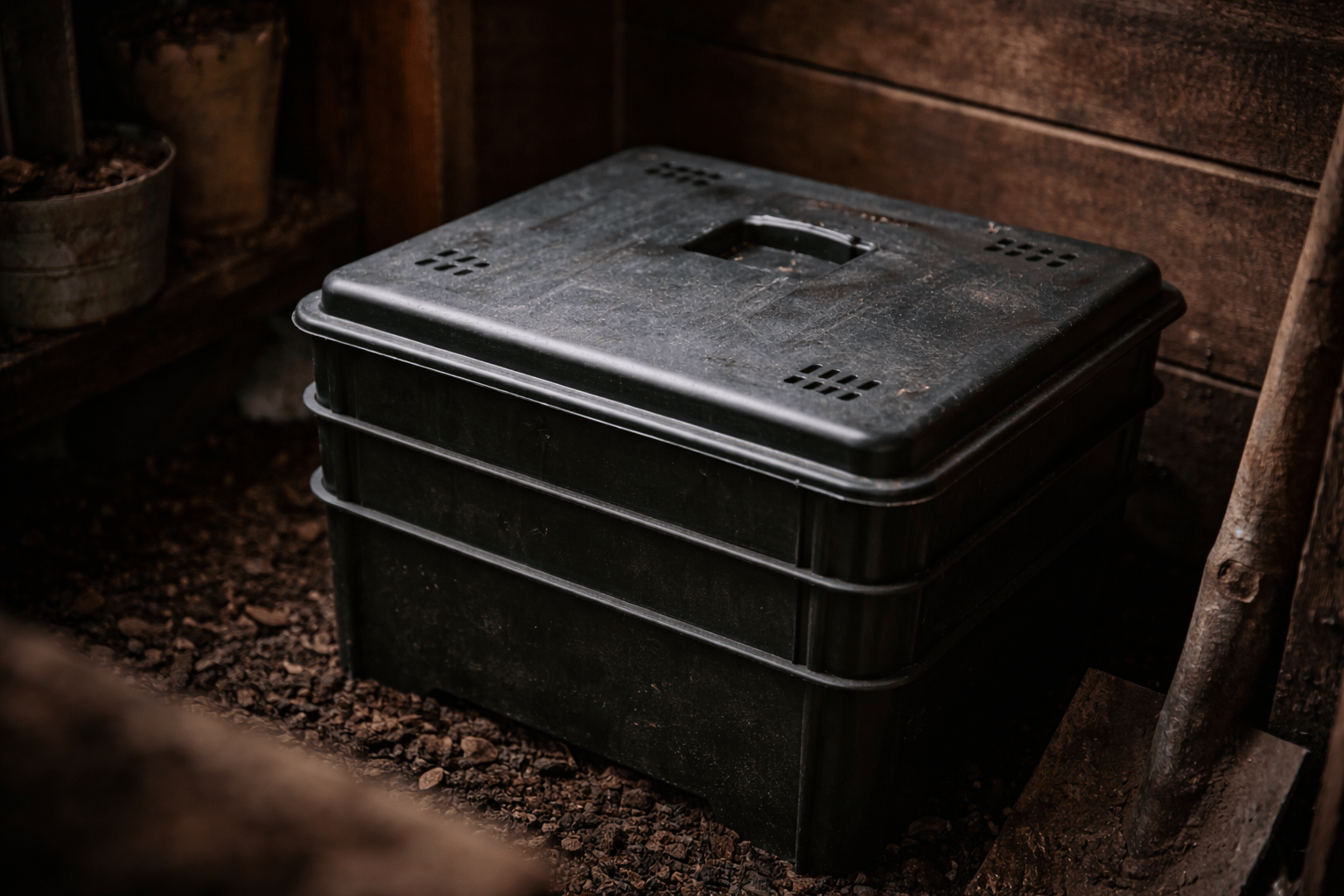
| Beginning Most worm farms don’t fail because anything dramatic goes wrong. They fail because someone wanted them to get going. There’s a particular moment at the start that repeats itself endlessly. A box arrives. Or a bin is drilled. Or a tray is stacked. Worms are tipped in with a mixture of care and excitement, the way people handle something alive that they’ve paid for. Food follows almost immediately, often too much of it, because the logic seems sound enough: worms eat waste, waste is plentiful, therefore feeding them properly means feeding them generously. What happens next rarely looks like a disaster. Nothing leaks. Nothing collapses. The lid goes back on. And quietly, the system begins to wobble. Worm farming is one of those practices that looks straightforward because the components are simple. Worms. Food. A container. Darkness. Moisture. It appears to be a closed loop you can set in motion with the right starting conditions. The internet reinforces this idea relentlessly, framing success as a matter of setup rather than time. But what’s being missed is that the beginning isn’t a technical phase at all. It’s a behavioural one. The worms don’t need much at first. The keeper does. The hardest thing about starting a worm farm is not choosing the right bin or the right species. It’s resisting the urge to intervene before there’s anything to respond to. Worms arrive ready to work, but the system they operate within does not yet exist. There is no established microbial population, no stable moisture gradient, and no rhythm of feeding and digestion. All of that takes time to form, and until it does, the worms are not the workers people imagine them to be. They are settlers, slowly adjusting to unfamiliar conditions. One of the quieter mistakes at this stage is assuming that visible activity equals health. New worm farms are often watched closely, lids lifted too often, bedding disturbed, food checked and rechecked. The intention is care, but the effect is disturbance. Worms are not encouraged by attention. They are encouraged by consistency. A calm bin that smells neutral and looks unremarkable is usually doing far better than one that feels busy. In the early weeks, a worm farm that appears boring is often the one that’s working. There’s also a common assumption that worms need to be “got going” in the same way compost heaps are. People talk about jump-starting, boosting, and activating. This language makes sense in a culture used to accelerating processes, but decomposition doesn’t respond well to urgency. Worms don’t speed up because you want results. They respond to stable conditions, gentle inputs, and the slow accumulation of biological relationships. If there is a single skill worth learning at the beginning, it is the ability to leave things alone without feeling negligent. Starting small matters more than most guides admit. Not because worms are fragile, but because systems are. A modest amount of food breaks down predictably. Moisture levels are easier to read. Mistakes stay small enough to correct themselves. Overfeeding at the beginning doesn’t usually kill worms outright; it overwhelms the unseen life that supports them. By the time smells appear or textures change, the problem has already been developing for days. The beginning rewards restraint because restraint keeps feedback readable. Another overlooked truth is that early failure often isn’t visible. Worm farms tend to fail quietly. Populations thin rather than crash. Feeding slows rather than stops. People assume things are fine because nothing looks obviously wrong, then lose interest when outputs don’t match expectations. What’s actually happening is that the system never stabilised. The worms didn’t die; they endured. And endurance is not the same as thriving. There’s a broader habit at work here, one that extends beyond worm farming. We are comfortable managing objects but less comfortable living alongside processes. A worm farm sits awkwardly between the two. It looks like a container you can control, but behaves like an ecosystem you can only influence indirectly. At the beginning, this mismatch creates frustration. People want evidence that they’re doing it right, when the absence of drama is often the evidence itself. It’s also worth acknowledging that not every worm farm needs to succeed. Some beginnings are experiments rather than commitments, and there’s nothing wrong with discovering that the practice doesn’t fit your space, your routines, or your temperament. Worm farming requires patience, tolerance for ambiguity, and a willingness to accept that not all effort yields visible reward. These are not universal preferences. Walking away early is sometimes the most honest outcome. For those who continue, the beginning sets the tone for everything that follows. A system allowed to find its own balance early on becomes resilient later. One that is pushed too hard at the start tends to require constant correction. The difference isn’t luck or technique so much as timing. Worms do their best work when they are not hurried, and the first lesson they offer is simple: starting well often means starting slowly. By the time a worm farm is truly underway, it no longer feels like something you are running. It feels like something you are sharing space with. That shift doesn’t happen because of a clever setup or the right ratio of inputs. It happens because, at the beginning, you gave the system time to become itself. |
| About our writing & imagery Many of our articles are written by us, drawing on real experience, reflection, and practical work in gardens and places we know. Some pieces are developed with the assistance of AI, used as drafting and research tools rather than as a voice or authority. Featured images may include our own photography, original AI-generated imagery, or—where noted—images kindly shared by other creators and credited accordingly (for example, via Pixabay). All content is shaped, edited, and published by Earthly Comforts, and the views expressed are our own. |

