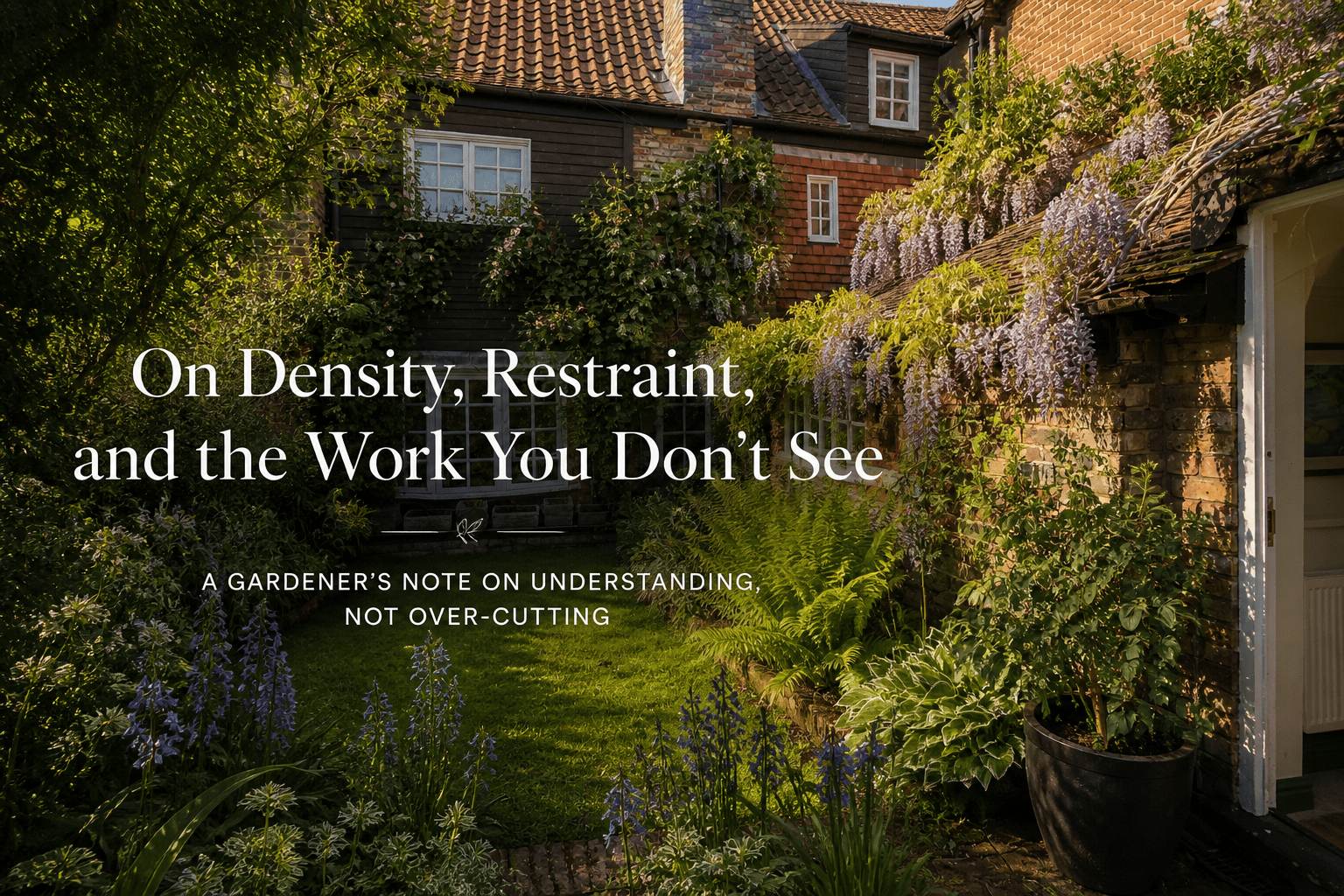
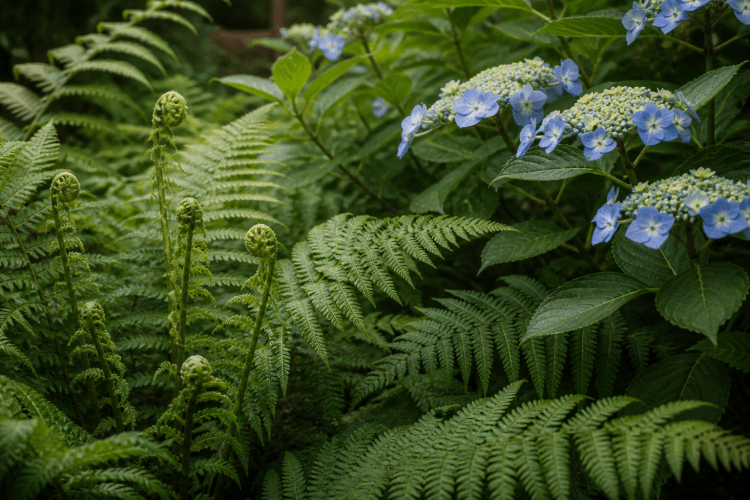
| A gardener’s note on a “bohemian” garden that already knows what it’s doing … Some gardens are described as loose and abundant—bohemian. The word suggests freedom, colour, and allowance rather than control. What is less often recognised is that this kind of garden, while appearing casual, is actually not casual at all; it is carefully constructed, not accidental. It is built, not spontaneous. Held by planning, not chance. Maintained by attention, not neglect. Above all, it was shaped by experience, not guesswork. The surface of things Stand in the late April garden, and you’ll see, not disorder, but decisions settled into place. Climbers train along walls. Wisteria stretches across, shaping but not overtaking structures. Roses thread upward, filling without smothering. Trellis stands ready—evidence of longer plans. At ground level, perennials form a base rhythm; low mounds soften edges, and seasonal interest comes and goes, leaving no gaps. There is repetition, not rigidity. Movement, not drift. The lawn sits in the centre as a pause—a place for the eye to rest before returning to borders. Even here, work continues: repairs, managing wear, and guiding growth. Nothing in this space is accidental. Though it may appear relaxed, every element is chosen—intentional, not random. What people mean by “density” When people talk about garden density, they usually mean fullness—not bare soil or gaps; a sense of space alive and occupied. That instinct is not wrong. Density isn’t just about plant quantity. It’s how plants relate—sharing light, layering, moving through seasons without conflict. A dense garden is not crowded, but composed. Instead of chaos, there is deliberate structure. A dense garden allows overlap without suffocation. One plant can pass in front of another, and visibility isn’t health. In a well-held garden, plants are not constantly kept in check; they are allowed room to express themselves, but always within a pre-considered structure. The work beneath the appearance Gardens like this do not arrive fully formed. This one, in particular, has taken time. Years, not months. It began in a state that required correction—structure reintroduced, planting rethought, balance restored where it had been lost. The kind of work that is rarely visible once it’s done. What you see now is not the absence of effort, but the result of it. The climbers have been retrained more than once. Borders readjusted and rebuilt. The lawn restored, season by season. Window boxes are replanted twice a year to keep them relevant. Even now, it is not finished. It will not be finished. A garden like this is ongoing by nature. It takes a steady hand—a willingness to revisit the same decisions and adjust each time. The quiet role of the gardener In a setting like this, the gardener’s role is not to impose control but to foster understanding. Control is replaced by observation and responsiveness. It is to recognise when something needs cutting and when it needs to be left. To see when a plant is moving out of its place and when it is simply passing through a phase of growth. To hold the overall shape of the garden in mind, even when individual elements appear to stray. It is, in many ways, a form of restraint. The work is not always visible because the aim is not to create constant change. It is to allow continuity. To ensure that what has been built remains intact, even as it evolves. When intention and interpretation diverge There are moments, however, when the understanding of the garden shifts—not in the plants themselves, but in how they are perceived by the clients. A plant leans a little further than expected. Something appears to sit in front of something else. A sense arises that one thing may be interfering with another. In those moments, it is easy for a client to act and overreact – not with malignancy, but through a lack of understanding how the garden is to flow under ‘bohemian styling’. Non-gardener cuts, made for instant visual gratification, thinking that the encroaching plants are damaging the plants behind. So the cut is made out of a desire to improve. To correct what seems out of place. To help one plant by reducing another. And sometimes, in doing so, the balance that had been quietly established is altered. Dramatically and in a way that announces itself immediately. Enough that something of the original intention is lost, at least for the remainder of the season and the year. A particular instance In this garden, there was a moment where that shift became visible. Among the layered planting at the base of the wall, one section had been holding its own comfortably within the broader composition. It was neither dominant nor suppressed. It was simply part of the structure—doing the job it had been given. Over the course of a day in late spring, that presence changed. What had been a full, contributing part of the planting was reduced, not selectively but decisively and significantly aggressively, by the client. The reasoning was straightforward enough: it was considered encroaching, perhaps limiting the progress of something nearby. It is a familiar line of thinking. The idea that one plant must give way for another to thrive is deeply rooted in how many people approach gardens. It makes intuitive sense. If something appears to be in the way, it must be removed. But in a garden that has been designed—or gradually shaped—to hold density, that assumption does not always apply. Plants can coexist without always competing. They occupy different layers, roles, and rhythms. What appears to be interference can be balanced. When that balance is interrupted, the effect is not always immediate. The garden still looks good. Still functions. But something of its quiet cohesion is reduced. The difficulty of seeing the whole Part of the challenge is that gardens are rarely viewed as complete systems. Gardens are experienced in fragments—a section, a plant, a moment—decisions usually follow what is visible then, not what has developed over time. The gardener, by contrast, is working with continuity. They see the same space repeatedly. They understand how it changes, settles, and responds to intervention. Their decisions are informed not just by what is present, but by what has been and what is likely to follow. This difference in perspective is where misunderstandings tend to arise. Not through disagreement, but through a mismatch in context. A gentle suggestion There is a simple way to bridge that gap that does not require expertise. It requires a pause. Before cutting, before correcting, before assuming that something is out of place, it is worth asking whether the moment you are seeing is part of a larger process. And if someone is maintaining the garden—someone tasked with holding its balance—it is worth asking them. Not for permission, but for perspective. Because in a garden where density is part of the design, not every overlap is a problem. Not every instance of fullness needs to be reduced. Sometimes, what looks like excess is simply the garden doing what it was intended to do. Sometimes what is present is simply the remit. Ongoing work None of this suggests that the garden is beyond intervention. Far from it. There is always work to be done: repairing the lawn, adjusting borders, guiding climbers, and keeping window boxes relevant each season. Even the densest planting needs editing over time. Plants outgrow their place. Conditions shift. Balance is not fixed; it is maintained. But that maintenance works best when it is informed by an understanding of the garden as a whole, rather than a reaction to a single moment within it. Closing thought A garden that feels relaxed is almost never a product of relaxed thinking. It is the result of focus, not ease. It is the outcome of careful decisions over time, with plants expressing themselves within a considered framework. Density, in that context, is not something to be controlled. It is something to be held. And perhaps the most valuable contribution anyone can make to such a garden is not another cut, but a moment of trust—in the process, in the planting, and in the quiet work already being done. |
| About our writing & imagery Most articles reflect our gardening experience and reflections. Some use AI in drafting or research, but never for voice or authority. Featured images may show our photos, original AI-generated visuals, or credited images shared by others. All content is shaped and edited by Earthly Comforts, expressing our views. |

