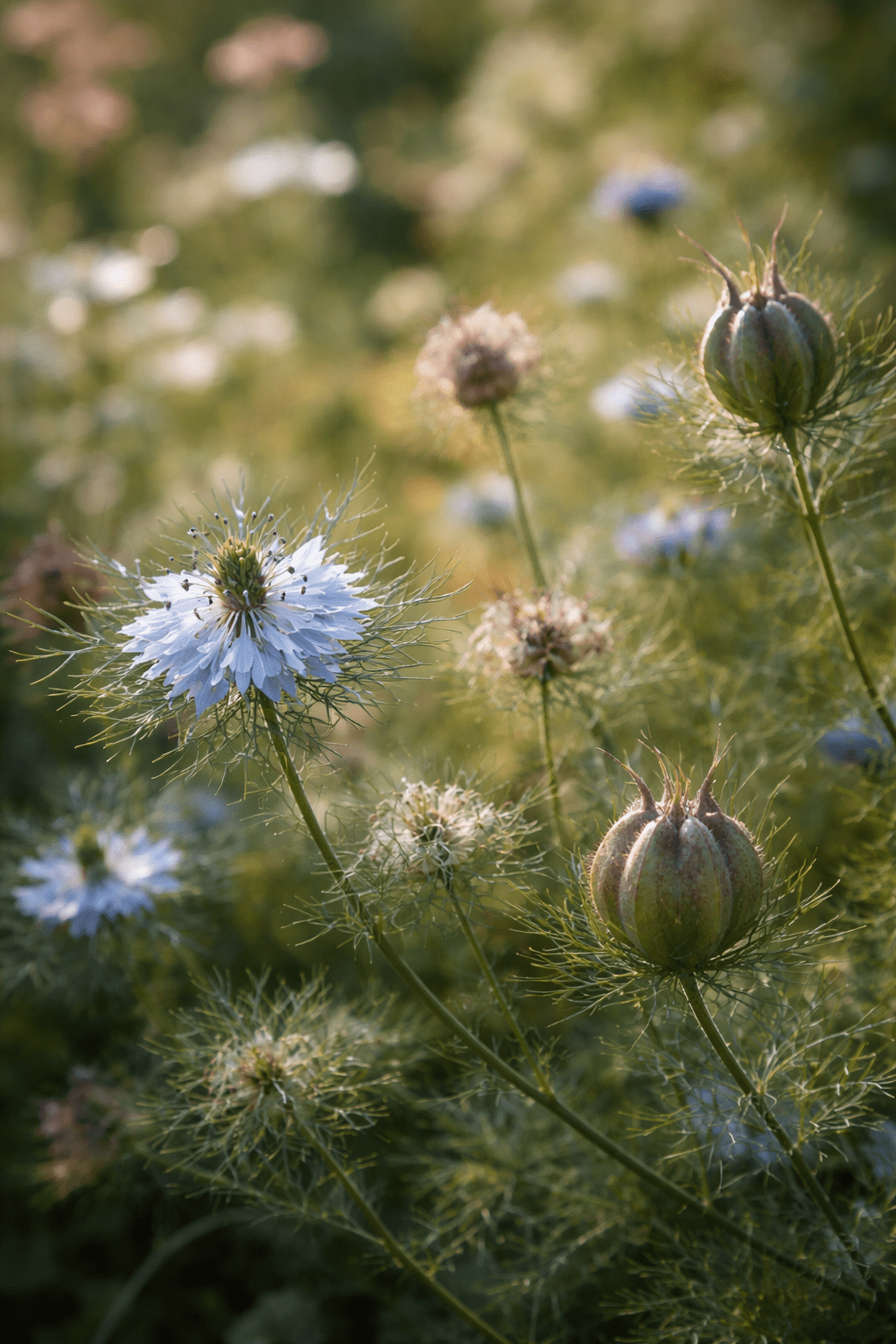
| Nigella (Love-in-a-Mist) Some plants are planned; others just arrive. Nigella is squarely in the latter camp. Even if you assign it a spot, it reappears elsewhere the next year—often somewhere more fitting than you chose. I see Nigella as a plant that quietly resists permanence. It flowers, seeds, and leaves within a season, never letting you believe it belongs forever. Amid a gardening culture obsessed with permanence, structure, and “investment planting,” Nigella feels gently contrarian. And yet, it earns its place. A brief presence, but not a small one Nigella’s garden stay is brief, but not simple. It starts with fine, thread-like foliage—a green haze if unnoticed. Then comes the flower—usually blue, sometimes white or pink—hovering as though unconvinced by gravity. Afterward, an architectural seedhead forms, oddly confident for such a delicate start. This sequence makes Nigella captivating. It demands attention over time, not just a glance. As a gardener, I often see plants judged too fast. If something blooms briefly, it’s deemed unworthy—as if value is solely in duration. Nigella defies that view. Its worth is in how it marks time, not how long it lasts. The seedhead changes the conversation. When petals drop, Nigella shifts—no longer merely ‘pretty.’ The seedhead forms fast, swelling from the flower, ribbed, papery, sometimes tinged purple or green. This is where many gardeners go wrong. The instinct is to tidy. To cut back. To keep the bed looking “finished.” But the seedhead is the second act, not the aftermath. Removing it too early is like leaving a play halfway through. Left alone, the pods dry and split, scattering seed with very little fuss. No drama, no precision—just enough to ensure a future presence without overwhelming the space. In real gardens, this self-sowing is rarely aggressive. More often, it’s selective. Nigella seems to prefer disturbed ground, light soils, and edges where human activity has loosened the soil. There’s a quiet lesson in that. It thrives where control loosens. A myth about self-seeders is that they ‘take over.’ In practice, Nigella is polite. It doesn’t push out other plants or dominate borders. It appears where there’s room—physically and philosophically. I notice Nigella most where beds are worked lightly. Open soil, not compacted; thin mulch; a gardener open to chance. In tightly managed gardens, it often vanishes within a year or two—not due to harshness, but lack of space for chance. Nigella doesn’t reward micromanagement. It responds better to restraint. A plant that resists categorisation It’s tempting to describe Nigella as a cottage-garden staple, but that feels lazy. It appears just as happily in contemporary planting, gravel gardens, informal vegetable beds, and even neglected corners where nothing else has volunteered. It doesn’t read as nostalgic unless you force it to. Nor is it showy enough to feel fashionable. It sits somewhere in between, which may be why it has endured without becoming tiresome. From a design perspective, it does something subtle but valuable: it softens transitions. Between perennials as they bulk up. Between bare soil and fullness. Between seasons. It fills gaps without pretending to be permanent. That quality—being useful without insisting on attention—is rare. Knowing when to leave it alone One of the hardest skills in gardening is learning when not to intervene. Nigella teaches this gently. If you sow it once and let it complete its cycle, it often takes care of the rest itself. Not identically each year, but consistently enough to feel intentional. There are, of course, limits. In very heavy soils, it struggles. In deeply mulched beds, seed may fail to make contact. In overly competitive planting, it can vanish altogether. This isn’t a failure of the plant so much as a mismatch of expectations. Nigella isn’t resilient in the way shrubs are resilient. Its strength lies in repetition, not persistence. What it offers, beyond the flower Perhaps the most interesting thing about Nigella is what it does to the gardener rather than the garden. It encourages a longer view. A willingness to accept that not everything needs to be present all the time to be worthwhile. In an era of instant results and constant display, a plant that asks you to notice beginnings, middles, and ends feels quietly radical. It doesn’t reward urgency. It rewards attention. And when it disappears, it does so cleanly. No mess. No resentment. Just the promise—never guaranteed, but often fulfilled—that it may return. That feels like enough. |
| About our writing & imagery Many of our articles are written by us, drawing on real experience, reflection, and practical work in gardens and places we know. Some pieces are developed with the assistance of AI, used as drafting and research tools rather than as a voice or authority. Featured images may include our own photography, original AI-generated imagery, or—where noted—images kindly shared by other creators and credited accordingly (for example, via Pixabay). All content is shaped, edited, and published by Earthly Comforts, and the views expressed are our own. |

