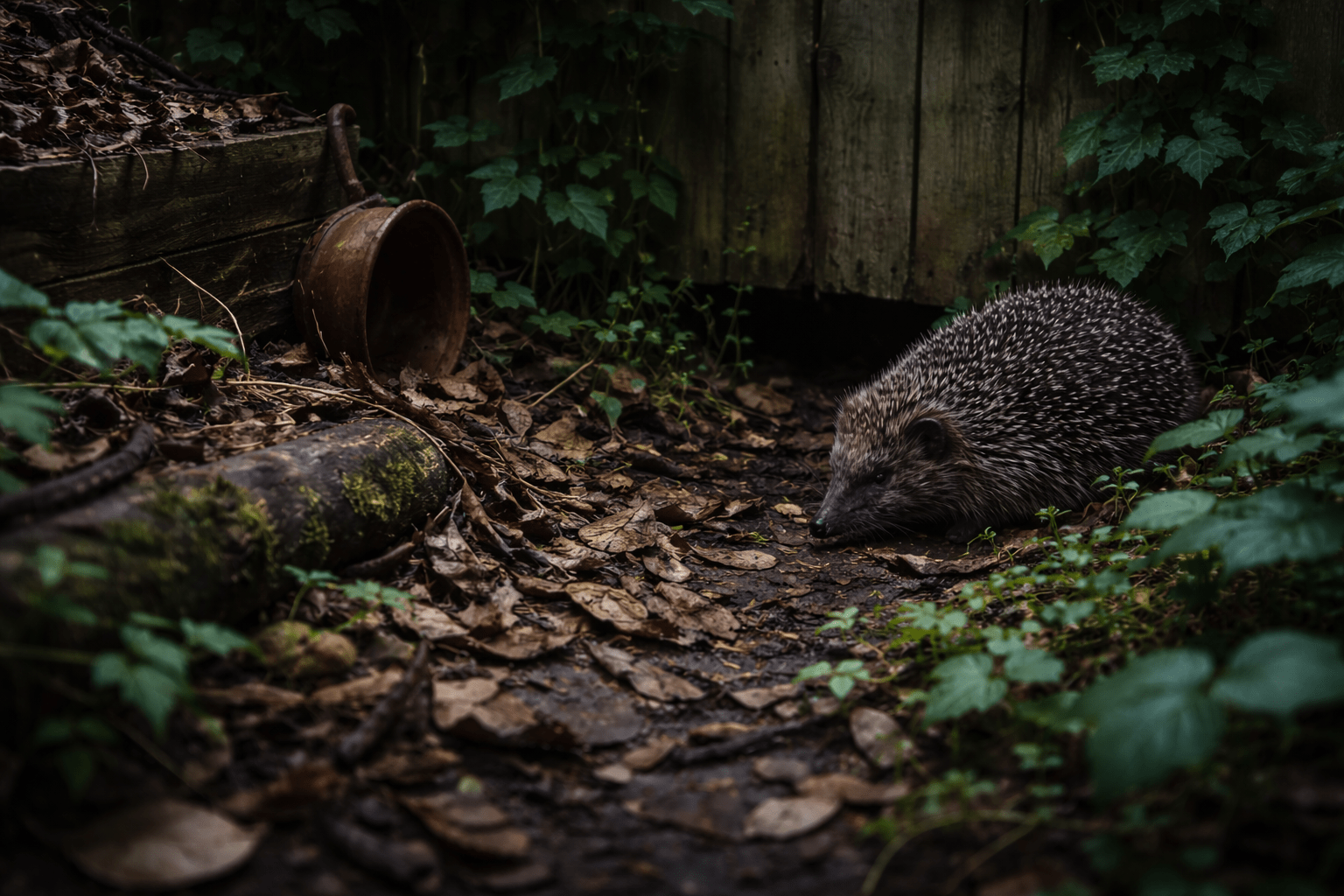
| (and Why Some Gardens Never See Them) Hedgehogs don’t arrive with announcements. When they appear, it’s usually indirect: a faint rustle at dusk, a shallow scrape under a fence, a disturbed patch of leaves that wasn’t there the night before. Many people only realise they have one when they nearly trip over it, or hear it snorting its way through a border with complete disregard for subtlety. And yet, for all their noise, hedgehogs return quietly — or not at all. In recent years, I’ve noticed something uneven. Some gardens, often modest and unassuming, begin to see hedgehogs again after years of absence. Others, sometimes larger and more obviously “done”, never do. The difference is rarely down to effort or enthusiasm. It’s down to conditions. Presence is not popularity. There’s a comforting idea that if you care enough, wildlife will appear. Put out food, build a shelter, show good intentions, and nature will reward you. Hedgehogs don’t work like that. They are not garden residents as people imagine. They are travellers, moving through multiple gardens in a single night, following routes older than most fences. A single garden, no matter how welcoming, is rarely enough on its own. This is where disappointment often creeps in. People do “everything right” — or think they do — and still never see one. Meanwhile, a neighbour who barely gardens at all mentions hedgehogs regularly, as if by accident. It isn’t an accident. It’s continuity. Gardens as corridors, not destinations The gardens that see hedgehogs tend to share one quality: they don’t behave like sealed units. Low gaps under fences. Untidy edges. Soft ground. Leaf litter is left to sit rather than be stripped back. These features don’t announce themselves as wildlife-friendly, but they allow movement. Hedgehogs follow edges — fence lines, hedges, walls- the same routes night after night. A single blocked boundary can bring down an entire network. Multiply that across a street, and hedgehogs disappear without drama or noise. When people say hedgehogs have “gone”, what they often mean is that the routes have. Why neat gardens often stay empty There’s a pattern I’ve seen repeatedly: the tidier the garden, the less likely it is to host hedgehogs. This isn’t a criticism. It’s an observation. Hard landscaping, tightly clipped boundaries, sealed decking edges, and bare soil create surfaces that are efficient for people but unhelpful for animals that move low and cautiously. Food sources decline quietly too — fewer insects, fewer larvae, fewer places to forage without exposure. The irony is that many of these gardens are maintained with care and expense, yet offer little usable space to anything that isn’t human. Hedgehogs aren’t avoiding people. They’re avoiding risk. The role of neglect — intentional or otherwise Some of the most reliable hedgehog gardens I know contain areas that would never be photographed. Piles of leaves. Forgotten corners. Borders that blur rather than end. Compost heaps that look like mistakes from a distance. These spaces are not designed habitats. They’re by-products of restraint. What matters is not wildness in the romantic sense, but tolerance. Tolerance for mess, overlap, decay, and uncertainty. Hedgehogs are practical animals. They don’t need perfection—they need continuity and coverage. Gardens that allow this tend to keep it, often without realising they’re doing anything at all. Why food bowls are not the answer There’s a common assumption that feeding hedgehogs is the key to helping them. Food can play a role, particularly in difficult seasons, but it’s often overstated. A garden that offers food but no safe passage, no shelter, and no foraging ground is a dead end. Hedgehogs may pass through briefly, or not at all. Worse, concentrated feeding can increase competition and exposure, drawing animals into risky situations they wouldn’t normally choose. The quieter work — leaving soil uncovered, reducing chemical use, allowing insects to exist — is less visible but far more effective. Hedgehogs don’t need to be invited. They need to be able to pass through unhindered. Why absence doesn’t mean failure One of the hardest things for people to accept is that a garden can be doing the right things and still never see a hedgehog. Location matters. Neighbouring boundaries matter. Roads, lighting, dogs, and cats matter. Some factors sit beyond any one gardener’s influence. This is where internet advice often does harm. It turns wildlife into a checklist and absence into guilt. Real ecosystems are messier than that. Progress is uneven. Success is often invisible. A garden that supports beetles, worms, fungi, and moths may be contributing quietly to a wider system, even if the hedgehogs themselves never arrive. The quiet return, when it happens When hedgehogs do return, it rarely feels dramatic. There’s no sudden abundance. Just the sense that something long missing has slipped back into place. People often ask what they did to cause it. Usually, the answer is nothing specific. They stopped sealing edges. They left leaves. They interfered less. Their garden became easier to move through, and someone noticed. Hedgehogs don’t reward effort. They respond to conditions. And that distinction matters. What hedgehogs teach, by example Hedgehogs are useful not because they’re charming — though they are — but because they expose how fragmented our gardens have become. They remind us that individual effort matters less than shared space. That connectivity beats intensity. Those quiet decisions, made repeatedly, shape outcomes more reliably than big gestures. Their return, where it happens, is rarely the result of a single garden doing everything right. It’s the result of several gardens doing enough without getting in each other’s way. Which, in many ways, is the most realistic model we have for living alongside anything at all. |
| About our writing & imagery Many of our articles are written by us, drawing on real experience, reflection, and practical work in gardens and places we know. Some pieces are developed with the assistance of AI, used as drafting and research tools rather than as a voice or authority. Featured images may include our own photography, original AI-generated imagery, or—where noted—images kindly shared by other creators and credited accordingly (for example, via Pixabay). All content is shaped, edited, and published by Earthly Comforts, and the views expressed are our own. |

