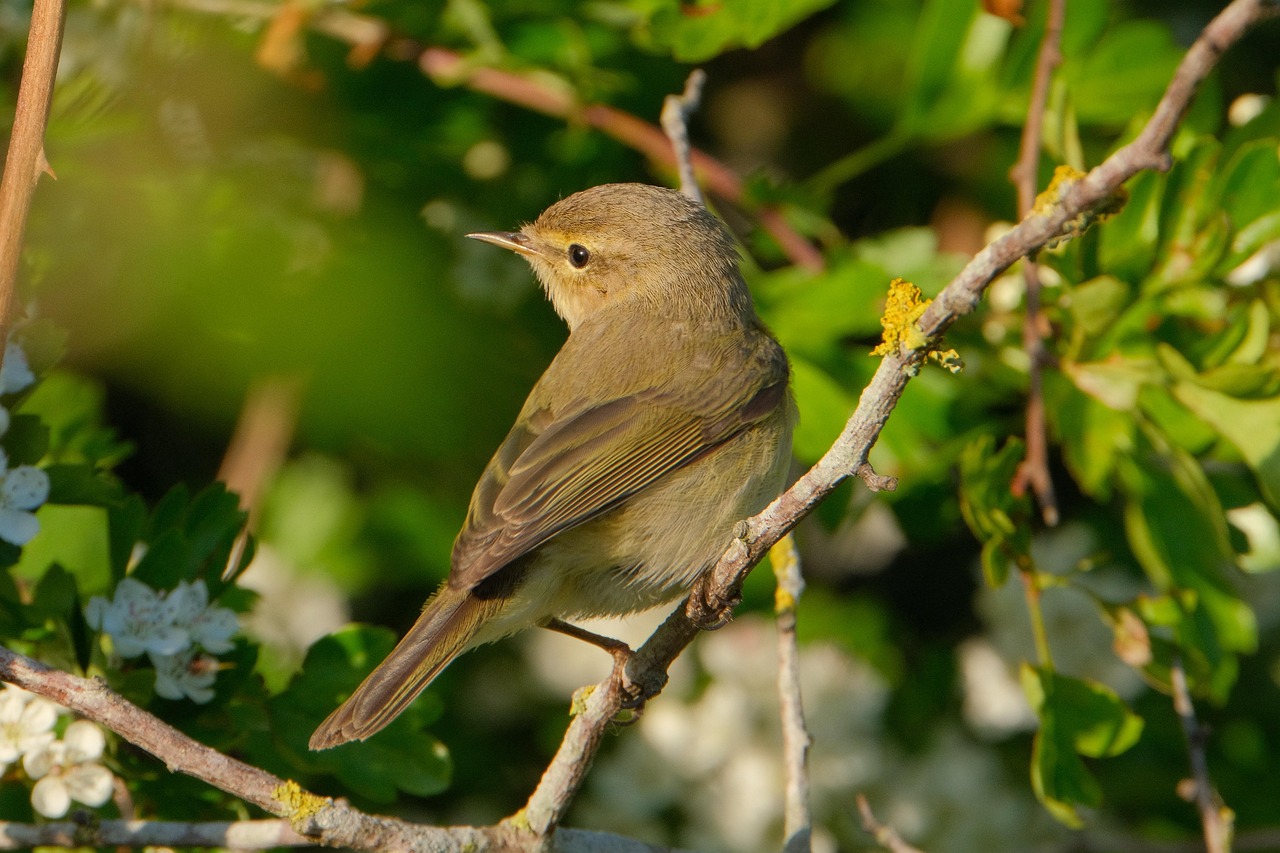
| Common Chiffchaff (Phylloscopus collybita) Summer migrant leaf warbler There are birds you notice because they blaze with colour, drama, or noise. And then there are birds you notice because the atmosphere shifts, and only later do you understand why. The common chiffchaff firmly belongs in the latter group. It doesn’t make a grand entrance. It simply appears, and the garden—if you’re attentive—subtly reorients around the sound. The first chiffchaff of the year often catches me while I’m working. Gloves on, shoulders already warm from the season’s first longer days, soil still carrying that faint winter dampness. There’s a pause—not a silence, exactly, but a thinning—and then the rhythm begins. Two notes. Repeated. Insistent without being loud. As if someone had tapped a coin twice on a wooden table, walked away, then returned to do it again. Once you’ve clocked it, you can’t unhear it. That sound marks a hinge point in the year. Not the start of spring—that’s too neat—but the moment when winter has clearly lost its grip, even if it hasn’t yet admitted it. The chiffchaff doesn’t wait for perfect conditions. It arrives early, often when trees are still bare, and insects are only just waking. That, in itself, tells you something important about the bird, and perhaps something about how nature actually works when it’s not being packaged into tidy seasonal diagrams. A bird is heard before it is seen Most people first meet the chiffchaff with their ears. Even experienced birdwatchers will tell you they’ve heard dozens before properly seeing one. This isn’t just down to its size—small, olive-brown, deliberately unflashy—but to how it moves. Chiffchaffs don’t perch in the open for long. They flick, hover, and dart through leaf cover, often low down, often half-hidden. You see movement before form, impression before detail. As a gardener, this feels familiar. So much of garden life happens at the edges of perception. Beneath leaves. Behind sheds. Along fence lines, no one really looks at them unless something goes wrong. The chiffchaff belongs to that same category of presence: quietly industrious, largely invisible, yet shaping what’s happening around it in subtle ways. When you do finally get a clear look, there’s almost a moment of anticlimax. It isn’t striking. No bold markings, no flamboyant colours. But that plainness is part of its success. It blends into early-spring woodland and scrub like a moving leaf, exactly where it needs to be. Arrival without spectacle Chiffchaffs are among the earliest migrant warblers to return to the UK, often arriving in March and sometimes even earlier in mild years. They travel from southern Europe and North Africa, not in dramatic flocks but singly or in pairs, slipping into familiar territories as if they never truly left. People tend to romanticise migration as epic or heroic. It can be. But the chiffchaff’s version feels practical. Less triumph, more timing. It arrives when it can make a living. Early spring brings fewer insects but also fewer competitors. The gamble is whether food will be enough and frost won’t return with force. This challenges the notion that nature waits for ideal conditions. Instead, it works with probabilities. The chiffchaff doesn’t arrive because spring is “ready”—it arrives when the balance has tipped enough in its favour. In gardens, this often coincides with the first flush of green: buds breaking, weeds stirring, lawns starting to grow again, whether you’re ready or not. The chiffchaff is tuned to that same threshold. It’s less a herald of spring than a participant in its messy beginning. Song as territory, not performance The chiffchaff’s song is one of the easiest bird songs to recognise and one of the easiest to misunderstand. People often describe it as cheerful, simple, or even monotonous. But simplicity isn’t the point. This isn’t music meant for us. It’s a working sound, doing a job. That repeated “chiff-chaff” establishes territory. It says: “I’m here; this patch is taken. Adjust accordingly.” It doesn’t need to be elaborate. It needs to be consistent, audible, and persistent. In that sense, it’s closer to a fence than a flourish. I’ve noticed that chiffchaffs will sing from surprisingly modest positions. Low branches. Shrubs. Sometimes, from hedges that have been cut a little too hard the previous winter. They don’t insist on height or grandeur. They insist on presence. There’s a parallel here with gardening work itself. The most effective interventions are often repetitive and understated. Turning compost. Weeding little and often. Checking soil moisture by feel rather than a gadget. None of it looks impressive, but all of it adds up to something functional. Life among leaves and insects Chiffchaffs are leaf warblers in the truest sense. Their lives centre on foliage—not just as shelter, but as a hunting ground. They glean insects from leaves, hover briefly to snatch flies, and sometimes dart out to catch prey mid-air. This is skilled, energy-efficient foraging, honed by necessity. In a garden context, they make quiet allies. They’re not going to solve a pest problem or clear an infestation—that’s another myth worth setting aside—but they are part of a living balance. Aphids, small flies, larvae: all are on the menu. Not in numbers we can easily measure, but in ways that matter over time. One of the more uncomfortable truths of gardening is that control is mostly an illusion—a negotiated balance rather than an absolute. You don’t eliminate pests; you continually interact with them. Birds like chiffchaffs take part in that negotiation: their presence helps maintain an ecological balance, easing extremes rather than dominating the system. It’s also worth noting what chiffchaffs don’t require: feeders, seed mixes, complex structures. They need leaves. Insects. Diversity. A garden stripped to lawns and hard surfaces offers little. A slightly messy garden—one with layers, shrubs, and an occasional unkempt corner—offers far more. Nesting without fuss The chiffchaff’s nest is as unshowy as the bird itself. Typically built low down, often close to the ground, it’s a domed structure made of grasses, leaves, and moss, lined with finer material. It’s tucked into vegetation where it’s unlikely to draw attention. This low, hidden nesting strategy carries risks. Ground predators. Flooding. Human disturbance. But it also reflects a long evolutionary calculation: being unnoticed is safer than being conspicuous. In managed landscapes, this can pose a problem. Over-tidying, aggressive clearance, and removal of undergrowth can quietly erase nesting sites without attention. As gardeners, we often speak of “wildlife-friendly” spaces. For a chiffchaff, it means specific things: cover at the right height, insects nearby, and minimal disruption during critical weeks. It’s not glamorous or easy to photograph, which is why it’s easily overlooked. A presence shaped by climate Chiffchaffs are also useful barometers of change. Over recent decades, their range and timing have shifted. Some now overwinter in the UK rather than migrating south, particularly in milder coastal areas. This has led to confusion with the closely related Siberian chiffchaff, and to heated discussions among birders that don’t always translate well to real-world observation. From a gardener’s perspective, what matters isn’t the taxonomy debate but the pattern beneath it. Now, winters are milder, seasons blur, plants leaf earlier, and insects emerge sooner. Birds respond in kind. The chiffchaff’s flexibility—its willingness to adjust timing and movement—has served it well so far. But flexibility has limits. Early arrival can mean exposure to late frosts. Changes in insect populations can ripple upward. There’s no guarantee that adaptability today ensures resilience tomorrow. This is another place where easy narratives fall short. Nature doesn’t automatically reset or heal itself. Instead, it tries various strategies, with mixed results. The chiffchaff is doing well right now, but its current success relies on a delicate, complex web of underlying conditions that we only partly understand. The danger of over-familiarity Because the chiffchaff is common, it’s easy to take it for granted. Each spring, it sings its two-note refrain and so fades into the background of expectation. This is perhaps its greatest vulnerability—not ecologically, but in our perception. We’re conditioned to value rarity, to notice what is scarce, and to overlook what is steady. Yet common species do most of the heavy lifting in ecosystems. They process energy, stabilise populations, and form the baseline against which change is measured. Losing a chiffchaff wouldn’t be dramatic in the way losing a large raptor would be. There’d be no single moment of shock. Just a quieter spring. A missing rhythm. And by the time we noticed properly, something else would already be unravelling. As someone who works daily in gardens, I’m becoming more aware of how absence makes itself felt only after things have changed. There are fewer worms, less birdsong, and soil that lacks its former vitality. The chiffchaff is part of this gradual pattern of noticing—or failing to notice—ecological shifts. A bird that resists symbolism There’s a temptation to turn birds into symbols—of hope, of renewal, or of freedom. The chiffchaff resists symbolic meaning. Its behaviour is straightforward, even repetitive, and not focused on spectacle. It does not embody soaring aspirations or dazzling displays; instead, it carries out its life with unobtrusive effectiveness. In that way, it feels honest. Its song is practical, its migration is functional, and its presence integrates into a garden rather than transforming it. Perhaps that’s why it resonates with gardeners more than with casual observers. Gardening, at its best, is also about steady attention rather than grand gestures. It’s about noticing small shifts, responding to conditions, and accepting that most of the work happens quietly. Listening as a form of practice One of the understated pleasures of working outdoors is that it teaches you to listen. Not in a poetic sense—though that comes too—but in a practical one. You learn to register changes in sound because they often signal changes in conditions. The chiffchaff’s arrival alters the soundscape of a place. It layers over the remaining winter birds and under the later arrivals. It fills a gap you didn’t realise was there until it’s filled. And once you’ve tuned into it, you start to notice where it sings and where it doesn’t. That, in turn, tells you something about the landscape. Dense hedges. Mixed planting. Woodland edges. Scrubby corners. The chiffchaff maps quality habitat solely by sound. If you’re willing to listen, it offers an informal audit of your surroundings. Limits and trade-offs It would be easy to present the chiffchaff as a success story and leave it at that. But that would miss the point. Its apparent abundance doesn’t mean it’s immune to pressure. Habitat loss, pesticide use, and climate instability—all exert subtle, cumulative effects. There’s also a trade-off in its early arrival. Being first means claiming territory, but it also means gambling with weather and food availability. Some years, that gamble doesn’t pay off. Breeding fails. Numbers dip. We don’t always see that clearly because the changes are spread across time and space. Acknowledging these limits matters. Not to induce guilt or urgency, but to keep our understanding grounded. The chiffchaff isn’t a mascot or a metric. It’s a living organism navigating constraints we’ve helped create. What remains, year after year Despite all this, the chiffchaff returns. It sings. It feeds. It nests. It raises young. And then, quietly, it leaves again, often before summer has fully settled. By late summer, the song fades, and many people don’t notice its departure at all. That, perhaps, is the final lesson it offers. Presence doesn’t need permanence to be meaningful. The chiffchaff’s contribution is seasonal, cyclical, and transient. It matters because it happens, not because it lasts. In gardens and landscapes shaped by human hands, this kind of rhythm is easy to disrupt and hard to restore. Paying attention to sounds, to timing, to small, consistent lives—may be one of the more practical forms of care we have left. Not because it saves everything. But because it helps us notice what’s still here. |
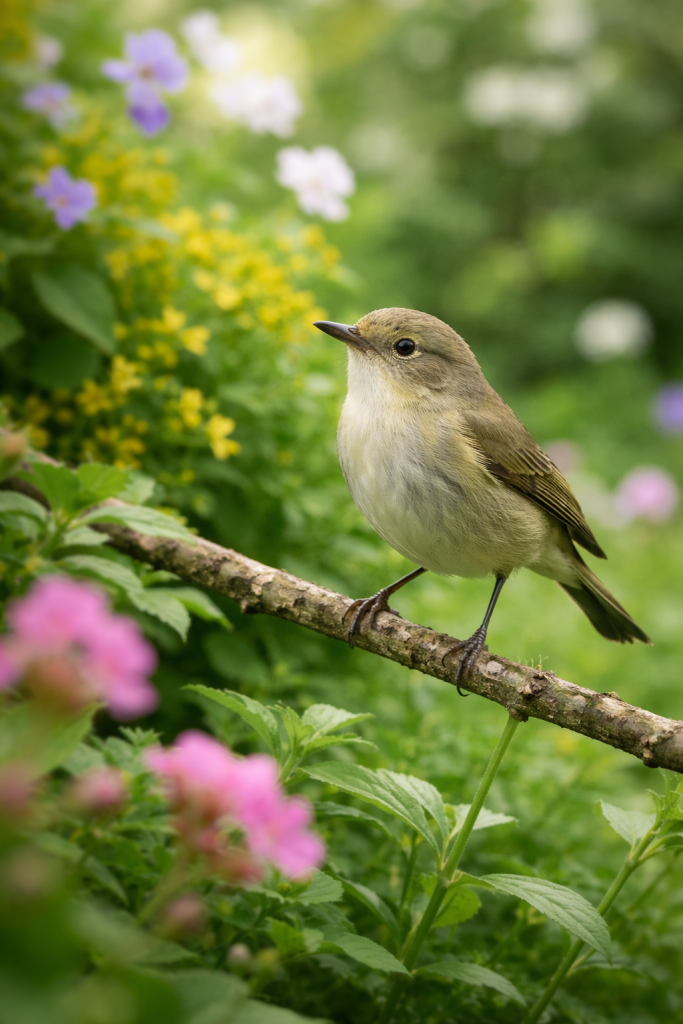
| About our writing & imagery Most articles reflect our real gardening experience and reflection. Some use AI in drafting or research, but never for voice or authority. Featured images may show our photos, original AI-generated visuals, or, where stated, credited images shared by others. All content is shaped and edited by Earthly Comforts, expressing our own views. |

