| Part 5 |
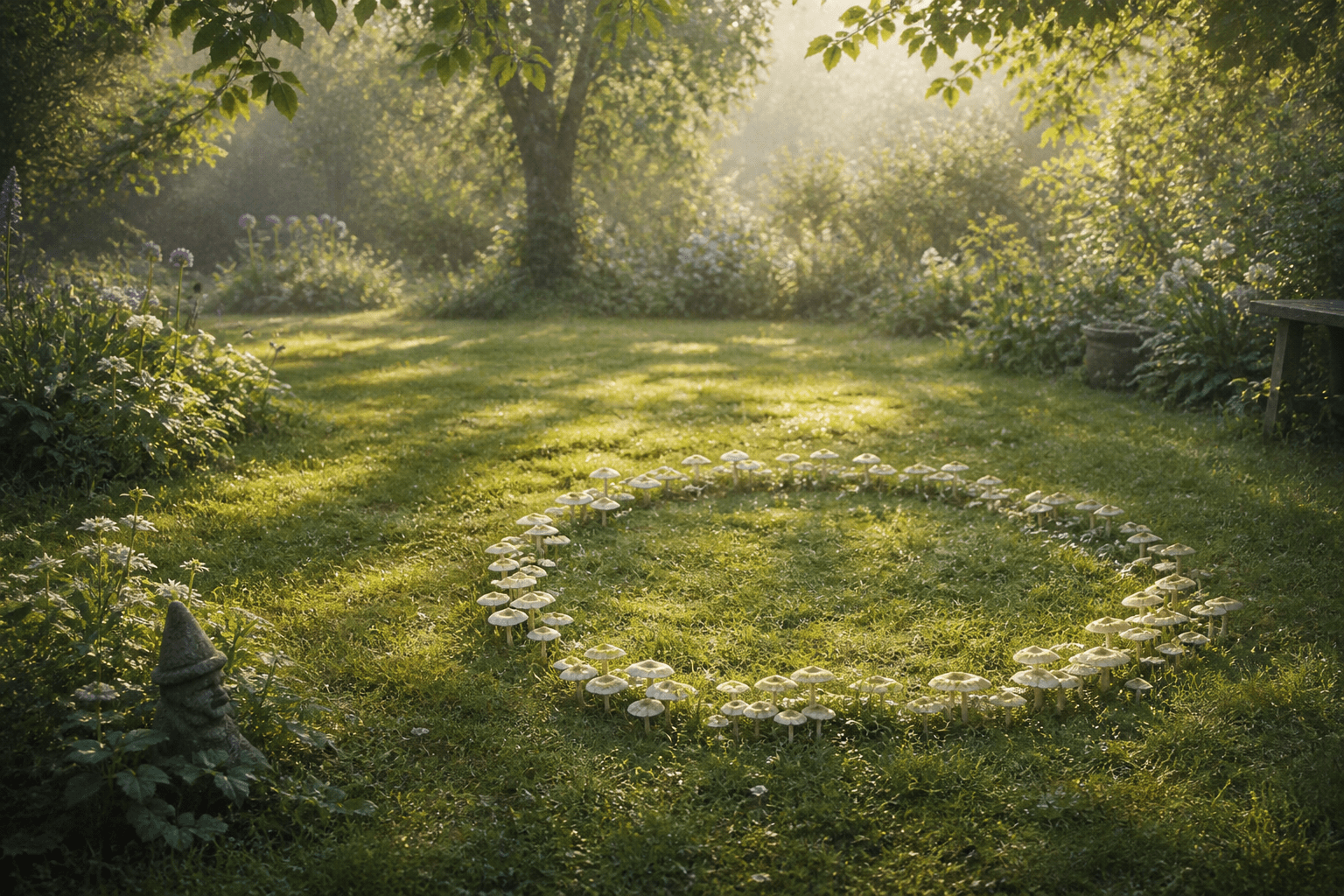
| By the time you have spent long enough working in the same gardens, you stop looking for obvious change and begin to notice the smaller adjustments that take place without announcement. The space is familiar, often to the point where you no longer need to think about its structure, and it is precisely that familiarity that allows certain details to stand out when they appear. You move through the garden as you always do, registering the usual signs of continuation—edges that have softened slightly, growth that has pushed further than expected, the quiet evidence that the place has been active in your absence, as it always is. It is within that familiarity that the circle begins to assert itself, not introduced as something new, but simply present in a way that feels as though it has been overlooked rather than formed. There is no deliberate boundary, no physical edge that defines it, and yet it holds a shape that the rest of the garden does not maintain. Sometimes it appears as a ring of mushrooms, sometimes as a shift in the colour or density of the grass, but whatever form it takes, it establishes a line that is too precise to feel entirely incidental. In a space where most things blur at the edges, where form is constantly softened by growth and time, the presence of a contained, repeating shape draws attention in a way that is difficult to dismiss. From a practical standpoint, there is no mystery in how these circles form. Fungal networks spread outward beneath the soil, following their own logic, consuming what is available and altering the ground as they expand. What becomes visible at the surface is simply the outer edge of that activity, the point at which the process reveals itself through fruiting bodies or subtle changes in growth. It is a system that can be understood, managed, and, where necessary, corrected, and there is no need to attribute anything beyond that. What is more difficult to account for is the response the shape produces, even when its origin is known. There is a brief moment, often so slight it barely registers, where you hesitate before stepping into it. The hesitation is not rooted in belief or uncertainty about what it is, but in the recognition of the boundary itself. The circle suggests enclosure, even when nothing is enclosed, and it is that suggestion that alters how the space is read. You are aware of having crossed into something defined, even though the definition is temporary and entirely natural. This response becomes more noticeable when the pattern persists. The lawn is cut, and the circle remains. Treatments are applied, and the shape fades, but not entirely. You return weeks later and find that there is still a trace of it, either in the way the grass grows or in the subtle variation of the ground. It behaves less like a random occurrence and more like something that continues to work outward over time, following a process that is only partially visible. That persistence gives the circle a weight that other irregularities do not carry. Most variation in a garden feels incidental, part of the broader inconsistency that defines a living space, but this holds its form long enough to feel deliberate, even when you know it is not. Clients tend to respond to these patterns in ways that reflect this same uncertainty. Some see them as a flaw in the lawn and want them removed immediately, the disruption to the uniform surface being enough to justify intervention. Others pause, not because they doubt the explanation, but because the shape itself suggests that it should not be disturbed without consideration. It is not uncommon for someone to ask whether it is best left alone, even when the practical answer is straightforward. That question is rarely about the condition of the grass; it is about the presence of the pattern and what it implies about the ground beneath it. Working within these circles changes the rhythm of the task, if only slightly. Instead of addressing a scattered issue across the surface, you find yourself following a defined line, moving along its curve rather than across it. The work becomes more contained, shaped by the pattern rather than imposed upon it. This is not a significant alteration, but it is noticeable, particularly when compared to the more general movement required in other areas of the garden. The circle dictates a form of engagement, even when you are attempting to break it. What these patterns reveal, more than anything else, is the extent to which the visible garden is only a surface expression of processes that extend far beyond it. The network that creates the circle exists largely out of sight, influencing the ground in ways that are not immediately apparent until they become visible. This is not unique to fungal growth, but it is one of the clearest examples. The garden is not a static surface to be maintained, but a layered system in which much of the activity occurs beyond direct observation. The circle, in this sense, is not the phenomenon itself, but the trace of something ongoing. There is also a broader pattern in how such shapes are interpreted. Humans respond to order, particularly when it appears in places that are otherwise irregular. A circle is one of the simplest forms of order, and when it emerges without intention, it carries a suggestion of meaning that is difficult to ignore. In a garden, where most forms are either designed or the result of organic growth, a naturally occurring boundary that holds its shape introduces a subtle shift in perception. The space is no longer entirely defined by the choices made within it; something else has imposed a structure, however temporary, that sits alongside those decisions. Over time, this changes how you read the garden. You begin to recognise that it is capable of producing its own forms, independent of the ones you create or maintain. These forms are not mysterious in the sense of being unexplainable, but they are significant in that they demonstrate the limits of control. The garden does not simply respond to intervention; it operates according to processes that continue whether you are present to observe them or not. The circle is one of the moments where that becomes visible, where the underlying system briefly reveals itself at the surface. There is no need to assign it more weight than that. It does not alter the work that needs to be done, nor does it suggest anything beyond the interaction of soil, moisture, and biological activity. But it introduces a pattern you did not place, a boundary you did not define, and a reminder that the ground beneath the garden is active in ways that are not always immediately apparent. Most of the time, that is simply noted and worked around. The circle is addressed, managed, or allowed to fade as conditions change, and the garden returns to its usual state of controlled irregularity. But the impression of it remains, not as something unresolved, but as something that has briefly made visible the processes that are usually hidden. And once you have noticed that, it becomes harder to treat the surface of the garden as the whole of it, because there is always the possibility that something beneath it is already in motion, forming shapes that will only reveal themselves when they have reached the point where they can no longer be ignored. |
| About our writing & imagery Most articles reflect our real gardening experience and reflection. Some use AI in drafting or research, but never for voice or authority. Featured images may show our photos, original AI-generated visuals, or, where stated, credited images shared by others. All content is shaped and edited by Earthly Comforts, expressing our own views. |

