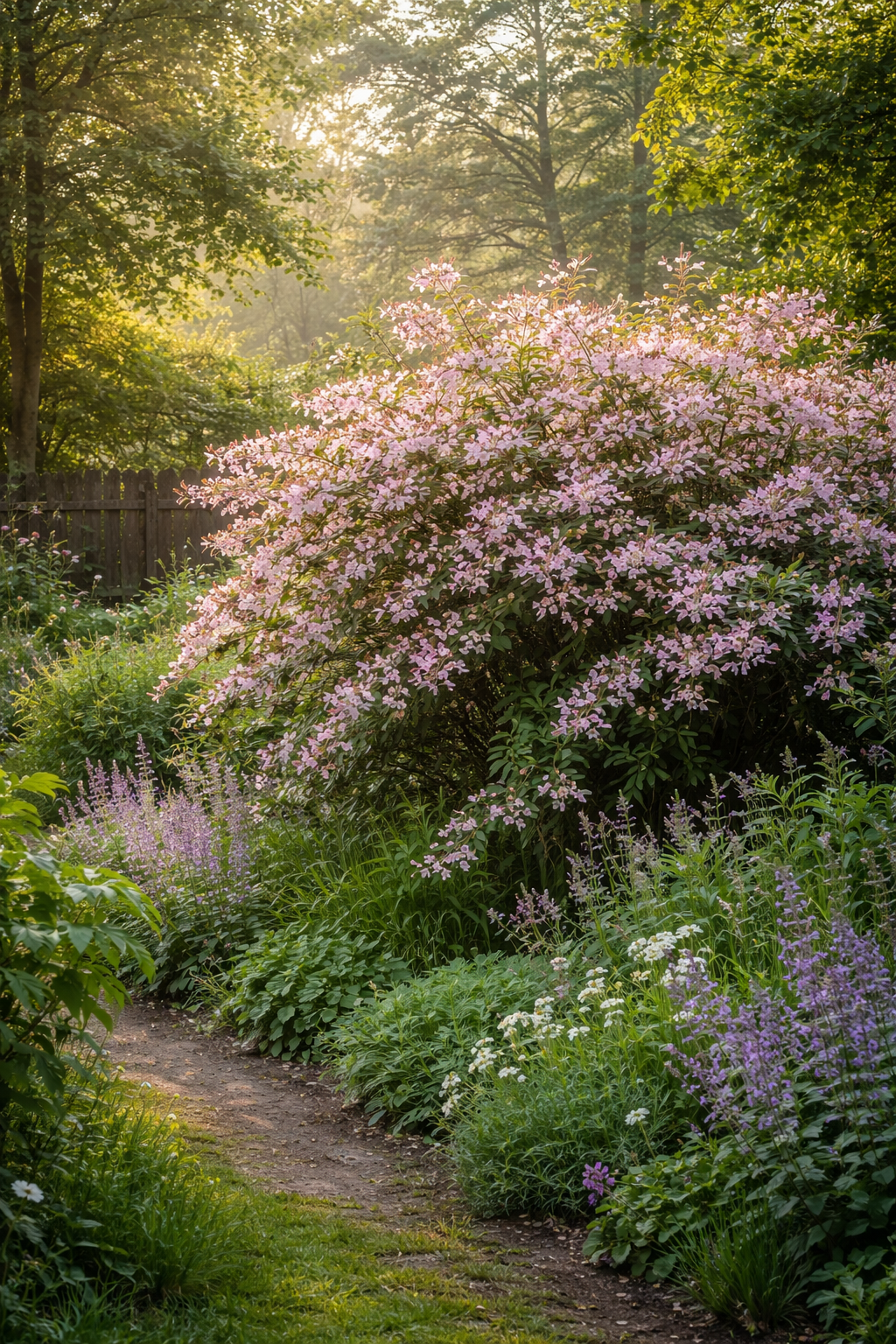
| The plant that stayed when fashions moved on There are plants that arrive with a fanfare and leave with a shrug. And there are plants that never really leave at all, even when they stop being talked about. Weigela belongs firmly in the second group. It doesn’t announce itself as fashionable. It doesn’t beg for attention. It simply continues to exist, season after season, often in the same corner of the same garden, doing what it has always done. For a long time now, Weigela has carried a faint air of embarrassment. It’s been described—sometimes kindly, sometimes not—as old-fashioned, suburban, safe. The sort of shrub you inherit rather than choose. The sort of plant you find yourself pruning because it’s there, not because you remember planting it. And yet, when you slow down and really look at Weigela, particularly through the eyes of someone who works in gardens rather than curates them on screens, it starts to tell a different story. Not a dramatic one. A steadier one. A story about continuity, compromise, and the quiet ways gardens outlast trends. A shrub with no interest in novelty Weigela doesn’t try to reinvent itself. Even the newer cultivars—with their darker foliage or tighter habits—feel like variations on a theme rather than a rewrite. The basic proposition remains unchanged: a deciduous shrub that flowers reliably in late spring to early summer, with arching stems and trumpet-shaped blooms that hover somewhere between decorative and cheerful. In older gardens, particularly across southern England, you’ll often find Weigela planted near boundaries or along the edge of lawns. Sometimes it’s been allowed to sprawl. Sometimes it’s been cut back year after year into something more rigid than it ever wanted to be. Either way, it persists. That persistence is worth paying attention to. Many shrubs lauded as “low maintenance” quietly fail when conditions drift away from the brochure version. Weigela tends to keep going. Not flawlessly. Not always beautifully. But dependably enough that generations of gardeners have tolerated it, and often come to rely on it. Generational planting, whether we admit it or not One of the more interesting things about Weigela is how often it becomes a marker of generational change. It’s common to hear a new homeowner talk about “clearing out the old shrubs” when they move in. Weigela is often among them. To some, it represents a previous aesthetic: generous borders, predictable flowering, a kind of polite abundance. But just as often, the plant survives the clear-out. Either because removing it feels like more trouble than it’s worth, or because someone hesitates. There’s a moment—sometimes barely conscious—where the shovel pauses. And then the plant stays. Years later, I’ve seen those same shrubs quietly reabsorbed into redesigned gardens. The lawn shrinks. The planting around it changes. Grasses arrive. Perennials drift. And the Weigela, pruned a little more thoughtfully, starts to look intentional again. This is one of its unspoken strengths: it bridges eras without demanding allegiance to either. The rhythm of a working plant From a working gardener’s point of view, Weigela has a rhythm that makes sense. It flowers on old wood. That simple fact—often ignored or misunderstood—explains a lot of the resentment it receives. Cut hard at the wrong time, and it sulks. Leave it alone entirely, and it can become leggy. But handled with even a basic understanding, it settles into a manageable cycle. Flower. Rest. Grow. Be lightly reshaped. Repeat. There’s something reassuring about a plant whose needs are legible once you’ve spent time with it. You don’t need a specialist feeding regime. You don’t need to hover anxiously with secateurs. You just need to work with its natural pace rather than against it. That quality matters more than we often admit, especially in real gardens that are tended intermittently, sometimes by different hands over decades. The flowers are not the whole story. It’s easy to reduce Weigela to its flowers, but that misses something important. The blooms—pink, white, red, sometimes fading or mottled—are charming rather than arresting. They arrive in a brief but generous flush, then pass. What lingers longer is the structure. The arching framework of stems. The way light filters through its leaves. In winter, particularly when lightly frosted, an older Weigela can have a quiet presence that doesn’t shout but doesn’t disappear either. This matters because gardens are not static images. They are lived spaces, seen at awkward times of year, in half-light, from kitchen windows and footpaths. A plant that holds its own across seasons earns its keep in a way that a short-lived spectacle rarely does. Challenging the “out of fashion” label One assumption worth gently questioning is that plants fall out of fashion because they fail. Often, they fall out of fashion because they succeed too quietly. Weigela didn’t stop being useful. It simply stopped being novel. In an age that prizes constant reinvention—new cultivars, new colourways, new planting schemes—there is little room for something that looks broadly the same decade after decade. But gardens are long-term projects, whether we plan them that way or not. A shrub that can sit comfortably through shifting tastes, ownerships, and levels of attention is doing something right. It’s also worth noting that many of the plants currently celebrated for their “naturalistic” qualities rely on careful management to avoid collapse. Weigela’s informality is earned rather than styled. It doesn’t pretend to be wild. It just grows itself. The trade-offs are real. None of this is to pretend Weigela is perfect. It can be coarse if neglected. It can dominate small gardens if planted without thought. Its flowering window, while reliable, is relatively short. In tighter spaces, or in gardens aiming for year-round intensity, it may not earn its place. There are shrubs with finer textures, longer seasons, or more dramatic winter interest. Acknowledging those limits doesn’t weaken the case for Weigela. It strengthens it. This is not a plant for every garden, but it understands its role. A quiet ally for changing gardens One of the most overlooked qualities of Weigela is its ability to adapt as gardens evolve. As trees mature and light levels change, as lawns shrink or disappear, as maintenance regimes shift with age or circumstance, Weigela tends to adjust rather than fail outright. I’ve seen it cope with partial shade, poorer soils, missed prunings, and over-enthusiastic ones. Not without scars, but without collapse. That resilience makes it a useful ally in gardens that are not frozen in time. In this sense, Weigela is less a design statement and more a companion plant to human lives, which are rarely as tidy as planting plans suggest. Why it still matters There is something quietly radical about valuing plants that endure rather than impress. Weigela reminds us that gardens are not exhibitions. They are places where time passes, where people change, where attention waxes and wanes. Choosing—or keeping—a plant like Weigela is not an act of nostalgia. It’s an acknowledgement that reliability has its own beauty, and that not everything needs to be new to be relevant. In a period when gardening is increasingly mediated by images and algorithms, Weigela asks very little of us. It doesn’t photograph particularly well. It doesn’t promise transformation. It just grows. And sometimes, that is exactly what a garden needs. |
| About our writing & imagery Most articles reflect our real gardening experience and reflection. Some use AI in drafting or research, but never for voice or authority. Featured images may show our photos, original AI-generated visuals, or, where stated, credited images shared by others. All content is shaped and edited by Earthly Comforts, expressing our own views. |


Very interesting indeed.
LikeLiked by 1 person
Thanks Michael.
LikeLiked by 1 person
You’re welcome.
LikeLiked by 1 person