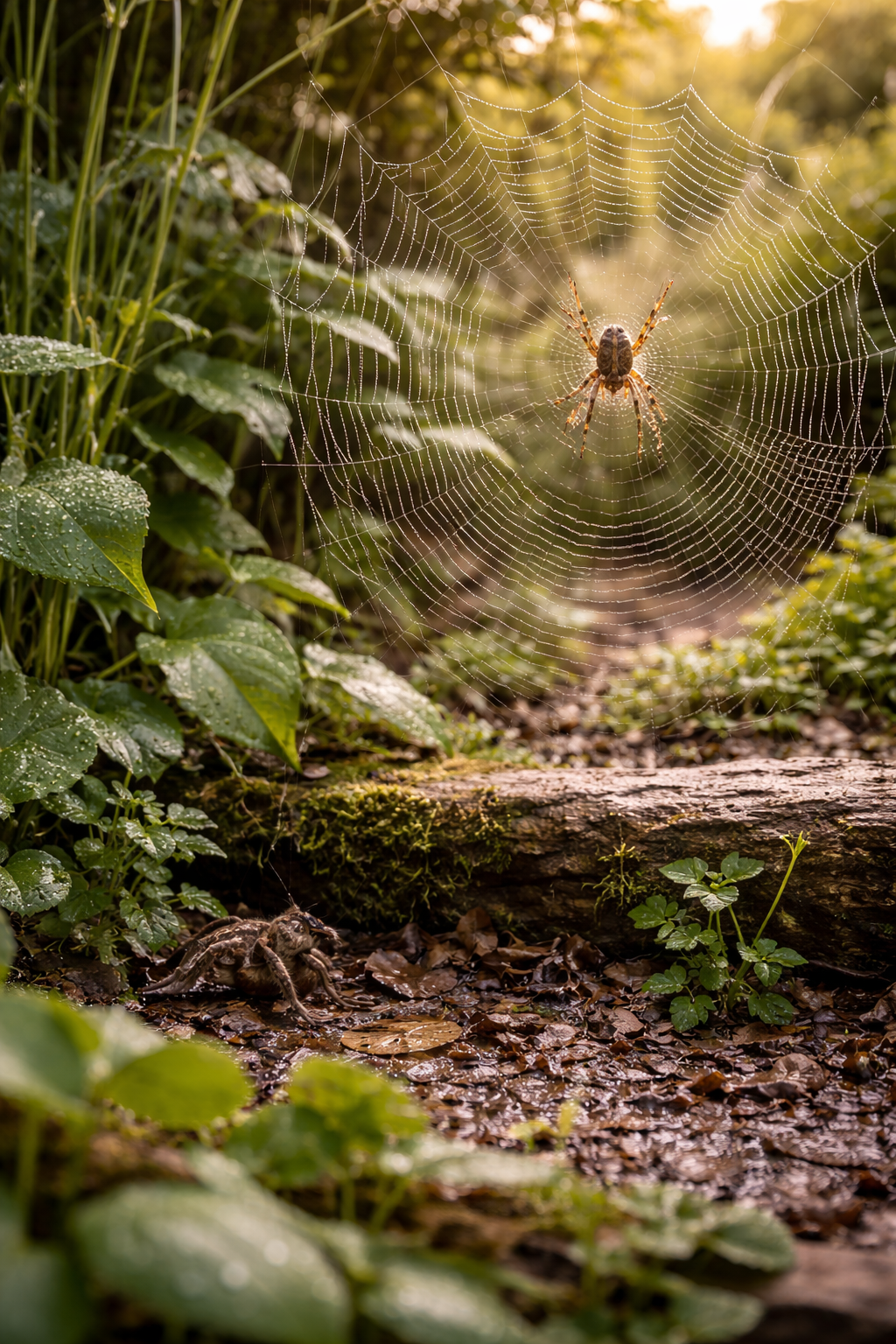
| Why quiet hunters belong in even the gentlest spaces Spiders are often the most misunderstood garden residents. They do not arrive with birdsong or colour. They do not announce the season or drift through sunlight. They work at night, at ground level, in corners and crevices — and they tend to be noticed only when something feels out of place. Yet spiders are among the most constant presences in the garden. They do not migrate. They do not disappear when flowers fade. They adapt, persist, and quietly shape the balance of life in ways few other creatures can. To understand spiders in the garden is not to learn to love them instantly — it is to recognise their role, their restraint, and the subtle stability they bring to living spaces shaped by people. |
| Always present, rarely acknowledged Almost every garden hosts dozens of spider species. They live: In hedges and shrubs Beneath stones and logs In leaf litter Along fences and walls Inside sheds, compost heaps, and soil Some spin webs. Others hunt on foot. Some are active by day, others only at night. Many live out their entire lives unseen. Unlike seasonal wildlife, spiders do not arrive and depart in dramatic ways. Their presence is steady, which is why their absence, when it occurs, often goes unnoticed until an imbalance elsewhere appears. |
| What spiders actually do Spiders are predators — but they are also regulators. They feed on: Flies Aphids Mosquitoes Midges Small beetles and larvae They do not wipe out insect populations. They limit excess. They respond to abundance rather than causing scarcity. In gardens where spiders thrive, insect numbers tend to fluctuate naturally rather than spiking suddenly. This is one reason spiders are so important in spring, when emerging insect life can otherwise overwhelm tender growth. They are not controllers. They are balancers. |
| Webs as working tools, not traps A spider’s web is not decoration. It is a precise, functional structure built to suit location, prey, and weather. Orb webs appear where flying insects pass through. Sheet webs lie low in grass and borders. Funnel webs sit at the edges of walls or hedges. In spring mornings, dew reveals these structures briefly — delicate, geometric, temporary. By midday, many will be gone, rebuilt elsewhere as conditions change. Webs tell you something important: insects are moving through this space. Where there are webs, there is life. |
| Ground hunters and unseen work Not all spiders spin webs. Wolf spiders, for example, hunt at ground level, moving through leaf litter and soil surfaces. Jumping spiders rely on sight rather than silk, stalking prey in sunlit areas. These spiders are rarely noticed, but they are particularly valuable in gardens where: Leaf litter remains Soil is undisturbed Edges are soft rather than sealed. Their presence indicates a functioning ground layer — one where insects, moisture, and shelter exist in balance. |
| Spring: a season of vulnerability Spring is a critical time for spiders. Over winter, many survive as adults hidden in sheltered spaces, while others overwinter as eggs protected in silk sacs attached to stems, bark, or leaf litter. Early spring clearing — removing old growth, sweeping borders bare, turning compost — can destroy these egg sacs before spiders ever emerge. Because spiders reproduce slowly and depend on stable habitat, these losses can take a full season to recover from. Gardens that feel “reset” in spring often lose more than they realise. |
| Spiders and fear: a human story Much of the discomfort around spiders is cultural rather than practical. UK garden spiders are not dangerous. They are shy, non-aggressive, and far more interested in avoiding disturbance than engaging with it. Bites are extremely rare and usually defensive. Fear persists because spiders move differently, appear suddenly, and occupy spaces we don’t expect to share. But spiders do not seek us out. They seek: Stillness Cover Insect movement Stable microclimates When spiders appear indoors or in frequently used spaces, it is usually because conditions elsewhere have changed. |
| Gardens that support spiders quietly Spiders thrive in gardens that: Retain leaf litter Leave some stems standing. Allow hedges to thicken. Avoid constant disturbance Maintain moisture and shelter. They do not require special features or structures. They require continuity. A single undisturbed corner can support multiple species across seasons. |
| The link between spiders and birds Spiders are not only hunters — they are prey. Many garden birds rely on spiders for: Protein-rich food Nest-building material (silk strengthens nests) Early-season feeding when insects are scarce Robins, wrens, tits, and sparrows all gather spiders or spider silk, especially in spring. Removing spiders from the garden reduces resources further up the food chain. In this way, spiders connect directly to birdsong. |
| Why absence matters more than presence Spiders are rarely celebrated. But when they disappear, gardens often experience: Increased fly numbers Sudden pest outbreaks Reduced bird activity Greater reliance on intervention Because spiders work quietly and continuously, their role is only obvious when it is missing. A garden without spiders is rarely a calm one. |
| Learning to coexist Living with spiders does not require affection. It requires tolerance. Allowing webs to remain where they are not in the way. Leaving corners undisturbed. Accepting that some aspects of life will operate outside our direct control. Spiders do not ask for much space. They do not damage plants. They do not seek attention. They simply occupy the gaps. |
| A measure of balance Spiders are indicators. Their presence suggests: Insects are present but not overwhelming. Shelter is available Disturbance is limited The garden is functioning as a system. In this way, spiders belong firmly within a wildlife-friendly garden — not as something to manage, but as something to recognise. |
| Quiet reassurance When a spider web appears between two shrubs, or a small shape moves across the soil at dusk, it is not a sign that something has gone wrong. It is a sign that the garden is doing what it is meant to do. Spiders remind us that much of nature’s work is silent, unseen, and ongoing — whether we notice it or not. And in gardens that make space for them, balance tends to arrive quietly, without being asked. |

