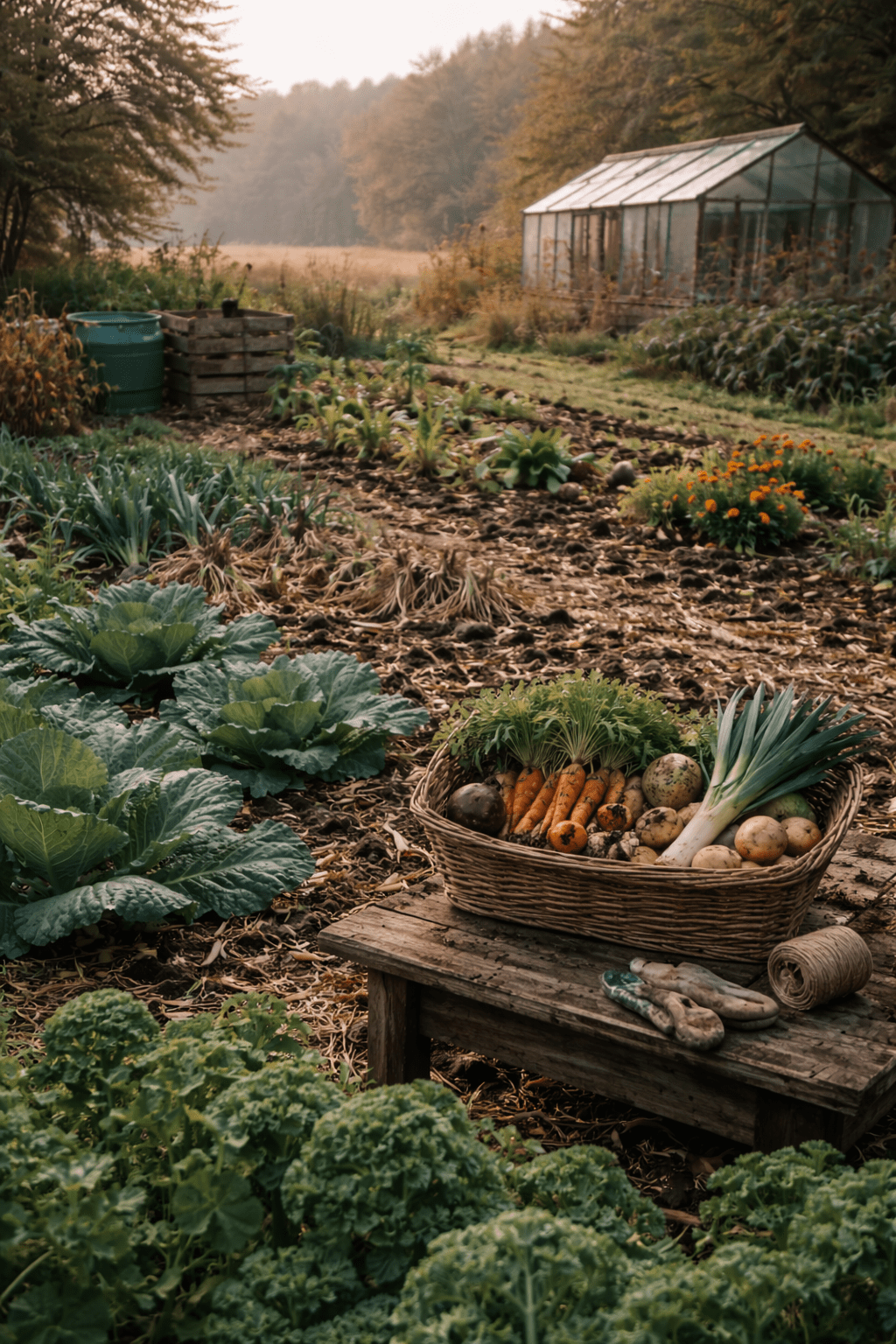
| Notes from the garden on food, resilience, and the years ahead |
| The Garden After Abundance Gardens have always been good at revealing when an era is ending. Not abruptly. Not with fanfare. But through small, cumulative changes that only become obvious in hindsight. A plant that once thrived now struggles. A reliable pattern becomes erratic. Tasks that were once optional become necessary. The garden after abundance does not announce itself as something new. It simply stops behaving as it used to. Abundance shaped our gardens more than we admit For the last few decades, many home gardens were designed in the image of abundance. Not necessarily abundance of food, but abundance of inputs. Water was assumed. Compost could be bought. Plants could be replaced if they failed. Soil could be ignored for a while and corrected later. Novelty crops were encouraged because failure carried little cost. Gardens became expressive spaces rather than functional ones. Places of pleasure, aesthetics, experimentation. There’s nothing wrong with that. It reflected the wider world we were living in. But abundance hid certain pressures. It allowed inefficiency. It tolerated fragility. It made it easy to confuse convenience with sustainability. As those external supports become less reliable — water restrictions, higher input costs, less predictable weather — gardens begin to change character. Not dramatically. Practically. The return of reliability as a value One of the first shifts I’ve noticed is a quiet move away from novelty. The garden, after abundance, values what works. Plants that tolerate poor summers. Crops that forgive missed watering. Perennials that don’t demand annual replanting. Varieties that don’t promise perfection but deliver consistency. This isn’t about austerity. It’s about trust. Gardeners begin asking different questions. Not “What’s new?” but “What holds?” Not “What looks impressive?” but “What keeps going?” You see it in the reappearance of unfashionable crops. In the renewed interest in cut-and-come-again harvesting. In this way, soil improvement becomes central rather than optional. Abundance allowed us to treat soil as a substrate. Constraint reminds us it’s a living system. Less intervention, more relationship Another quiet change is a reduction in constant correction. In times of abundance, gardens were managed reactively. Problems were solved as they appeared. Feed, spray, adjust, replace. The assumption was that intervention could always restore balance. The garden after abundance encourages a different approach. Fewer interventions, made earlier. More observation, less fixing. You begin to notice which plants cope without help. Which beds hold moisture better? Which areas suffer first in drought or heavy rain? The garden becomes a conversation rather than a project. This doesn’t make it easier. It makes it slower. But slowness, it turns out, saves effort over time. Yield looks different now. One of the internet myths worth challenging here is the idea that the garden after abundance must be lower-yielding. In practice, yields often change shape rather than shrink outright. You may harvest less of one thing and more of another. Fewer perfect specimens, more usable ones. Smaller harvests spread over longer periods, rather than single flushes. What declines is surplus-for-surplus’s sake. What improves is reliability. Gardens become less about peak performance and more about steady contribution. They stop being judged by totals and start being valued for continuity. That’s a subtle but important shift — especially for people used to measuring success numerically. Time becomes the main input again. Abundance masked the role of time. You could compress seasons with polytunnels, lights, heat, and feed. You could rush growth and correct mistakes quickly. Time was flexible because energy was cheap. As those supports weaken, time reasserts itself. The garden after abundance runs on patience. On longer horizons. On preparation rather than rescue. Soil built over the years rather than amended at the last minute. Perennials chosen for what they become, not how fast they perform. This doesn’t suit everyone. It asks for a different rhythm. But it’s a rhythm gardens have always preferred. What the garden no longer promises Perhaps the most honest thing to say about the garden after abundance is that it promises less. It does not promise total self-sufficiency. It does not promise a constant supply. It does not promise immunity from bad years. What it offers instead is participation. A share in the system rather than control over it. A sense of proportion. A reminder that contribution matters even when it’s partial. Gardens have always operated like this. What’s changed is that the world around them is starting to feel the same way. Living with enough The garden after abundance isn’t grim. It’s quieter. It produces food, but also knowledge. It sharpens judgment. It trains attention. It helps people live better with limits without feeling diminished by them. Abundance taught us to expect more. Gardens teach us to recognise enough. That lesson feels increasingly relevant — not because the future will be harder, but because it will be less predictable. And gardens, more than most places, are already fluent in that language. |
| About our writing & imagery Many of our articles are written by us, drawing on real experience, reflection, and practical work in gardens and places we know. Some pieces are developed with the assistance of AI as a drafting and research tool. Featured images may include our own photography, original AI-generated imagery, or—where noted—images kindly shared by other creators and credited accordingly (for example, via Pixabay). All content is shaped, edited, and published by Earthly Comforts, and the views expressed are our own. |

