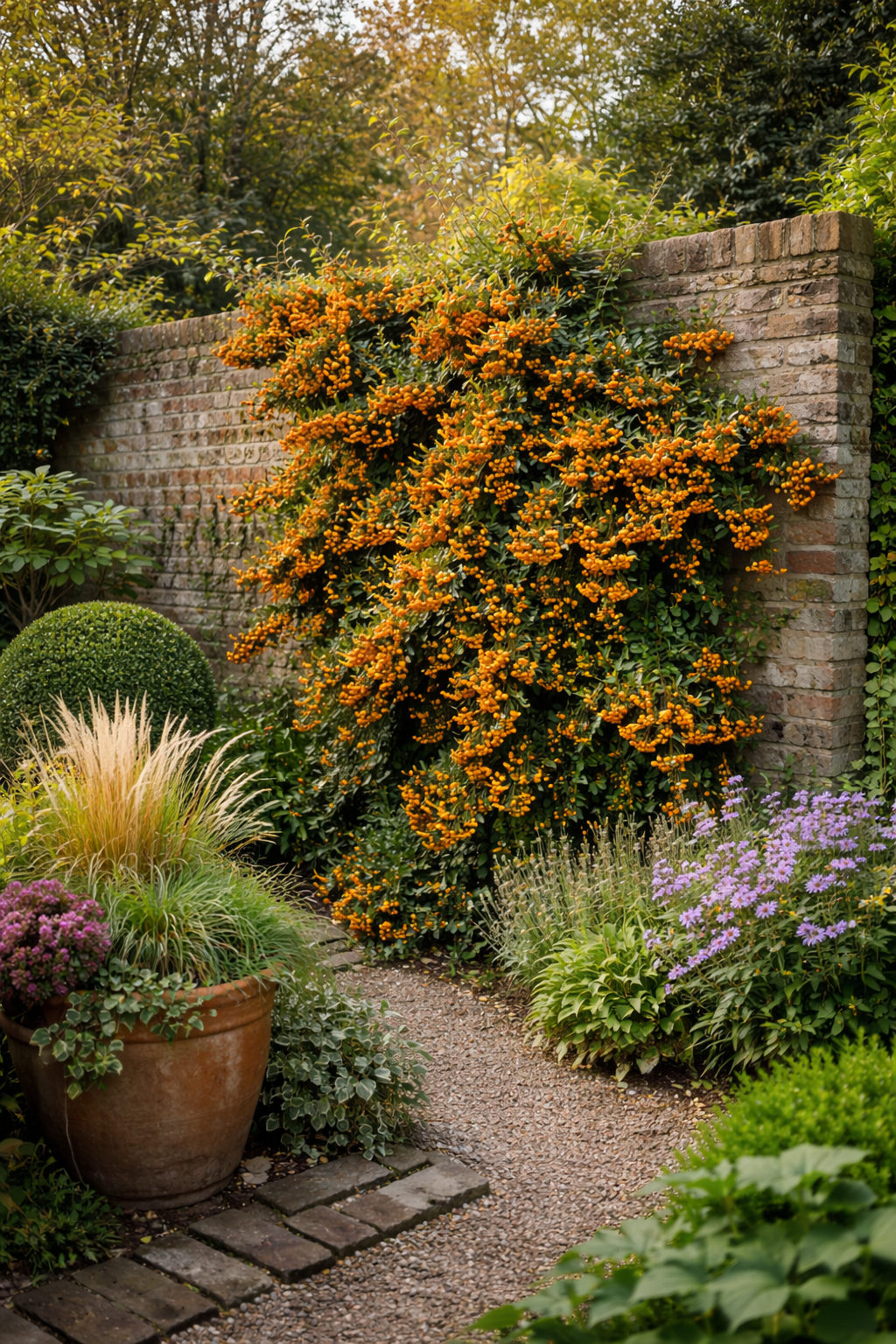
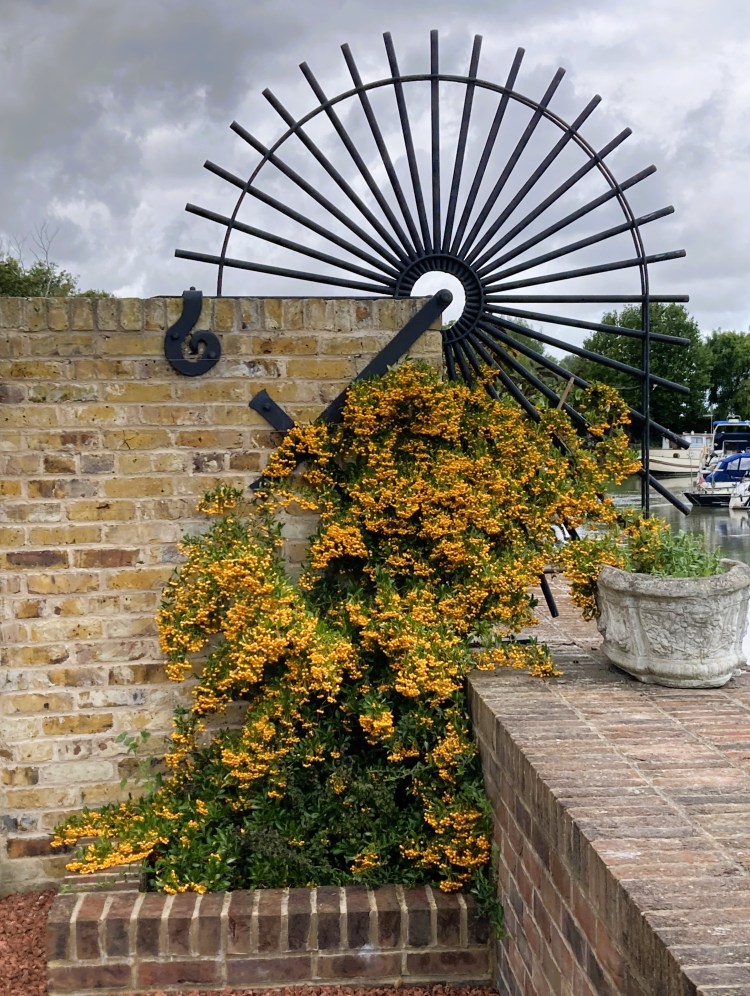
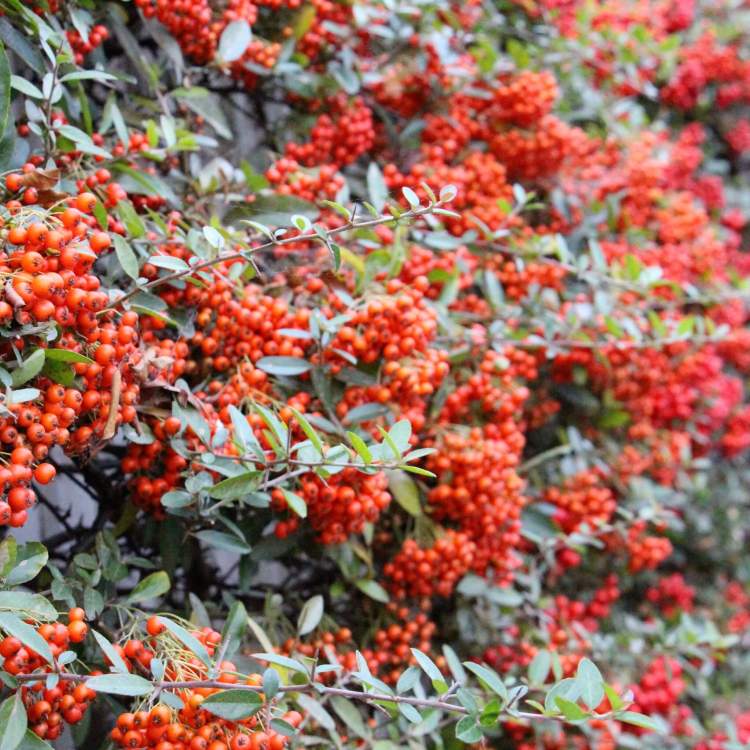
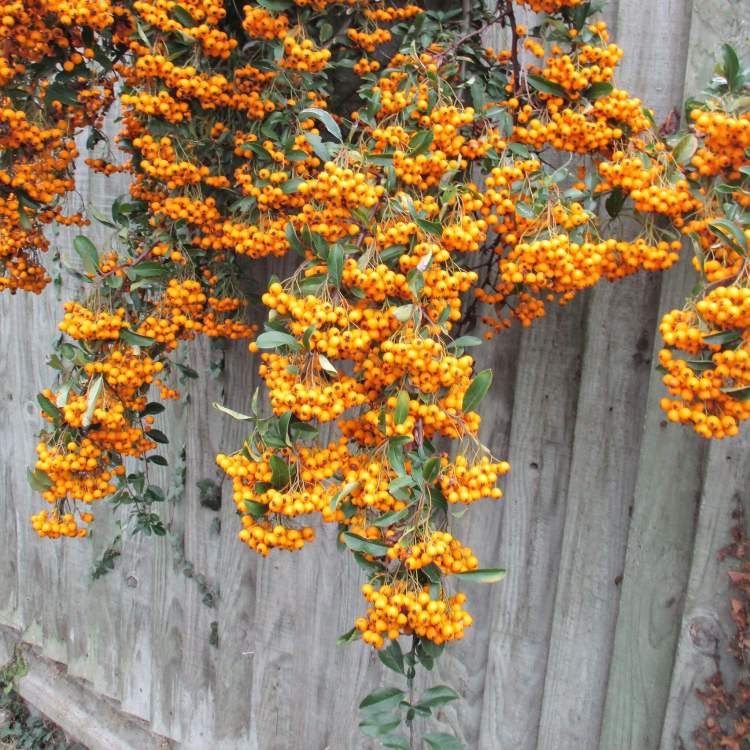
| Under a low winter sun, Pyracantha looks almost theatrical. Brick walls and harbour edges take on colour when most plants have withdrawn, and the firethorn steps forward instead. Orange, red, sometimes yellow berries hang in dense clusters, so heavy they pull the stems into arcs. From a distance, it reads as generosity: abundance, colour, life. Up close, it’s sharper, more guarded. You learn quickly where the thorns are. Firethorn has a reputation, and like most reputations earned in gardens, it’s only partly fair. It’s often described as aggressive, defensive, even hostile. Garden writers talk about it as if it were a necessary evil — good for birds, bad for people; useful but unlovable. That framing says more about how we expect plants to behave than about Pyracantha itself. It’s a shrub that refuses to soften itself for our convenience, and that refusal unsettles some gardeners. I’ve worked with Pyracantha in private gardens, along public walkways, against historic brick, beside water, and occasionally in places it clearly chose for itself. It’s not a plant that disappears into the background. It asserts its presence year-round. That alone makes it unusual in British gardens, which so often rely on summer performance and winter absence. Firethorn stays. It watches the seasons come and go and marks them in its own way. A plant that understands walls Pyracantha belongs to walls in a way few shrubs do. Not just because it tolerates training, but because it seems to understand vertical surfaces as habitat. When tied in loosely and allowed space to develop laterals, it forms a living skin over brick and stone. The berries sit against warm masonry, catching light that ground-level shrubs never receive. In coastal towns and older settlements, you see Pyracantha where other climbers struggle — places exposed to wind, salt, reflected heat, or poor soil. This relationship with walls isn’t accidental. Firethorn evolved to grow among rocks and slopes, scrambling through scrub and open woodland edges. Walls mimic that environment surprisingly well. They drain quickly, warm up fast, and offer protection from grazing animals. What we sometimes call “wall shrubs” are often just plants that recognise these conditions as familiar. There’s a tendency to compare Pyracantha to climbers like ivy or jasmine, but it isn’t really a climber at all. It doesn’t twine or cling; it leans, braces, and hooks itself through thorns. That difference matters. When people struggle with firethorn, it’s often because they expect it to behave like something else — something more cooperative. Pyracantha needs structure, but it also needs space to express its weight. Tie it too tightly or prune it too hard, and it responds with chaos: long whips, crossing branches, and thorny rebellion. The thorns are the point. The thorns are what most people talk about, usually with a slight shudder. There’s truth in that reaction. Firethorn thorns are serious. They’re not the fine irritants of roses or gooseberries; they’re rigid, angled, and determined. Anyone who has tried to prune Pyracantha without thick gloves will remember it. But those thorns aren’t an unfortunate side effect. They are the point. Firethorn is a plant that invests heavily in defence because it invests heavily in fruit. Those berries are valuable. They represent stored energy, and in the wild, they would be taken by birds when other food sources are scarce. Without thorns, Pyracantha would be stripped bare long before winter had done its work. This is where a common assumption slips in: that a good wildlife plant should be gentle, soft, and accommodating. In reality, many of the best wildlife plants are armed. Hawthorn, blackthorn, bramble — all are defensive, and all are ecological powerhouses. Pyracantha belongs in that lineage. It offers shelter as much as food, and the shelter works precisely because predators think twice. In practice, this means Pyracantha is one of the few shrubs I’ve seen where small birds genuinely disappear. Not just hide, but vanish into it, safe from cats, corvids, and human disturbance. You don’t see the birds so much as hear them, rustling somewhere behind the berries. That quality is hard to replicate artificially. Flowering is often overlooked. Because Pyracantha is so strongly associated with berries, its flowering stage is often treated as incidental. In late spring, the plant produces clusters of small white flowers — unshowy at first glance, easily overshadowed by more flamboyant neighbours. But spend time near a flowering firethorn, and you realise how busy it becomes. The flowers hum. Insects arrive in numbers that surprise people who only think of Pyracantha as a winter feature. There’s a quiet lesson here about scale and expectation. We often judge flowers by how they look to us, not by how they function. Pyracantha flowers aren’t meant to stop you in your tracks; they’re meant to feed. They open reliably in large numbers, with little fuss. In a mixed planting, they act as connective tissue, supporting pollinators that then move on to more specialised plants. One thing I’ve noticed in practice is that Pyracantha flowers best when it isn’t over-pruned. Hard pruning in winter or early spring often removes flowering wood, leading to lush growth but sparse blossom. This feeds another myth: that Pyracantha “doesn’t flower well” or “is unreliable.” In reality, it’s responding logically to how it’s treated. Firethorn rewards patience and restraint more than constant intervention. Berries and the timing of hunger The berries themselves are where Pyracantha earns its keep in most gardens. Orange is perhaps the most common colour, but reds and yellows have their place too, each catching light differently as the year darkens. What’s interesting is not just that the berries exist, but when they are taken. Birds don’t usually strip Pyracantha immediately. Early in the season, the berries remain largely untouched. Only after frost, scarcity, and shorter days do they start to disappear in earnest. This delayed consumption is crucial. It turns Pyracantha into a food reserve rather than a quick snack. Gardeners sometimes worry when berries linger. They assume something has gone wrong, or that the berries are “inedible.” In truth, many birds prefer softer fruits early on and turn to tougher berries later, when options narrow. Firethorn berries persist precisely because they are structured to last. I’ve seen winters where Pyracantha was the last plant still feeding birds in a garden. Everything else had been stripped bare — hips gone, ivy berries finished — and the firethorn still held on, rationing its colour until January or February. That kind of reliability isn’t flashy, but it’s rare. A plant that asks for judgment, not rules One of the hardest things about Pyracantha is that it resists simple rules. You can’t reduce it to a pruning calendar or a single best practice. Each plant develops its own architecture based on site, training, and age. Working with firethorn is less about following instructions and more about reading structure. In older specimens, you often see a clear framework: thick, woody arms laid out against a wall, with younger growth layered over the top. Maintaining that framework requires selective removal, not wholesale cutting back. When gardeners ignore this and treat Pyracantha like a hedge, they end up with dense, impenetrable growth that’s difficult to manage and less productive. There’s also a trade-off between neatness and value. A tightly clipped Pyracantha might look orderly, but it will flower and fruit less. A looser plant, allowed to arch and sprawl slightly, will reward you with berries and birds. This tension mirrors a broader gardening question: how much mess are we willing to tolerate for the sake of life? Firethorn makes that question visible. You can’t hide its choices. Either you accept a degree of wildness, or you suppress the very qualities that make the plant worthwhile. Firethorn and fear It’s worth acknowledging that some people genuinely dislike Pyracantha, and not without reason. In small gardens or narrow paths, it can feel threatening. The thorns catch sleeves, skin, and attention. In family spaces, it’s often deemed unsuitable. These concerns aren’t trivial. But there’s a subtle shift that happens when Pyracantha is placed intentionally. When it’s used as a boundary, a backdrop, or a wall companion — rather than a path-side shrub — its character changes. It stops being an obstacle and becomes a presence. Context matters enormously with this plant. I’ve also noticed that Pyracantha is often blamed for problems caused by neglect rather than inherent behaviour. Left untrained for years, it becomes a tangle. Then, when someone finally intervenes, the experience is unpleasant, reinforcing the idea that the plant is hostile. In reality, it’s simply responding to long periods without guidance. That doesn’t mean Pyracantha is for every garden. It means it needs honesty. If you want softness, choose something else. If you want resilience, structure, and winter life, firethorn is upfront about the terms. Longevity and quiet confidence One of the most underrated aspects of Pyracantha is its longevity. Given a suitable position, it will outlast many trend-driven plants. It doesn’t exhaust itself through excessive flowering, and it doesn’t rely on constant feeding or pampering. It settles, thickens, and deepens with time. In older gardens, Pyracantha often marks a certain era — post-war planting, municipal design, practical optimism. But that association can obscure its continuing relevance. In an age of climate uncertainty, plants that tolerate heat, drought, poor soil, and exposure deserve renewed attention. Firethorn doesn’t ask for perfect conditions; it asks for space and respect. There’s also something quietly reassuring about a plant that doesn’t chase novelty. Pyracantha doesn’t change its character to suit fashion. It remains what it is, year after year, offering the same cycle of flower, fruit, and shelter. In a world that often feels hurried and disposable, that steadiness has value. Rethinking the “problem plant” label Firethorn is sometimes described as a “problem plant.” Too thorny, too vigorous, too much. But that language reveals our expectations more than the plant’s nature. Pyracantha isn’t problematic; it’s specific. It thrives when used deliberately and struggles when treated casually. As a working gardener, I’ve learned that the plants people label difficult are often the ones doing the most work — holding soil, feeding wildlife, withstanding exposure, or defining space. Firethorn does all of these. It just refuses to do them quietly. Perhaps the real challenge with Pyracantha is that it asks us to slow down. To look before we cut. To accept that some plants aren’t decorative accents but structural participants in a garden’s life. Firethorn doesn’t want to be fussed over. It wants to be understood. In that sense, it’s less a shrub and more a conversation — one that unfolds over years, not seasons. If you’re willing to listen, Pyracantha has a lot to say. |
| About our writing & imagery Most articles reflect our real gardening experience and reflection. Some use AI in drafting or research, but never for voice or authority. Featured images may show our photos, original AI-generated visuals, or, where stated, credited images shared by others. All content is shaped and edited by Earthly Comforts, expressing our own views. |


It’s beautiful to look at, Rory.
LikeLiked by 1 person