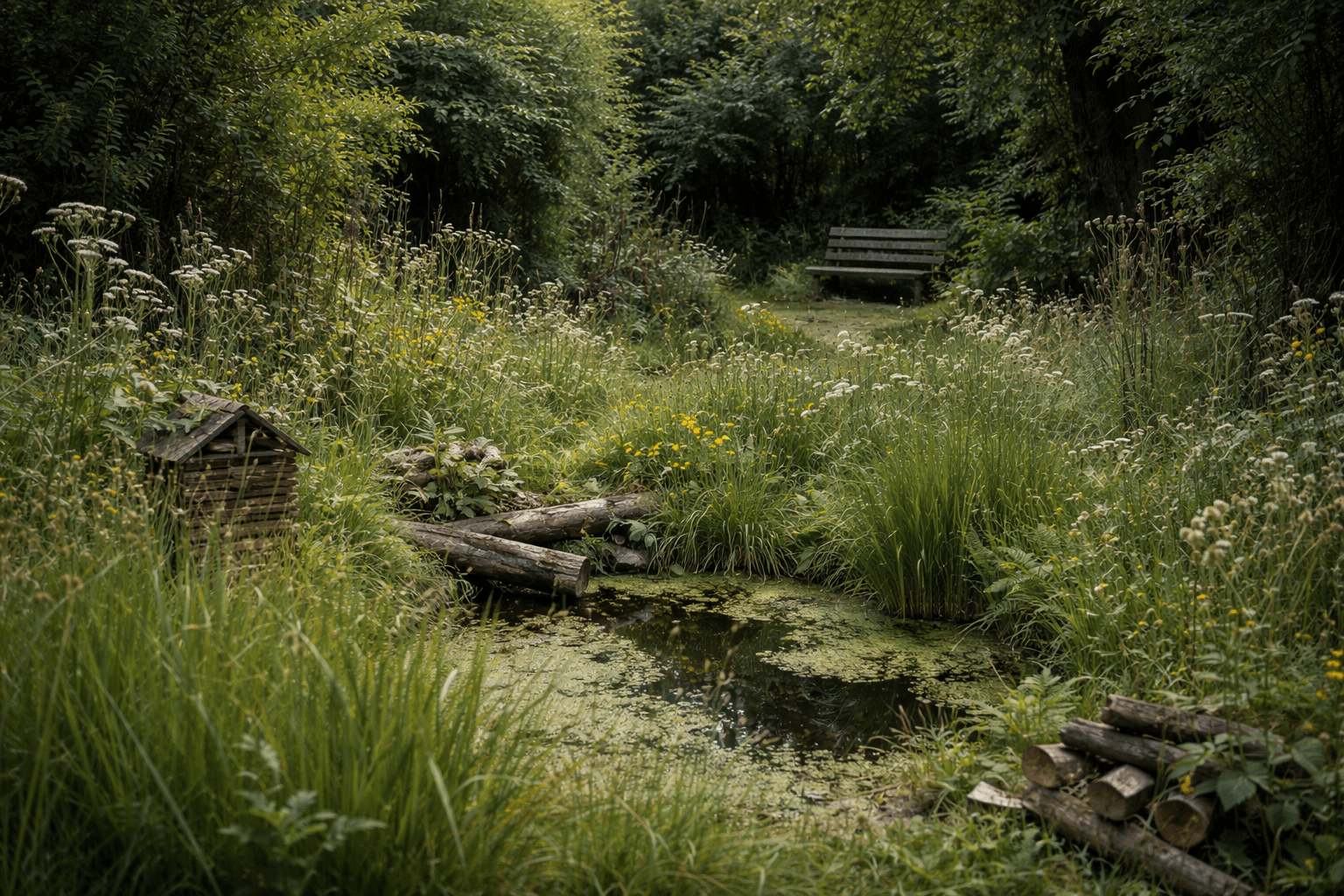
| I now work in many wildlife gardens. That’s not surprising. Since leaving Gazen Salts, I’ve intentionally focused my work on gardens, striving—sometimes awkwardly, sometimes carefully—to allow for more than just neatness. More often than not, Earthly Comforts is called in for new maintenance work because of this approach to wildlife gardens. Clients come to us because they appreciate that we work carefully and quietly, always with an eco-friendly perspective. They aren’t seeking a dramatic transformation or a show garden; what they want is a gardener who understands why their garden is the way it is, and who won’t undo those intentions. And yet, early on, the same question still tends to surface. A new client will explain that they’ve done the right things. That their garden is wildlife-friendly. Then, usually with a note of uncertainty, they’ll ask why it all feels so empty. Why, despite the intention, doesn’t it seem to be much actual wildlife about? What are they doing wrong? It’s understandable to ask this. But the real question isn’t what’s missing from their actions, but why expectations often don’t match the current experience. |
| Under almost any article about wildlife gardening, there is a familiar comment. Someone will say they have “done everything right” and yet their garden remains strangely empty. They planted for pollinators. They stopped spraying. They let the grass grow. They bought the log pile, the bug hotel, and the pond liner. And still—nothing much arrives. A few flies, perhaps. A robin that was already there. No hedgehogs. No frogs. No sense of return. It is tempting to treat this as a failure of technique. Something must be missing. The wrong plant, the wrong feature, the wrong month. But after years of working in gardens that claim to be wildlife-friendly—some sincerely so—I have come to suspect that emptiness is often the point where the real conversation begins, not where it ends. Wildlife absence is rarely accidental. It is usually the result of timing, history, scale, or expectation colliding with modern gardening culture. The garden has been prepared to look welcoming, but not yet to be lived in. |
| The idea of welcome, and the reality of arrival A garden can signal welcome in all sorts of ways that matter more to humans than to animals. Long grass. Native plants. A corner “left wild.” These things reassure us that we are doing the right sort of gardening. They read correctly from a distance. But wildlife does not read gardens symbolically. It responds to conditions, continuity, and risk. For most species, arriving somewhere new is dangerous. It means crossing unfamiliar ground, passing through gaps, and navigating edges. A hedgehog moving through a housing estate is not looking for a philosophically sound planting scheme. It is looking for uninterrupted routes, reliable cover, and the absence of immediate threat. A solitary bee is not checking whether a garden meets an ethical threshold; it is assessing whether the forage is predictable enough to justify nesting nearby. Many wildlife-friendly gardens are technically hospitable but practically isolated. They are small islands in a landscape that has been fragmented, making easy movement difficult. The garden itself may be sound, but the routes to it are blocked by fencing, walls, paving, roads, lighting, dogs, or simply distance. We tend to judge gardens as self-contained units. Wildlife does not. It experiences them as brief moments along a journey, or not at all. This helps explain why some gardens remain empty despite good intentions. They are offering shelter without context, like a well-furnished room in a building with no doors. Time is doing most of the work, not us. One of the quiet myths of wildlife gardening is that it operates on human timescales. We plant, we wait a season, we look for results. When nothing happens, we assume something is wrong. In reality, time is often the missing ingredient, and not just a little of it. Soil takes years to soften after compaction. Invertebrate populations rebuild slowly. Predator–prey relationships take time to re-establish. A garden that has been intensively managed for decades does not reset itself in twelve months simply because the mower schedule changed. I have seen gardens that were ecologically empty for years suddenly begin to hum—not because the owner added something new, but because they stopped intervening long enough for processes to settle. The ground cooled. Fungal networks returned. Leaf litter stayed where it fell. Insects appeared quietly, then multiplied. Birds followed, then mammals. This lag can be deeply frustrating, especially in a culture that rewards visible effort. A neat before-and-after photograph feels like proof of progress. Wildlife recovery rarely offers such moments. It creeps in sideways, often unnoticed until it is already established. Gardens that remain empty are sometimes simply young. They are still in the awkward adolescence where human intention has outpaced ecological response. Wildness without structure is still unstable. Another common assumption is that wildlife prefers mess. The more untidy a garden becomes, the more life it will attract. There is some truth here, but it is incomplete. Wildlife does not thrive in chaos; it thrives in structure. Cover, edge, depth, repetition. A completely unmanaged garden can be just as unhelpful as an over-managed one if it lacks the features animals actually use. Tall grass without variation offers little. A heap of random cuttings dries out quickly and becomes sterile. A “wild corner” that is periodically reset never develops the layers that support real habitation. In practice, many wildlife-friendly gardens oscillate between neglect and correction. They are left alone for a while, then cut back hard. Tidied in bursts. Reset just as things begin to stabilise. From a human perspective, this feels permissive. From a wildlife perspective, it feels unreliable. What animals need is not endless growth, but predictable refuge. Places that stay damp. Places that remain shaded. Places that are not suddenly exposed. If a garden offers food but no permanence, it becomes a feeding stop rather than a home. You will see visitors, but they will not stay. This is one reason why people report seeing wildlife briefly, then losing it again. The garden looked wild, but it did not behave consistently enough to support settlement. Clean gardening leaves invisible gaps. Modern wildlife gardening advice often focuses on what we add: plants, features, habitats. It talks less about what we remove—or more accurately, what we keep removing without noticing. Many gardens that describe themselves as wildlife-friendly are still fundamentally clean spaces. Leaves are cleared. Dead stems are cut back early. Soil is exposed. Edges are trimmed. Surfaces are swept. None of this feels hostile. It is simply a habit. But collectively, it creates a landscape with very few safe margins. For invertebrates, especially, these margins are everything. The overwintering stage of many species depends on undisturbed material—rotting wood, hollow stems, leaf litter, and soil crevices. A garden can be rich in nectar and still be empty if these quieter requirements are missing. There is also the issue of chemical cleanliness. Even gardeners who avoid obvious pesticides often use products that affect soil life, slug populations, or fungal networks. Lawn treatments, path cleaners, and ant deterrents. The effects are subtle but cumulative. Wildlife may visit briefly and then avoid returning, responding to signals we do not perceive. In this sense, emptiness can be a form of feedback. The garden looks inviting to us, but something about it remains too exposed, too managed, too chemically tidy to feel safe. Wildlife does not respond evenly. Another uncomfortable truth is that not all gardens are equally placed to support wildlife, no matter how well they are managed. Soil type, surrounding land use, local species decline, and historical disturbance all matter. Some areas have simply lost their source populations. Hedgehogs cannot return to a neighbourhood where they no longer exist nearby. Amphibians cannot colonise isolated ponds without a connection to other water bodies. Certain insects will never appear if the regional population has collapsed. A garden can be perfect in theory and still remain empty because there is nothing left to arrive. This is rarely acknowledged in glossy wildlife gardening narratives, which tend to imply that effort guarantees outcome. In reality, gardens exist within larger ecological stories. Sometimes those stories are already in their final chapters. This does not mean wildlife gardening is pointless. It means expectations need adjusting. A garden might become a refuge for common species rather than a site of dramatic return. It might function as a corridor rather than a destination. Its value may be cumulative rather than visible. The danger comes when gardeners interpret absence as personal failure rather than contextual limitation. That sense of quiet discouragement—“I did everything, and nothing happened”—can erode the patience that wildlife recovery actually requires. Observation is more revealing than success. One of the most useful shifts I have seen is when gardeners stop asking why nothing has arrived and start asking what the garden is telling them. Emptiness is not neutral. It has texture. It has clues. Is the garden quiet at night as well as during the day? Does the soil dry quickly after rain? Are edges hard or soft? Do birds feed and then leave, or linger? Are there signs of transit but not settlement—paths through grass, brief visits, disturbed leaf litter? These observations do not lead neatly to solutions, and that is the point. They ground the gardener in the actual life of the space rather than the idea of it. They replace ambition with attentiveness. In my own work, the gardens that eventually support the most wildlife are often those whose owners stopped trying to achieve wildlife and began simply making room for it—physically and mentally. They slowed down their interventions. They accepted unevenness. They tolerated periods of apparent inactivity without rushing to fix them. Ironically, it is often at this point that life begins to appear. A different measure of success Perhaps the hardest adjustment is letting go of the idea that wildlife presence should be obvious. We are conditioned to notice birds, mammals, and large insects. We overlook soil organisms, nocturnal invertebrates, fungi, and microbial life. Yet these are the foundations on which everything else rests. A garden can be teeming with life and still feel empty to the human eye. The hum is underground. The movement is small. The activity happens at night or out of sight. When gardeners learn to recognise this quieter abundance, the sense of failure often lifts. This does not mean settling for less. It means recalibrating attention. A wildlife-friendly garden is not always lively; it is alive. Those are not the same thing. In the end, many wildlife-friendly gardens stay empty because they are still negotiating the gap between intention and reality. They are generous spaces, learning to be trustworthy. There are pauses in a landscape that has learned to be wary. They are places where time, structure, and context have not yet aligned. That alignment cannot be forced. It can only be waited for, noticed, and quietly supported. And sometimes, the most wildlife-friendly thing a gardener can do is to accept the emptiness—not as a verdict, but as part of the long, uneven process of return. |
| A wildlife-friendly garden doesn’t always broadcast its purpose. Sometimes, when people notice an absence, it’s less a failure and more a sign of timing, history, or the scale at which the garden works. A garden may be prepared for wildlife before the larger landscape is, or it might provide food, but not yet enough cover for safety. Activity may be present, but occur underground, at night, or at such a small scale that it escapes notice, making the garden’s role as a haven less visible. Not all gardens will host the same life, even if cared for similarly. Soil, nearby green spaces, and past land use all shape what can arrive—and what can stay. Some gardens serve as places of passage, not settlement. Others need years to settle into themselves. Emptiness in a wildlife garden isn’t always a final judgment; it can be a stage in a gradual process, a signal about what the site can support, or simply a natural part of the slow transformation as the space is made and wildlife is given time to discover and inhabit it. |
| About our writing & imagery Most articles reflect our real gardening experience and reflection. Some use AI in drafting or research, but never for voice or authority. Featured images may show our photos, original AI-generated visuals, or, where stated, credited images shared by others. All content is shaped and edited by Earthly Comforts, expressing our own views. |

