| A 5-Part Series |
| A curated exploration of Britain’s most iconic, curious, and ecologically important insects |
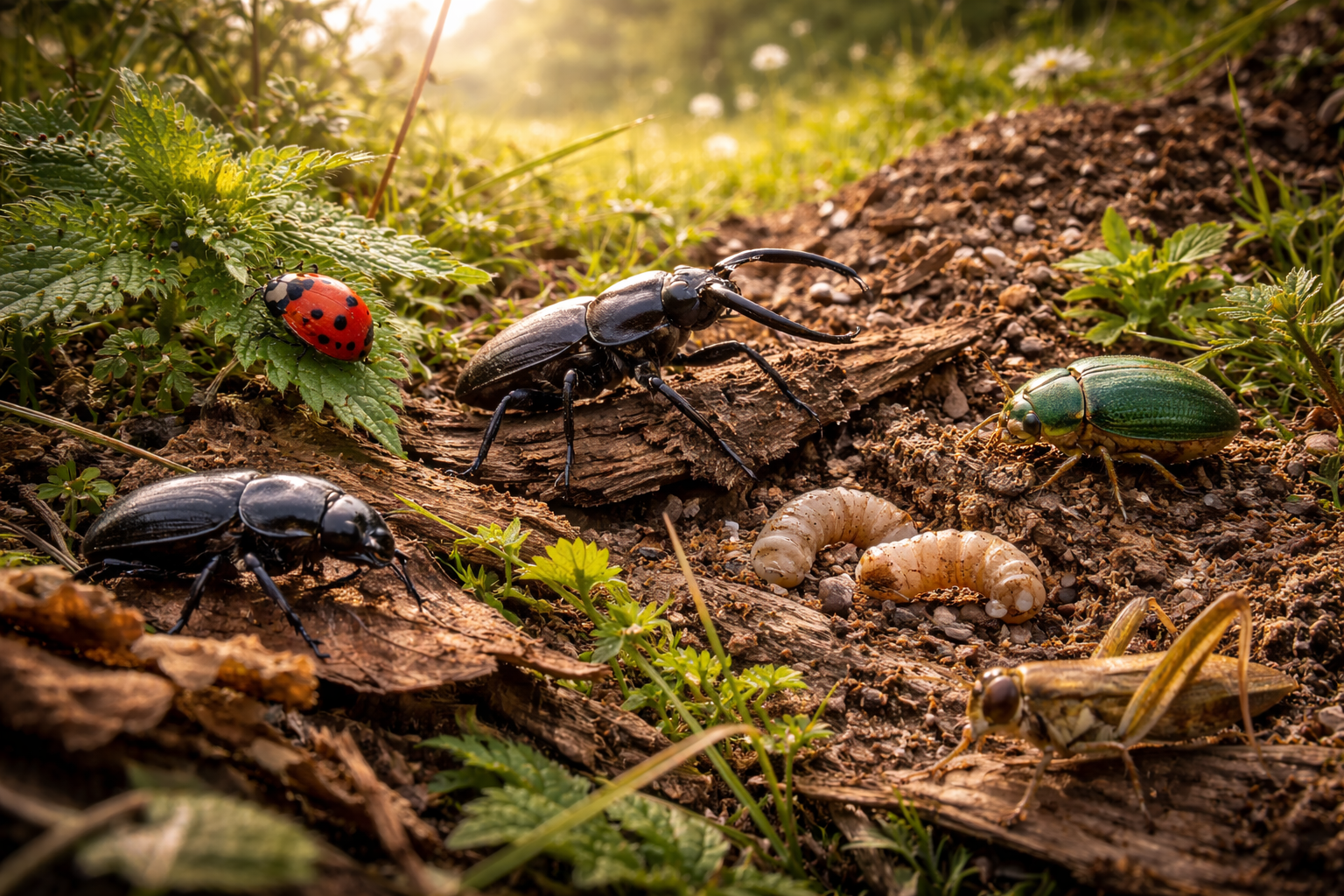
| Part 3 Beetles, Grasshoppers & Locust Relatives: The Framework Species Beetles form the backbone of insect life in the UK, even if they rarely draw attention. They are not showy, nor do they dominate soundscapes or summer imagery as butterflies or bees often do. Instead, they work persistently at ground level, in soil, leaf litter, dead wood, grassland, and hedgerows. Their influence is slow, cumulative, and foundational. To understand British ecosystems properly, one must look down rather than up. Beetles represent the largest group of insects in the UK by far, occupying almost every terrestrial habitat. They recycle organic matter, regulate other invertebrate populations, and maintain soil structure. Many are nocturnal or hidden for most of their lives, which is why their decline often goes unnoticed until consequences appear elsewhere. Ground beetles are among the most important yet overlooked predators in Britain. Mostly active at night, they patrol soil surfaces, woodland floors, field margins, and garden beds, hunting slugs, snails, caterpillars, and other soft-bodied invertebrates. Unlike flying insects, ground beetles depend on continuous habitat. They do not migrate easily or recolonise fragmented landscapes quickly. Their presence therefore indicates stable, undisturbed ground with intact soil layers, leaf litter, and moisture levels. Where ground beetles disappear, slug populations often rise sharply. This imbalance is frequently treated with chemical intervention, masking the underlying issue: soil systems that have been compacted, over-cultivated, or stripped of cover. In this way, ground beetles act as quiet sentinels of land health. Ladybirds occupy a unique place in British insect life. They are among the few beetles people actively welcome, recognise, and protect. Brightly coloured and easy to identify, they have become symbols of “good insects” — a rare case where ecological value aligns with public affection. Their appetite for aphids makes them powerful allies in gardens, allotments, and agricultural systems, particularly where chemical use is limited. A single ladybird larva can consume hundreds of aphids during its development, making it far more effective than its small size suggests. Yet even ladybirds are not immune to broader pressures. Habitat loss, climate instability, and competition from introduced species have begun to affect some native populations. Their familiarity should not obscure their vulnerability — nor should it distract from the countless less visible beetles performing equally vital work. Stag beetles are among Britain’s most striking insects and its largest native beetle species. Their presence feels almost anachronistic — heavy-bodied, slow, and tied to old landscapes. They are often seen only briefly, during warm summer evenings, when adults emerge to mate. The real life of a stag beetle, however, unfolds underground. Its larvae spend between four and seven years feeding on decaying wood beneath the soil. This makes stag beetles entirely dependent on dead trees, rotting stumps, and long-term continuity of habitat. In a landscape that prizes tidiness, dead wood is often removed for aesthetic or safety reasons. Yet in doing so, we dismantle the life cycles of species like the stag beetle. Their decline is not sudden or dramatic; it is slow, measured in missed generations rather than visible collapse. Stag beetles remind us that conservation in Britain is often about restraint — about leaving things in place long enough for life to complete its work. Chafer beetles rarely receive the sympathy afforded to stag beetles or ladybirds. Their larvae live underground in lawns, pastures, and sports fields, feeding on plant roots. When present in large numbers, they can cause visible damage, leading to brown patches and weakened turf. This has positioned chafers as pests rather than participants in soil systems. Yet they are not invaders or anomalies. They are long-established components of British grassland ecology, part of a complex web involving birds, mammals, fungi, and microorganisms. Chafer larvae themselves are an important food source for badgers, foxes, birds, and other insectivores. Their populations rise and fall in response to soil conditions, moisture levels, and land management practices. Attempts to eradicate them entirely often result in wider disruption, exposing the fragility of simplified landscapes. Their presence forces an uncomfortable question: at what point does inconvenience outweigh ecological function? Grasshoppers occupy a different sensory space in British ecosystems. While beetles work in silence, grasshoppers announce themselves through sound. Their songs form part of the acoustic fabric of summer meadows, heathland, and rough grass margins. Grasshoppers thrive in unmanaged or lightly managed grassland — areas cut late, grazed lightly, or left to grow naturally. Their presence signals intact vegetation structure, varied plant height, and a lack of excessive disturbance. When grasslands are intensively mown, sprayed, or reseeded, grasshopper populations often vanish. The silence that follows is rarely remarked upon, yet it marks a profound ecological simplification. Grasshoppers are both herbivores and prey, linking plant growth to the populations of birds and mammals. Their disappearance quietly unravels food webs, without the spectacle of collapse. Crickets are often heard more than seen. Their calls emerge from hedgebanks, stone walls, grassy banks, and warm south-facing slopes. Unlike grasshoppers, many crickets rely heavily on shelter — crevices, dense vegetation, and stable microclimates. This makes them particularly sensitive to habitat loss. Removal of hedgerows, over-tidying of gardens, and loss of rough ground reduce the sheltered spaces crickets depend on. Climate change adds further pressure, disrupting the temperature thresholds that govern their life cycles and calling behaviour. Crickets are indicators of continuity. Where land is left uneven, layered, and imperfect, they persist. Where it is smoothed and simplified, they fall silent. Unlike Australia or parts of Africa, the UK does not experience true locust plagues. Grasshopper populations do not erupt into vast, landscape-altering swarms. This absence of spectacle can make their ecological role easy to underestimate. Yet British beetles, grasshoppers, and crickets still shape vegetation, soil structure, and nutrient cycles in quieter ways. They regulate plant growth, feed birds and mammals, and maintain balance at small scales repeated across millions of hectares. Their work is cumulative rather than explosive. Remove them, and systems do not collapse overnight — they thin, weaken, and unravel gradually. In Britain, insects rarely demand attention. They persist instead — beneath leaves, within soil, inside wood, and along grassy margins. Beetles, grasshoppers, and crickets exemplify this quiet endurance. They are not symbols or spectacles, but mechanisms — the moving parts that keep land functioning. To notice them is to notice the land itself. What survives among them tells us less about the insects than about the choices we make in how we manage space, time, and restraint. |
Unless stated, featured images are my own work, created independently or with the assistance of AI.

