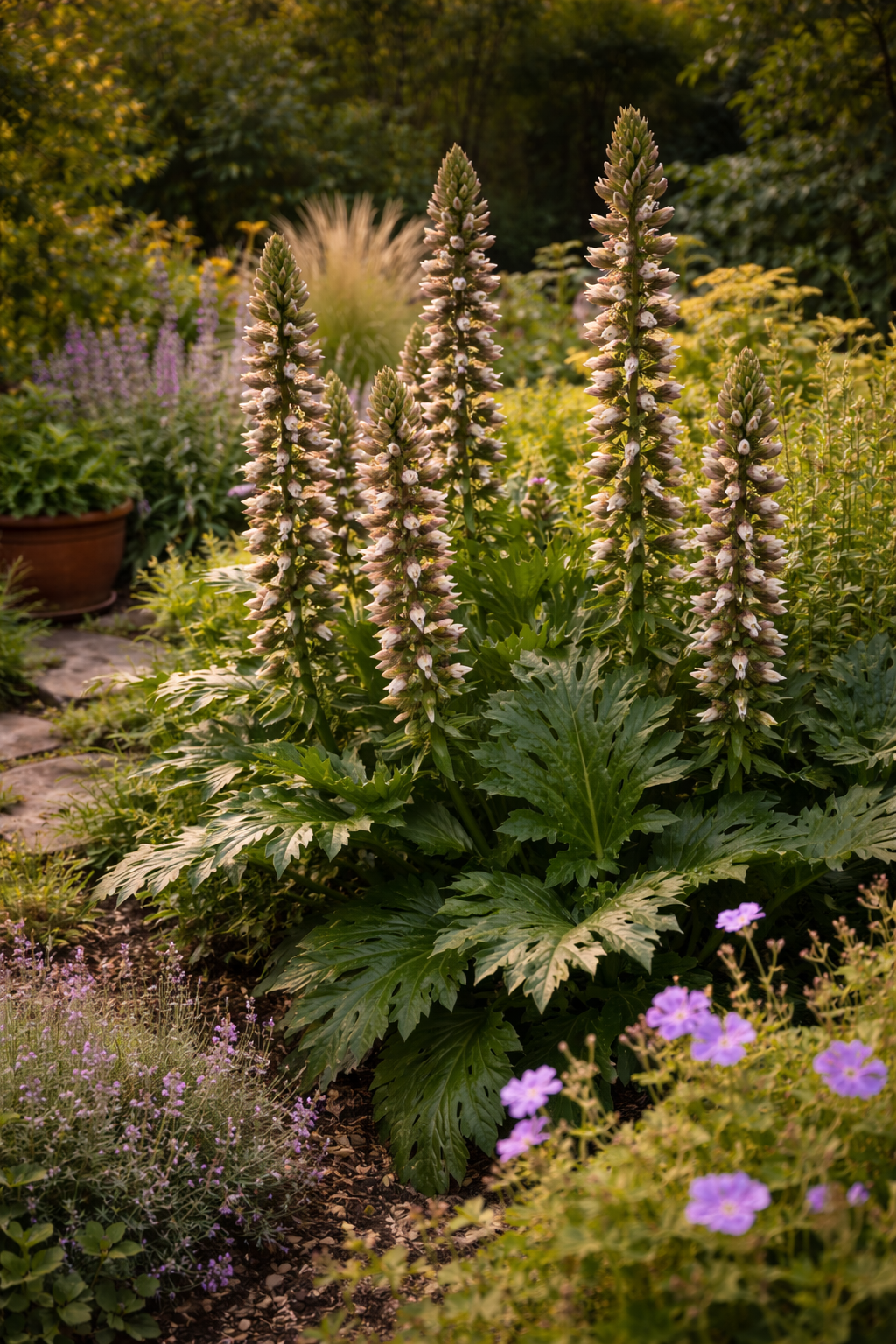
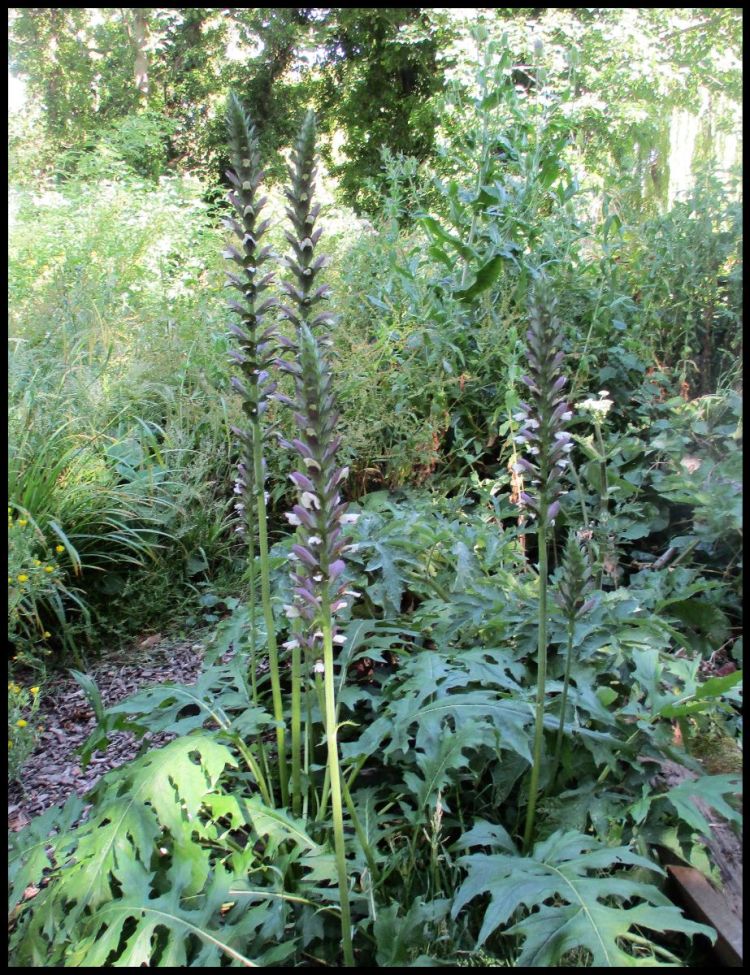
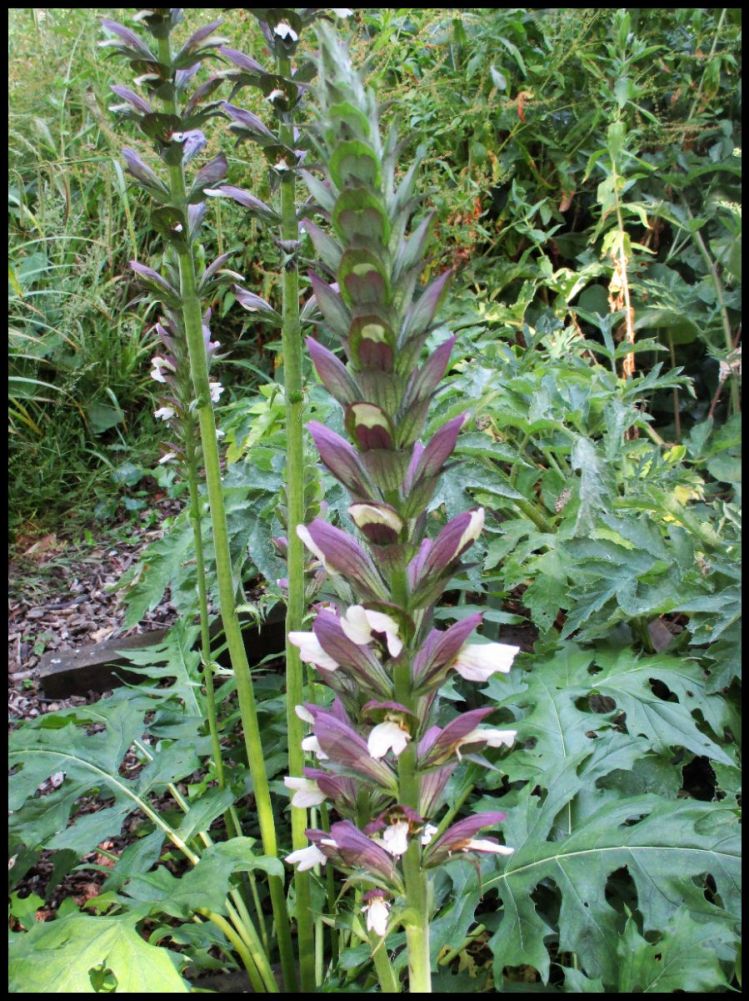
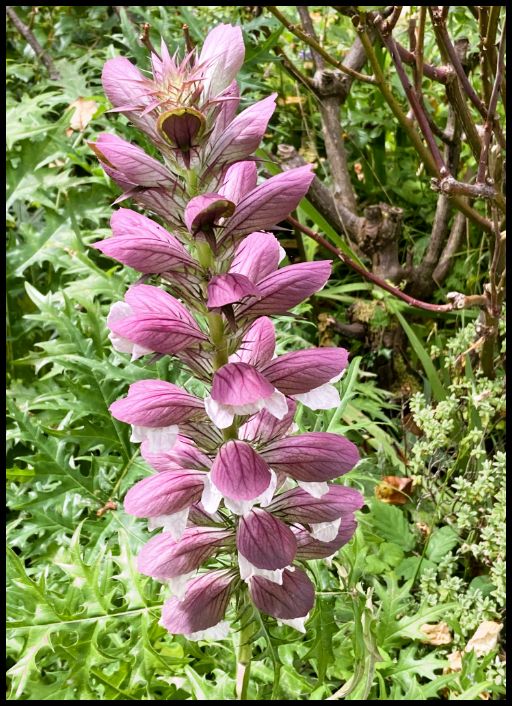
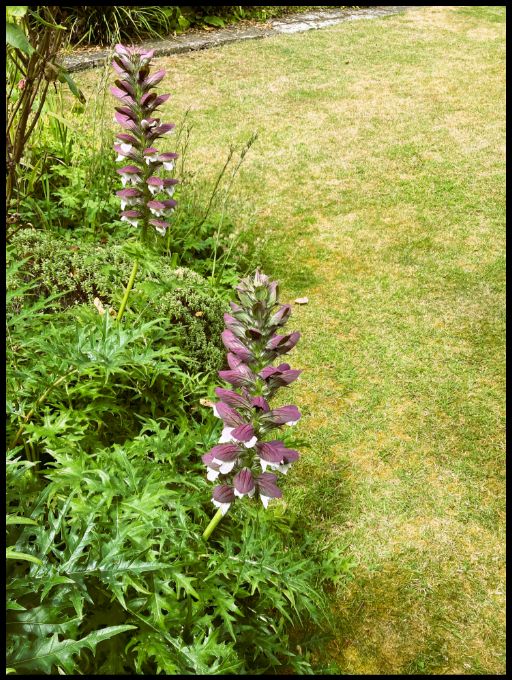
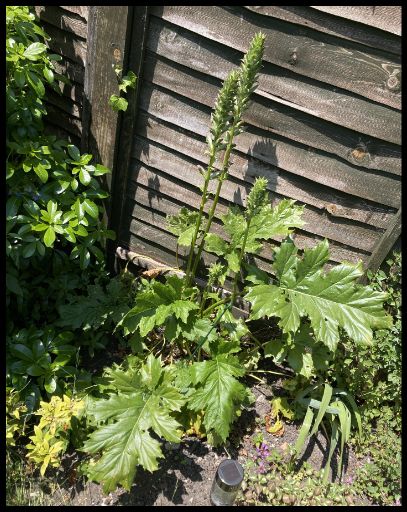
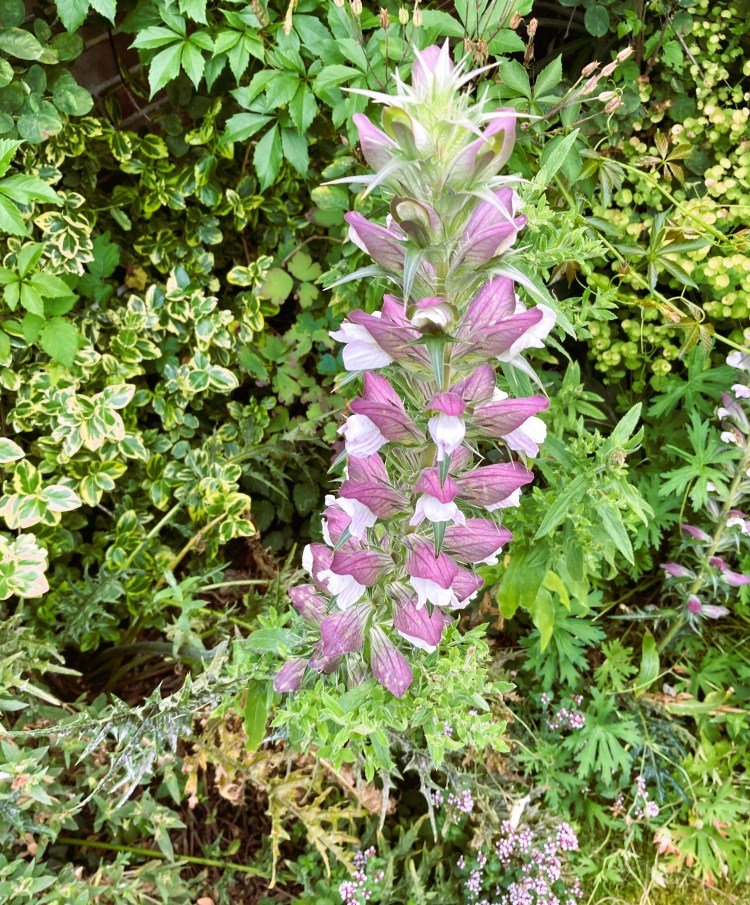
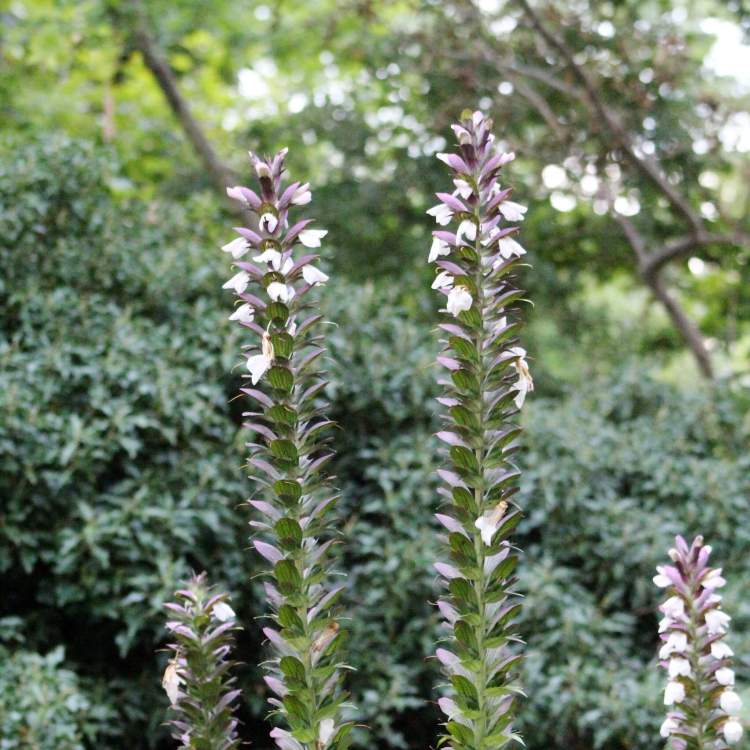
| Bear’s breeches is a plant you don’t stumble into lightly. You don’t brush past it without noticing. You don’t forget the first time you really look at it. Even before it flowers, Acanthus has weight—not just physical, but visual authority as well. Its leaves sit low and broad, deeply cut and glossy or matte depending on species, as if they’ve been carved rather than grown. When the flower spike rises, it feels less like a bloom. It feels more like a declaration. In gardens, bear’s breeches often mark a shift in confidence. Someone planted this knowing it would be seen. It’s not filler, not background, not polite. It deliberately occupies space and asks the garden around it to respond. I’ve worked with Acanthus in formal borders, loose cottage-style plantings, dry shade, hot sun, and places where it frankly had no right to succeed — and yet did. It’s a plant that exposes assumptions. People think it’s delicate because it looks classical, or unruly because it spreads, or dangerous because it’s spiny. In reality, Bear’s Breeches is simply honest about its nature. A plant with history in its bones It’s impossible to talk about bear’s breeches without acknowledging its long cultural shadow. As the plant transitions from living garden presence to artistic inspiration, the leaves of Acanthus are famously echoed in Corinthian columns, carved into stone capitals that have survived for millennia. That detail alone tells you something important: this is a plant whose form has been considered worth preserving, abstracting, and repeating. But that history can be misleading. It tempts us to treat Acanthus as ornamental in the museum sense—classical, refined, static. In the garden, it’s none of those things. It’s vigorous, responsive, and sometimes awkward. The carved stone version is frozen perfection. The living plant is movement, damage, and regrowth. That tension is part of its appeal. Bear’s breeches bridges cultivated design and raw growth: it looks composed, even as it behaves unpredictably. The contrast between image and reality is constant. Leaves that do the heavy lifting Long before the flowers appear, Acanthus earns its place through foliage alone. The leaves are large, lobed, and often armed with soft or sharp spines, depending on the species — Acanthus mollis being the gentler, Acanthus spinosus the more assertive. One grounded observation from practice: bear’s breeches works best when it’s allowed to be a foliage plant first. People sometimes treat the flower spike as the whole point, but the leaves carry the plant for most of the year. In winter, the foliage may collapse or retreat; in spring, it resurfaces with quiet determination; by early summer, it’s a solid mass again. The leaves cast real shade. They cool the soil, suppress weeds, and create microclimates beneath them. Smaller plants that enjoy shelter — spring bulbs, self-seeders, ground-hugging annuals — often find a home at its base. This is one of those unplanned relationships that only emerges when a plant is left to settle rather than constantly adjusted. The flower spike: architecture, not decoration When bear’s breeches flowers, usually in early to midsummer, the effect is architectural rather than floral in the conventional sense. The spike rises straight and tall. It is layered with bracts—often green flushed with purple or pink—from which white or pale flowers emerge. It’s a complex structure, and not immediately readable. Some people find it strange or even awkward at first. That reaction is telling. We’re used to flowers that face us openly, petals spread wide, colour doing the talking. Acanthus flowers are recessed, protected, and partially hidden. The bracts are as important as the blooms themselves. This is where another assumption can be gently challenged: that flowers must be immediately legible to be valuable. Bear’s breeches reward attention rather than glances. Stand with it for a moment, and the logic of the structure reveals itself. It’s built for endurance, not display. The spike holds for weeks, weathering wind and rain with minimal damage. Spines, boundaries, and respect Much is made of the spines on bear’s breeches, particularly Acanthus spinosus. They are real. You don’t want this plant leaning into a narrow path or children’s play area. But the spines are often exaggerated in reputation. They are treated as if they make the plant hostile. In practice, the spines function more as punctuation than aggression. They mark edges. They say, “This is where I end.” When bear’s breeches is given appropriate space, the spines are rarely an issue. Problems arise when it’s squeezed into places that don’t suit its scale. This leads to a wider point about garden design: not every plant wants to be approachable. Some plants define boundaries rather than soften them. Bear’s breeches does that beautifully. Placed at the back of a border, against a wall, or in open ground where its shape can be read clearly, it becomes grounding rather than threatening. Soil, sun, and survival Bear’s breeches has a reputation for being demanding. That’s only partly true. It does best in free-draining soil and appreciates sun or light shade. What it really dislikes is winter wet combined with cold. In heavy clay, it can sulk or rot unless conditions are improved. Once established, though, Acanthus is surprisingly resilient. It tolerates drought better than people expect, thanks to its deep roots and thick foliage. In hot summers, it often looks fresher than neighboring plants. These neighbors were assumed to be tougher. Here’s a practical trade-off worth acknowledging: bear’s breeches are not easy to move once settled. Disturbing its roots usually results in a long sulk, if not outright refusal. This makes initial placement important. It’s not a plant for constant rearrangement. But in return for that commitment, it offers longevity and presence. Spreading and the myth of control One of the most persistent myths around bear’s breeches is that it “takes over.” This is sometimes true, but often misunderstood. Acanthus spreads via underground roots. It sends up new shoots at a distance from the original plant. In loose soil, this can feel unpredictable. But unlike genuinely invasive plants, Acanthus spreads slowly and visibly. New shoots are substantial and easy to identify. They don’t creep unnoticed. They announce themselves. Removal is possible, though not always effortless. From experience, bear’s breeches spreads most aggressively in soil that’s been overworked or enriched. On leaner, more stable ground, it behaves with restraint. This again challenges a common assumption: that feeding and improving soil always benefits plants. For Acanthus, moderation produces better manners. Seasonal presence and absence Bear’s breeches teach patience. In winter, especially after frost, it can look battered or absent altogether. New gardeners sometimes assume it’s died. Then, in late spring, thick shoots push through the soil with unmistakable force. The plant returns, unapologetic. This rhythm matters. Acanthus isn’t evergreen in the emotional sense. It doesn’t try to be present at all times. It withdraws when conditions are harsh, and re-enters when it’s ready. In a garden culture that often prizes year-round neatness, this can feel unsettling. But there’s honesty in that cycle. Bear’s breeches doesn’t pretend resilience it doesn’t have. It rests, then grows. Over the years, this rhythm has become familiar, even comforting. A plant that anchors space One of the most valuable roles breeches plays is as an anchor. In mixed planting, it provides visual gravity. Lighter, more transient plants can move around it, knowing there’s something solid holding the composition together. I’ve noticed that gardens with Acanthus often feel more settled, even when other elements change. It’s a plant that suggests permanence without stiffness. That quality is rare. It also encourages restraint elsewhere. When you have something this strong in a border, you don’t need everything to shout. Bear’s breeches absorb attention. It allows quieter plants to exist without being overwhelmed. Living with bear’s breeches Living with bear’s breeches requires a certain acceptance. It won’t be perfect. Leaves will tear in the wind. Flower spikes may lean. Old foliage will need to be cut back with gloves and care. But in exchange, you get a plant that feels grounded, deliberate, and quietly dramatic. It’s not a plant for every garden, and that’s part of its value. Where it fits, it fits deeply. Where it doesn’t, it makes that clear quickly. Bear’s breeches remind us that gardens aren’t just collections of pretty things. They’re negotiations between space, time, and intention. Some plants negotiate gently. Others, like Acanthus, negotiate firmly but fairly. If you listen to what it’s asking for—space, drainage, respect—it will repay you. It won’t offer constant performance. Instead, it offers presence. In the long life of a garden, presence often matters more. |
| About our writing & imagery Most articles reflect our real gardening experience and reflection. Some use AI in drafting or research, but never for voice or authority. Featured images may show our photos, original AI-generated visuals, or, where stated, credited images shared by others. All content is shaped and edited by Earthly Comforts, expressing our own views. |

