| Notes from the garden on food, resilience, and the years ahead |
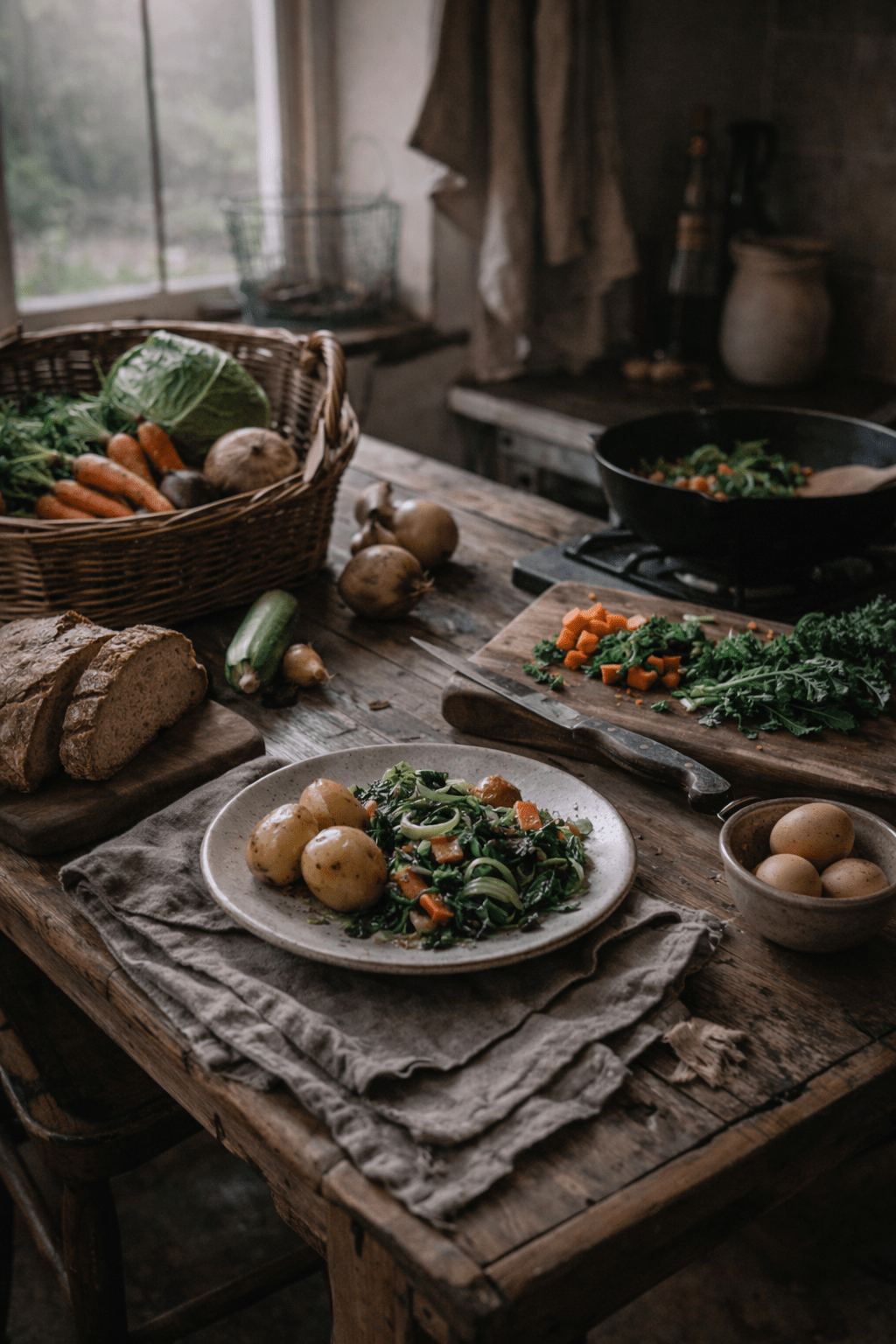
| Eating Without Certainty Certainty used to do a lot of work for us. Meals were planned around expectation rather than availability. Shopping lists assumed continuity. Recipes assumed access. If something was missing, it was an inconvenience rather than a condition. You adjusted once and moved on. Eating without certainty feels different. It asks questions earlier and more often. What’s actually here? What will last? What can be swapped without loss? What matters, and what was habit pretending to be a need? Gardens introduce this way of eating gently. Most people just didn’t notice until now. Certainty shaped how we cook. Much of modern cooking is built on the idea of reliable inputs. Recipes are precise because the system behind them is precise. Ingredients arrive standardised, interchangeable, and on demand. That precision produces confidence. You know what dinner will be before you start. You know what it should taste like. You know roughly how long it will take. When certainty loosens, that confidence wobbles. Suddenly, the question isn’t how to cook something, but whether it makes sense to cook it at all. You begin to cook in response rather than in advance. The cupboard speaks before the recipe does. This isn’t a loss of skill. It’s a different skill. Gardens teach flexible hunger. One of the most practical lessons gardening offers is that appetite is adaptable. You don’t crave tomatoes when none are ready. You stop imagining salads in February. You eat what grows, and the body follows more readily than we tend to admit. Eating without certainty brings that lesson indoors. Meals become anchored to what exists rather than what was planned. Not in a chaotic way, but in a responsive one. You begin to recognise patterns of sufficiency rather than ideals of completeness. A meal does not need to feel finished to be enough. The myth of the “proper meal” There’s a deeply ingrained assumption that a meal must conform to a certain shape. Protein, carbohydrate, and vegetable. Hot, plated, recognisable. Deviate too far, and it starts to feel provisional, like something temporary or inferior. That idea holds surprisingly little weight once certainty fades. Gardens quietly dismantle the notion of the “proper meal.” You eat odd combinations because that’s what’s ready. You snack from beds. You assemble rather than compose. None of this feels like deprivation when it’s familiar. It only feels uncomfortable when expectation outpaces reality. Eating without certainty reveals how much of our discomfort around food is cultural rather than physical. Less planning, more readiness There’s a common belief that uncertainty demands more planning. In practice, it often demands less. Rigid plans break easily. Flexible readiness holds. Gardeners tend not to plan meals around specific harvest dates. They plan for harvests. There’s a difference. One is prescriptive; the other is adaptive. You keep certain staples. You know what combines well. You understand which foods carry meals and which merely decorate them. When something is missing, the structure remains. This isn’t about stockpiling. It’s about familiarity. People who eat without certainty don’t spend less time thinking about food — they spend less time being surprised by it. Substitution as a form of literacy Substitution is often framed as a compromise. A second-best option. A failure to get the right thing. In practice, substitution is literacy. Knowing what can stand in for what. Understanding which flavours matter and which textures can move. Recognising when something is essential and when it’s incidental. Gardening sharpens this literacy because substitution begins in the soil. One crop fails, another fills the space. The system doesn’t insist on sameness; it values contribution. Eating without certainty rewards the same approach. Meals become less about replication and more about balance. When food becomes quieter One unexpected effect of eating without certainty is that food becomes less performative. When meals are no longer designed to meet fixed expectations, they no longer need to impress. They serve their purpose and move on. This doesn’t make food joyless. It makes it calmer. Pleasure shifts from novelty to adequacy. From spectacle to satisfaction. From perfect outcomes to reliable nourishment. That shift can feel like a loss if you’re attached to the display. It feels like relief if you’re tired of managing expectations. The role of acceptance Eating without certainty requires acceptance — but not resignation. Acceptance that not every meal will be ideal. That variety ebbs and flows. That repetition is not failure. That simplicity is not a moral position, just a condition. Gardens normalise this acceptance because they don’t offer alternatives on demand. You eat what’s there, or you wait. Neither option is framed as defeat. When that mindset moves into the kitchen, eating becomes steadier. Less emotionally charged. Less freighted with anxiety about doing it “right”. You begin to trust your ability to adapt. Living well with fewer guarantees Eating without certainty doesn’t mean eating poorly. It means eating honestly. Honest about the season. Honest about availability. Honest about what matters most. Calories before novelty. Sustenance before style. For many people, this shift arrives not as hardship but as a quiet recalibration. A sense that meals are doing their job without demanding constant attention. Gardens have always eaten this way. They offer what they can, when they can, without apology. Learning to eat alongside them — rather than ahead of them — may turn out to be one of the more useful skills of the years ahead. |
| About our writing & imagery Many of our articles are written by us, drawing on real experience, reflection, and practical work in gardens and places we know. Some pieces are developed with the assistance of AI as a drafting and research tool. Featured images may include our own photography, original AI-generated imagery, or—where noted—images kindly shared by other creators and credited accordingly (for example, via Pixabay). All content is shaped, edited, and published by Earthly Comforts, and the views expressed are our own. |

