| A 5-Part Series |
| A curated exploration of Britain’s most iconic, curious, and ecologically important insects |
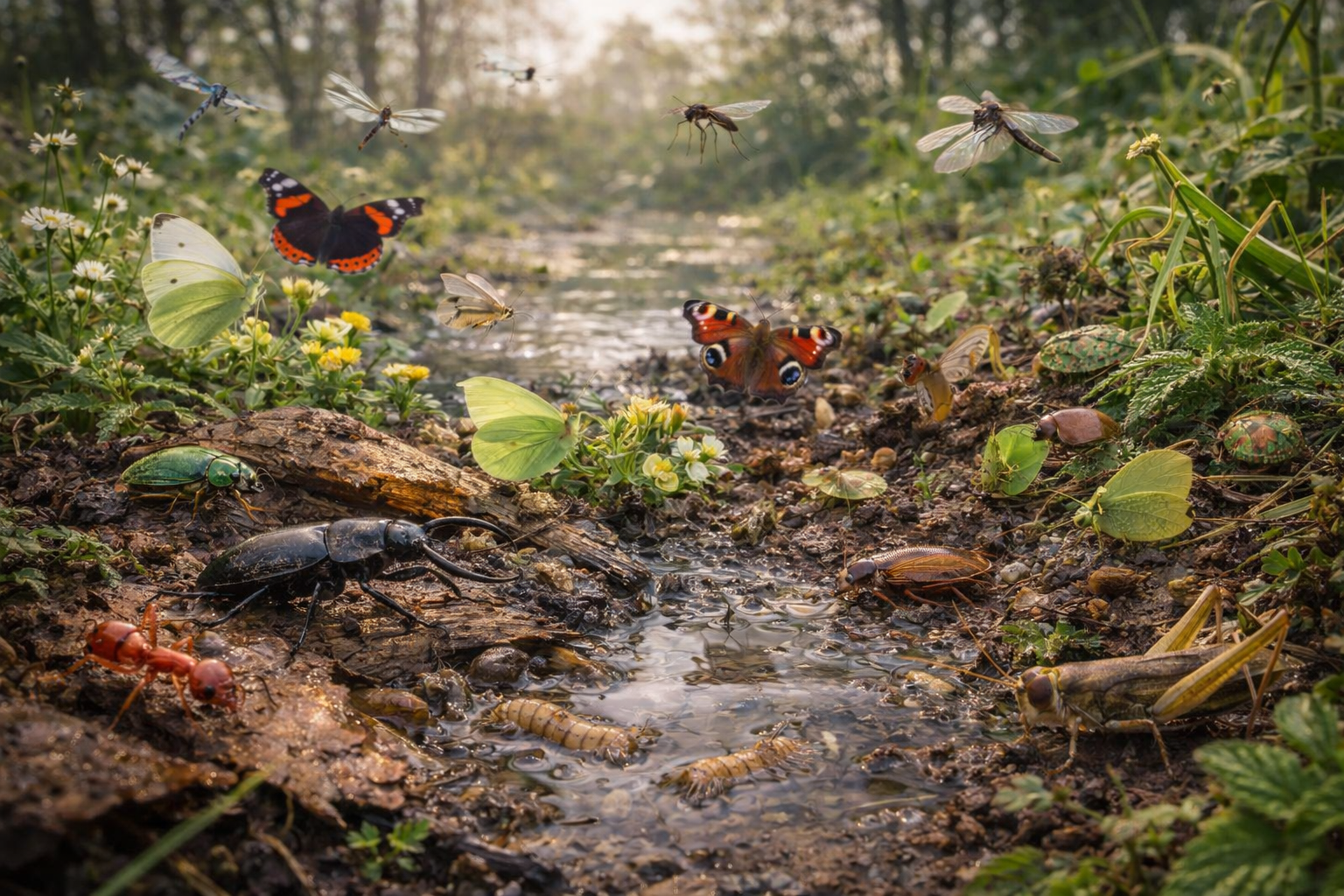
| Part 5 Cicadas, True Bugs & Predators: A Quieter Ending The UK lacks the dramatic cicada choruses associated with warmer parts of the world. There are no deafening summer walls of sound, no sudden seasonal eruptions that dominate the landscape. Yet sound, shape, and stealth still play an important role in Britain’s insect life — expressed more subtly, more locally, and often more fleetingly. Where other climates announce insect abundance, Britain tends to murmur. Its insects operate in narrower windows of warmth, quieter habitats, and smaller populations, shaped by cool seasons and fragmented landscapes. This does not make them less important — only easier to overlook. Shield bugs, often referred to as stink bugs, are among the most noticeable of Britain’s true bugs, not because they move quickly or arrive in large numbers, but because they defend themselves chemically. When disturbed, they release strong-smelling compounds that deter predators and make handling unpleasant. This reliance on deterrence rather than escape reflects a broader survival strategy seen across many British insects — endurance through defence rather than speed. Their colours vary widely, from muted browns and greens that blend into foliage, to bright, contrasting patterns that serve as warning signals. These visual cues are part of a language understood by birds and other predators: this is not worth eating. Shield bugs feed on plant sap, and while some species can cause local damage, they are part of long-established plant–insect relationships rather than recent intrusions. Leafhoppers are far smaller, but far more numerous. Often unnoticed unless disturbed, they move through grass, hedgerows, and crops at a constant, rapid pace. Their ability to feed efficiently on plant fluids and to jump instantly when threatened makes them well-adapted to exposed environments. Ecologically, leafhoppers occupy an important middle ground. They transfer energy from plants to higher-level consumers, supporting a wide range of predators, from spiders and beetles to birds. Their abundance means that even small changes in their populations can ripple outward, affecting species that rely on them as food. Aphids sit even lower in the public imagination, often viewed only as garden pests. Yet they are among the most significant insects in terms of energy transfer. Feeding on plant sap, they convert plant growth into a form that is easily consumed by other insects. Ladybirds, hoverfly larvae, lacewings, parasitic wasps, and many birds depend heavily on aphids, particularly during breeding seasons when protein demands are high. Aphids also produce honeydew, which feeds ants and supports fungal and microbial communities. Their rapid reproduction makes them sensitive to environmental change, but also ensures they remain a reliable food source. In ecological terms, they are less a problem than a foundation. Dragonflies and damselflies bring a presence entirely different. Found near rivers, ponds, canals, and wetlands, they represent precision, speed, and control. Their large eyes, powerful flight muscles, and agile wings make them some of Britain’s most effective aerial predators. They feed on flying insects, including midges and mosquitoes, helping to regulate populations around water. Their life cycle bridges aquatic and terrestrial systems: larvae develop underwater for months or years before emerging as adults. This dual existence ties the health of waterways directly to insect populations on land. Where dragonflies are abundant, it is usually a sign of clean water and intact wetland habitats. Praying mantids are not native to Britain, and their appearances remain rare and irregular. When they do occur, usually as isolated individuals, they attract attention precisely because they feel out of place — larger, slower, and more deliberate than most local insects. Their presence is often linked to warmer conditions and accidental introduction, but increasingly, it also reflects shifting climate patterns. As temperatures rise and seasons lengthen, species once confined to southern Europe occasionally appear further north. Mantids are not yet part of Britain’s ecological fabric, but their occasional arrival serves as a reminder that insect boundaries are not fixed. The quiet stability of British insect life is now intersecting with change. In Britain, insect life rarely shouts. It moves cautiously, emerges briefly, hides often, and persists year after year in the margins — hedgerows, damp ground, sheltered banks, and patches of unmanaged land. The story that emerges is not one of spectacle or dominance, but of continuity. Of species adapting to narrow windows of opportunity, surviving cold winters, and coexisting with long-altered landscapes. It is a quieter ending, but not a lesser one. In the restrained lives of cicadas, bugs, and predators, Britain’s insect world reveals its defining trait: quiet persistence. |
| Epilogue — The Small Lives That Hold the Land The insects of Britain rarely demand attention. They do not arrive in overwhelming numbers, nor do they dominate landscapes through size or spectacle. Instead, they persist — season after season, generation after generation — woven quietly through soil, hedgerows, grassland, woodland, and water. Across this series, a pattern emerges. British insects are shaped by restraint. By cooler temperatures, shorter summers, and landscapes that have been managed, divided, and reused for centuries. Survival here has favoured adaptability over abundance, patience over speed, and continuity over dramatic expansion. Ants, bees, and wasps form the infrastructure — stabilising soils, pollinating plants, and regulating other insects. Butterflies and moths respond quickly to change, reflecting shifts in climate, land use, and plant diversity with delicate precision. Beetles, grasshoppers, and crickets work closer to the ground, breaking down organic matter, supporting food webs, and filling the countryside with sound only when conditions allow. Flies, roaches, and other overlooked species manage decay and transition, preventing systems from stalling. Cicadas, true bugs, and predators bring the series to a quieter close, revealing how much of Britain’s insect life operates below the threshold of notice. Together, they form a living system that does not announce itself, but endures. What becomes clear is that British insects do not exist in isolation. Their lives are tightly bound to human choices — how land is managed, how much is tidied, which plants are allowed to grow, and which habitats are left intact. Small changes accumulate. Hedgerows removed, wetlands drained, dead wood cleared, or grass cut too short can unravel processes that took decades to establish. The decline of insects is often discussed in abstract terms, measured in statistics and trends. Yet on the ground, it is experienced as absence. Fewer sounds in summer. Less movement in long grass. Empty flowers. Silent evenings near water. This series is not a call to nostalgia, nor a catalogue of loss. It is an invitation to attention. To notice what remains, what persists quietly, and what depends on restraint rather than intervention. In a landscape shaped by centuries of use, insects remain among the most honest indicators of balance. They respond quickly, recover slowly, and tell the truth about the land’s condition. To care for Britain’s insects is not to seek spectacle, but to allow space — for mess, for decay, for continuity, and for time. The smallest lives, after all, are the ones that hold everything else together. |
Unless stated, featured images are my own work, created independently or with the assistance of AI.

