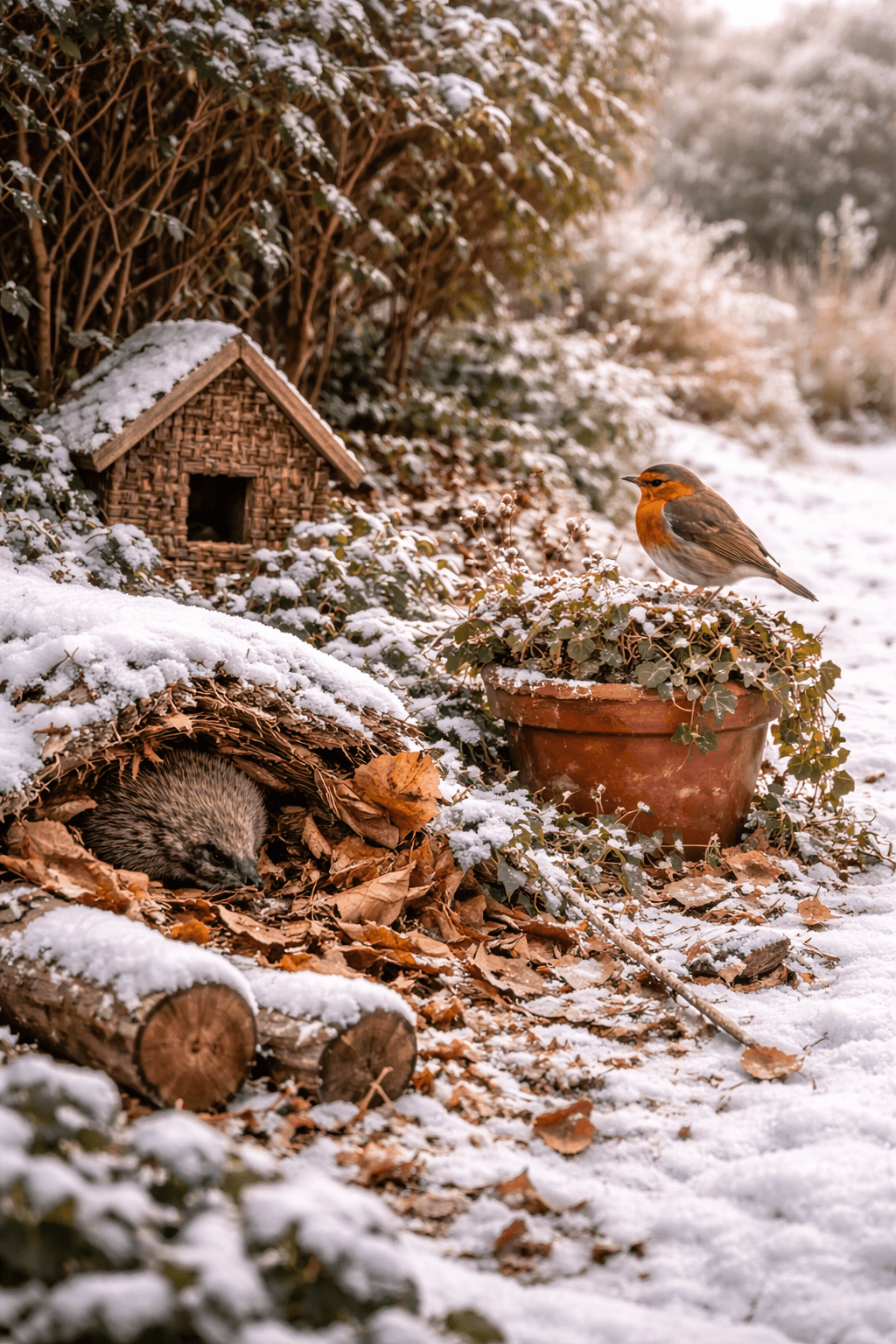
| Who stays, who sleeps, and who struggles Winter often gives the impression that the garden has emptied. Leaves have fallen. Growth has slowed. Birds seem quieter. The soil looks still. To human eyes, it can feel as though life has retreated elsewhere, waiting for spring to return. But winter is not an absence. It is a different way of being present. Beneath leaf litter, inside hedges, under sheds, within soil and bark, the garden is full of lives navigating the hardest season of the year. Some remain active. Some slow themselves almost to nothing. Some depend entirely on the choices made months earlier. Watching winter wildlife is not about spotting movement — it is about understanding how survival works when visibility disappears. |
| The residents who stay awake Many garden animals remain active throughout winter, adapting their behaviour rather than retreating. Birds such as robins, wrens, blackbirds, and sparrows do not migrate. Instead, they: Reduce energy use Rely on familiar territories. Seek shelter close to food sources. Become more sensitive to disturbance. Wrens, in particular, face winter as a test of endurance. Cold, wet weather can be devastating for such small birds. Their survival often depends on dense hedges, ivy, old nests, and sheltered corners where they can roost communally and conserve warmth. Insects, too, are present — just less visible. Many beetles, spiders, and larvae remain active beneath leaf litter or within soil, continuing the slow work of decomposition even as temperatures drop. |
| Those who sleep through the cold For some species, winter is survived by stepping almost entirely out of time. Hedgehogs hibernate. Frogs and toads bury themselves in mud or compost. Many insects overwinter as eggs, larvae, or pupae. Metabolism slows. Movement stops. Survival becomes a matter of insulation and stability. Hibernation is not a deep, unbroken sleep. Animals may wake during warmer spells, especially in milder winters, searching for food before returning to dormancy. This makes winter increasingly unpredictable — and potentially dangerous — as climate patterns shift. A garden that appears quiet may be supporting dozens of sleeping lives, relying on shelter that must remain intact for months. |
| The importance of winter shelter Winter survival depends less on food than on protection. Shelter provides: Insulation from frost Protection from predators Stable temperatures Moisture control Leaf piles, log stacks, compost heaps, dense hedges, long grass, ivy, and undisturbed soil all become vital winter structures. Removing them in autumn or winter strips away the very places animals depend on to survive until spring. This is why winter wildlife support often begins in earlier seasons — through what is left rather than what is added. |
| The quiet role of the garden In winter, gardens function less as feeding grounds and more as refuges. Food sources are limited. Insects are scarce. Plants offer little growth. What matters most is familiarity — known routes, known shelters, known cover. Animals that survive winter often do so because they do not need to search for new territory. They rely on gardens that remain stable, predictable, and relatively undisturbed. Sudden changes — heavy clearing, major pruning, or soil disturbance — can be far more disruptive in winter than in any other season. |
| Winter is not a reset button. It is tempting to view winter as a pause — a time when nothing much happens, and the garden can be freely reshaped. But winter is not a blank slate. It is a holding phase. What exists in winter determines what appears in spring. A garden stripped bare in winter may look neat, but it often enters spring depleted — fewer insects, fewer birds, fewer signs of continuity. By contrast, gardens that carry winter forward — leaves still present, stems standing, corners intact — tend to wake more fully when warmth returns. |
| Who struggles most Winter is hardest on the smallest and the young. Late broods. Underweight animals. Insects that failed to find suitable shelter. Hedgehogs that entered hibernation without enough fat reserves. Birds are weakened by repeated cold snaps. These losses are rarely visible. They are felt later, as absences rather than events. Winter wildlife watch is not about rescuing every life. It is about understanding vulnerability — and recognising that survival is often decided quietly, long before spring. |
| The value of stillness Perhaps the most important thing a winter garden can offer is stillness. Reduced intervention allows: Sleeping animals are to remain undisturbed. Insects to complete overwintering stages Soil life to stabilise Energy to be conserved In winter, doing less is often doing more. This does not mean abandoning care, but shifting its focus — from shaping to safeguarding, from action to awareness. |
| Seeing winter differently Once you begin to think of winter as a season of hidden life rather than emptiness, the garden changes. A pile of leaves becomes a refuge. An uncut hedge becomes insulation. An untouched corner becomes a promise of return. Winter wildlife does not ask to be seen. It asks only to be allowed through. |
| Carrying winter into spring When spring arrives, it does not start from nothing. It builds on what survived. Birdsong returns because birds endured. Insects emerge because the shelter is held. Growth accelerates because the soil was fed slowly through the cold months. Winter is not the opposite of life. It is the foundation of it. And a garden that understands winter as part of its living rhythm will always greet spring more fully than one that rushes to erase it. |
| This completes the Life in the Garden — A Wildlife Series for UK Gardens spring journey, carrying awareness from the first stirrings of life to the quiet endurance that makes renewal possible. |

