| Notes from the ground, with muddy boots on |
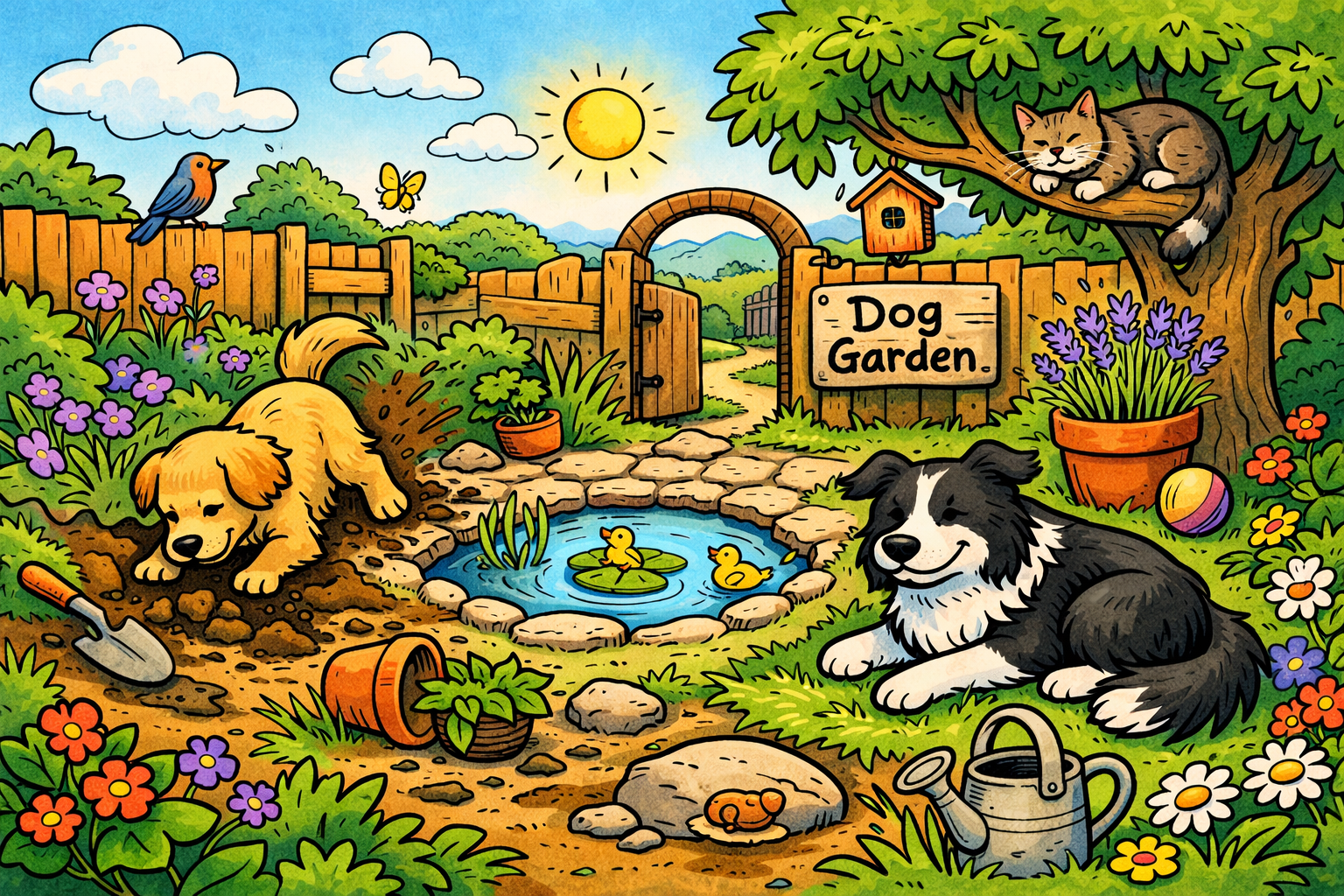
| A garden shared with a dog is never quite still. Even when the animal is asleep somewhere warm, the garden bears their imprint: a compressed arc of lawn where they run the same loop each evening, a patch of earth newly ventilated by enthusiasm, a gate that has been leaned against often enough to remember a shoulder. This is not damage in the abstract sense. It is used. And use, in a living space, is not a flaw so much as a conversation. Most people who ask about dog-friendly gardens begin with anxiety. What plants are safe? How do I stop the digging? Will the lawn ever recover? These are sensible questions, but they are framed by an assumption that the garden should remain as it was, only with a dog added to it, like a new piece of furniture. In practice, the opposite is true. A dog does not arrive in a garden; the garden becomes something else entirely. I have worked in gardens with dogs for years now—spaniels that believe every border hides treasure, elderly retrievers who move slowly but lean heavily, lurchers who appear from nowhere at speed, terriers whose relationship with soil is philosophical rather than practical. Over time, patterns emerge. Not rules exactly, but tendencies. The land adapts. So does the gardener, if they are paying attention. What follows is not a guide, or a checklist, or a promise of harmony. It is an attempt to describe what actually happens when a garden is honestly shared with an animal that does not recognise ornamental intent, only comfort, curiosity, and routine. |
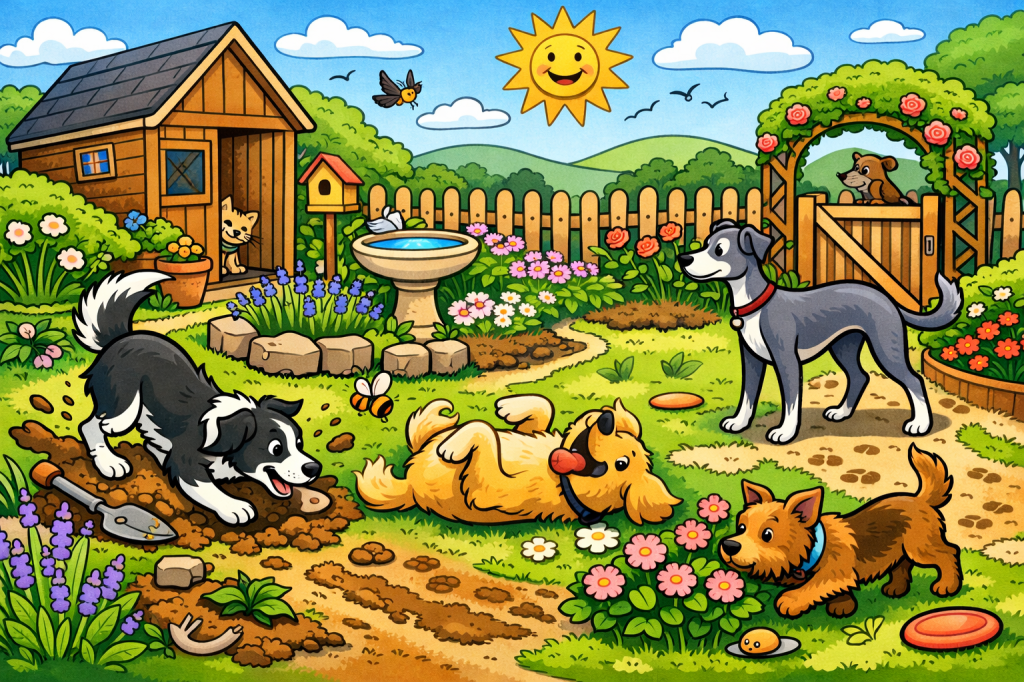
| The garden as territory, not display Dogs experience gardens first as territory and second as landscape. This seems obvious until you watch how often design choices work against it. A dog will walk the boundary before anything else, nose tracing the edge, checking continuity. They are less interested in the centre than the edges: fences, hedges, walls, gates. The places where inside meets outside, where something might change. Many gardens are designed from the centre outward, with a lawn as the primary visual anchor and borders arranged for colour and texture. Dogs invert this logic. They read the perimeter first and daily. Over time, the grass wears thin, not because the dog dislikes lawns, but because they are following a line that makes sense to them. It is the same line, always. The typical response is to fight this: re-seed, re-turf, scold, fence off. Sometimes that works temporarily, but often it simply creates friction. A more durable approach is to accept the perimeter as a working route. In some gardens I maintain, this has resulted in a kind of informal track—a slightly firmer, slightly shorter ring of grass or groundcover that looks intentional once you stop pretending it shouldn’t be there. The rest of the lawn often recovers on its own, relieved of constant traffic. This is one of the quiet shifts that makes a garden dog-friendly without ever naming itself as such. It is less about accommodation than recognition. Soil remembers pressure Digging is usually framed as a behavioural problem, something to be corrected or prevented. But digging is rarely random. Dogs dig where the soil gives way easily, where it smells interesting, or where moisture collects. In other words, they dig where the ground already has a story. In gardens with heavy clay, digging is less common, not because dogs behave better on clay, but because clay resists. In lighter soils, particularly those improved with compost or leaf mould, the ground is more inviting. It yields. It smells alive. A dog, especially a young one, reads that as a possibility. I have noticed that the most persistently dug areas are often those we have recently worked: freshly turned beds, newly planted shrubs, places where the soil is loose and rich. From the dog’s perspective, this is not vandalism. It is engagement. Over time, I have become less inclined to blame the dog and more inclined to adjust timing and texture. Mulches that knit together quickly—woodchip, bark, even well-rotted compost—tend to discourage repeated excavation simply by settling. Bare soil invites interaction. Covered soil suggests completion. There is also an honesty required here. A garden that is always in flux will attract attention from animals that notice change. If you are a gardener who enjoys constant tweaking, a dog may force you to slow down, to finish things correctly, or at least to accept that unfinished ground is a shared temptation. The garden as territory, not display Dogs experience gardens first as territory and second as landscape. This seems obvious until you watch how often design choices work against it. A dog will walk the boundary before anything else, nose tracing the edge, checking continuity. They are less interested in the centre than the edges: fences, hedges, walls, gates. The places where inside meets outside, where something might change. Many gardens are designed from the centre outward, with a lawn as the primary visual anchor and borders arranged for colour and texture. Dogs invert this logic. They read the perimeter first and daily. Over time, the grass wears thin, not because the dog dislikes lawns, but because they are following a line that makes sense to them. It is the same line, always. The typical response is to fight this: re-seed, re-turf, scold, fence off. Sometimes that works temporarily, but often it simply creates friction. A more durable approach is to accept the perimeter as a working route. In some gardens I maintain, this has resulted in a kind of informal track—a slightly firmer, slightly shorter ring of grass or groundcover that looks intentional once you stop pretending it shouldn’t be there. The rest of the lawn often recovers on its own, relieved of constant traffic. This is one of the quiet shifts that makes a garden dog-friendly without ever naming itself as such. It is less about accommodation than recognition. Soil remembers pressure Digging is usually framed as a behavioural problem, something to be corrected or prevented. But digging is rarely random. Dogs dig where the soil gives way easily, where it smells interesting, or where moisture collects. In other words, they dig where the ground already has a story. In gardens with heavy clay, digging is less common, not because dogs behave better on clay, but because clay resists. In lighter soils, particularly those improved with compost or leaf mould, the ground is more inviting. It yields. It smells alive. A dog, especially a young one, reads that as a possibility. I have noticed that the most persistently dug areas are often those we have recently worked: freshly turned beds, newly planted shrubs, places where the soil is loose and rich. From the dog’s perspective, this is not vandalism. It is engagement. Over time, I have become less inclined to blame the dog and more inclined to adjust timing and texture. Mulches that knit together quickly—woodchip, bark, even well-rotted compost—tend to discourage repeated excavation simply by settling. Bare soil invites interaction. Covered soil suggests completion. There is also an honesty required here. A garden that is always in flux will attract attention from animals that notice change. If you are a gardener who enjoys constant tweaking, a dog may force you to slow down, to finish things correctly, or at least to accept that unfinished ground is a shared temptation. Lawns are working surfaces, not carpets. Few elements of the garden cause more quiet despair than the lawn, particularly when dogs are involved. There is an expectation—often inherited rather than chosen—that grass should be uniform, soft, unmarked. Dogs dismantle this illusion quickly. Urine scorch, wear patterns, winter mud, summer dust. These are not signs of failure so much as evidence that the lawn is being used as intended, albeit not solely by humans. The problem arises when we insist on a standard that no longer fits the role the lawn is playing. In gardens with dogs, lawns function more like commons than showpieces. They are spaces for movement, for lying down, for rolling, for waiting. Grass species that tolerate this—those with deeper roots, slower vertical growth, a willingness to spread laterally—fare better in the long run than those selected for appearance alone. There is also a seasonal rhythm that becomes more pronounced. Winter lawns will suffer. They always have. Trying to maintain summer perfection through winter use is a losing battle. Accepting seasonal roughness and allowing areas to rest or thin without panic often leads to stronger recovery in spring. One of the quiet pleasures of gardening with dogs is learning to read lawns less emotionally. To see them as surfaces in flux rather than statements of competence. This is liberating, though it takes time. Shade, rest, and the overlooked value of doing nothing Dogs spend a surprising amount of time not moving. They choose spots carefully: a cool patch in summer, a sunny corner in winter, a place with a view of the gate. These resting places shape gardens just as much as movement does. I have seen dogs compact soil simply by lying in the same place each afternoon. Over time, these spots become part of the garden’s architecture. Attempts to remove them—by planting, fencing, or redirecting—often fail unless an equally appealing alternative exists. This has taught me to think differently about shade and shelter. A dog-friendly garden is not one filled with activity zones, but one with places to pause. Trees matter here, not just as features but as providers of temperature regulation. So do walls, hedges, and structures that break wind or hold warmth. There is also a lesson for gardeners in this attentiveness to rest. Dogs are excellent judges of where the garden feels balanced and calm. Where it makes sense to stop, watching where they choose to lie can reveal more about microclimates than any diagram. Boundaries are both emotional and physical. Fences, gates, hedges. These are often discussed in terms of containment, but for dogs, they also carry emotional weight. A secure boundary reduces vigilance. An insecure one increases it. In gardens where boundaries are sound, dogs settle more easily. They patrol less. They bark less. They rest more deeply. This has knock-on effects for the garden itself. Reduced stress means less frantic movement, less pacing, and less wear in specific spots. It is tempting to see boundaries as purely functional, but they shape behaviour. A low fence that a dog can see through may look open and friendly to a human, but to a dog, it can feel perpetually unresolved. Something is there, but not quite blocked. This can lead to repeated checking, jumping, or leaning. More solid boundaries—whether hedge, wall, or fence—tend to calm the space. This does not mean turning gardens into fortresses. It means understanding that clarity is often kinder than ambiguity. Living with trade-offs, not chasing perfection The most important thing a dog teaches a gardener is how to live with trade-offs. You cannot have every plant you admire. You cannot maintain every surface at peak condition. You cannot control every interaction. What you gain instead is a garden that is genuinely inhabited. One that shows signs of a relationship rather than performance. Muddy patches that mark favourite routes. Bent stems that recover. Grass that grows back unevenly but persistently. There is a particular kind of satisfaction in this, though it is rarely advertised. It suits those who see gardening as stewardship rather than display. As an ongoing negotiation rather than a finished product. I have worked in gardens where dogs were treated as problems to be managed, and in gardens where they were treated as part of the ecology. The latter are not always tidier, but they are almost always more relaxed. The people, too. The quiet reward of shared space In the end, a dog-friendly garden is not defined by what it prevents, but by what it allows. It allows movement without constant correction. It allows rest without disturbance. It allows the gardener to stop fighting every sign of use and start reading them instead. This does not mean abandoning care. On the contrary, it requires attentiveness. You notice patterns sooner. You intervene more thoughtfully. You plan with an eye not just to growth, but to behaviour. There is a moment, usually after a few years, when the garden and the dog seem to agree with one another. The dog knows where it can go without consequence. The garden has adjusted accordingly. Nothing is perfect, but everything functions. That moment is not achieved through products or prescriptions. It emerges over time through observation and a willingness to let the garden be a place where life happens, not just where it is arranged. For a working gardener, this is familiar territory. Gardens are never static. Dogs make that truth harder to ignore—and, if you let them, easier to accept. |
| About our writing & imagery Most articles reflect our real gardening experience and reflection. Some use AI in drafting or research, but never for voice or authority. Featured images may show our photos, original AI-generated visuals, or, where stated, credited images shared by others. All content is shaped and edited by Earthly Comforts, expressing our own views. |

