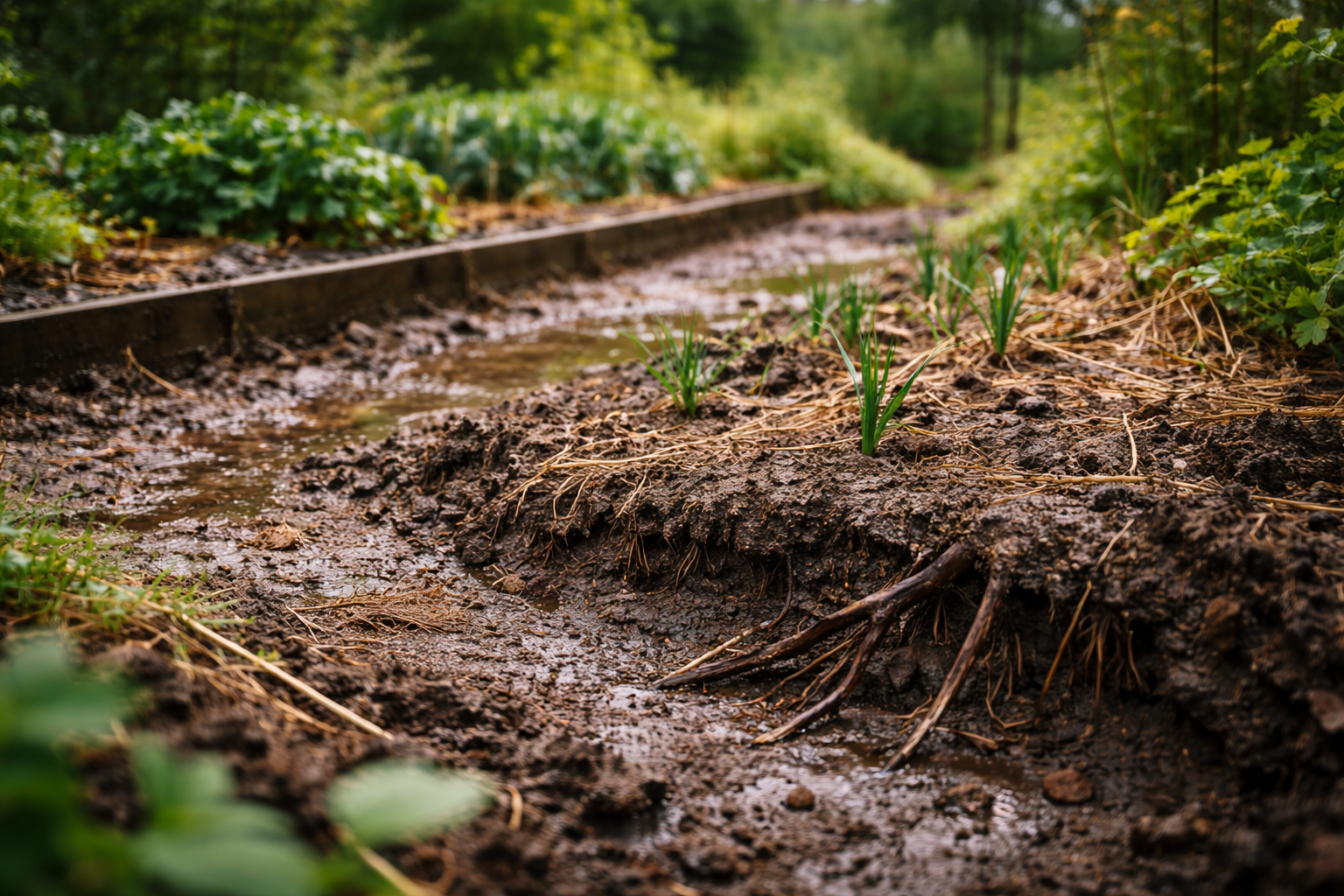
| Flooding, soil life, and what winter quietly left behind |
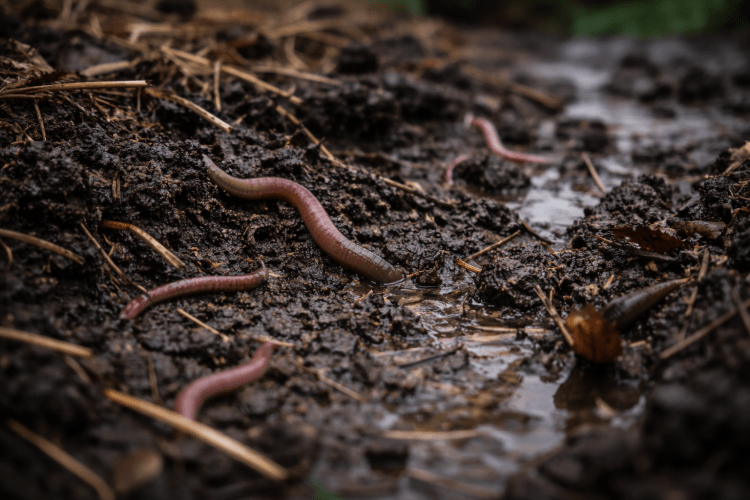
| Looking back at this past winter, the rain did not feel dramatic. There were no biblical scenes, no sandbags stacked at cottage doors, no riverbanks giving way in the night. What we had instead was persistence—weeks of it. The kind of rain that does not shock you — it simply refuses to leave. Now, in June, with lawns growing and borders beginning to fill out, the effects are becoming clearer. What appeared at the time to be temporary saturation is revealing itself in subtler ways. Patches of turf that have not quite recovered. Shrubs that seem slower than they should be. Soil that feels heavier underfoot, even on dry mornings. Winter rarely announces its long-term consequences. It simply presses itself into the ground and waits. As gardeners, we often think of flooding as an event — something visible and finite. Yet the more meaningful changes tend to occur out of sight. Soil is not damaged in one dramatic gesture; it shifts by degrees. Structure loosens or collapses. Biology slows. Air disappears from spaces where it once moved freely. And so what we are observing now, in early summer, is not a seasonal fluctuation. It is the after-effect of prolonged saturation. Soil After Saturation Healthy soil contains as much air as it does solid matter. Those invisible spaces allow roots to breathe and microbes to function. During winter, those spaces are filled with water. Oxygen levels fell. The soil effectively held its breath for extended periods. In June, we see what that breathlessness meant. In some gardens, recovery has been swift. Sandy or well-structured loams rebound quickly once temperatures rise. But in heavier clay soils — common across Kent and much of the South East — recovery is slower. The ground feels tighter. Less friable. More reluctant to open. There is a temptation to attribute this simply to “wet weather” and move on. But prolonged saturation does more than dampen soil. It alters its internal architecture. Clay particles disperse when fully waterlogged. Aggregates weaken. When the ground is then walked on — even lightly — those particles compress more easily. What looked like temporary softness becomes gradual compaction. And compaction does not shout. It accumulates. Earthworms in a Wetter Pattern One of the quieter signs this spring has been a reduction in visible worm activity in certain gardens. Not everywhere — but enough to notice. Earthworms tolerate rain perfectly well. What they struggle with is extended oxygen deprivation throughout the soil profile. When burrows remain flooded for prolonged periods, worms surface. Some survive. Some do not. Reproduction slows. By late spring, lawns that once showed abundant casts may show fewer. Borders feel heavier. Mulch remains longer on the surface before being drawn down. This is not a crisis. Worm populations are resilient. But they are also foundational. Their burrows form drainage pathways. Their castings stabilise the structure. Their presence signals biological health. When activity dips, drainage slows. When drainage slows, saturation persists longer. The pattern reinforces itself. In June, we begin to understand what winter costs. Delayed Root Stress Many plants endured the winter without visible complaint. It is only now, in active growth, that subtler stress becomes apparent. Roots require oxygen. In saturated soils, oxygen diffusion slows dramatically. Fine feeder roots are the first to suffer. The plant survives, but its capacity is reduced. A hedge that should be dense by now may appear thinner in places. A shrub may leaf out, but without its usual vigour. Lawns may look serviceable yet lack resilience under light wear. This is not a disease in the dramatic sense. It is a reduced function. And reduced function is harder to spot than obvious failure. Nutrients That Drifted Another common assumption is that heavy rain washes nutrients away and can be corrected with feeding. There is some truth to that — nitrates are mobile and may leach beyond shallow root zones. But the more subtle shift is in balance. Anaerobic conditions change how elements behave in soil. Iron and manganese become more soluble. Nitrogen cycles stall. Microbial exchange slows. In June, the result can be pale or hesitant plants despite feeding. It is not always a deficiency of input; sometimes it is a deficiency of soil function. The answer is rarely more products. It is time, oxygen, and biological rebuilding. A Shift in Practice This year has quietly reinforced several working principles. We have been slower to move onto saturated ground, even when the diary is tight. The long-term cost of compacting wet soil outweighs the inconvenience of delay. We have prioritised steady additions of organic matter rather than corrective interventions. Compost and leaf mould buffer structure gradually. They invite biology back. We have paid closer attention to planting choices in areas that repeatedly hold water. Some species cope better with fluctuating moisture than others. Adaptation feels more sensible than resistance. None of this feels dramatic. It feels considered. Not a One-Off Event If this were a singular winter, the soil would likely recover entirely in time. But rainfall patterns are shifting. It is not only the total rainfall that matters, but its concentration—long dry spells followed by intense downpours place alternating stress on soil systems. In that context, what we observed this winter is fewer anomalies and more patterns. The gardener’s role shifts accordingly. We are not simply maintaining surfaces. We are stewarding living systems that respond to climate as much as care. A Quieter Understanding June is a revealing month. Growth exposes both strength and weakness. What endured winter lightly now moves forward confidently. What struggles begin to show? Flooding does not always leave visible scars. It leaves adjustments. Slight losses in structure. Subtle dips in worm activity. Reduced root depth. Slower drainage. None of these is catastrophic. All are cumulative. The soil held its breath through winter. Now, in early summer, we are listening to how it exhales. And the work is not to panic, nor to rush correction, but to rebuild steadily. To protect the structure. To encourage biology. To tread lightly. The rain has passed. The consequences remain, but so does the soil’s remarkable capacity to recover — if we allow it. |
| About our writing & imagery Most articles reflect our real gardening experience and reflection. Some use AI in drafting or research, but never for voice or authority. Featured images may show our photos, original AI-generated visuals, or, where stated, credited images shared by others. All content is shaped and edited by Earthly Comforts, expressing our own views. |

