| A 5-Part Series |
| A curated exploration of Malaysia’s most iconic, curious, and ecologically important insects |
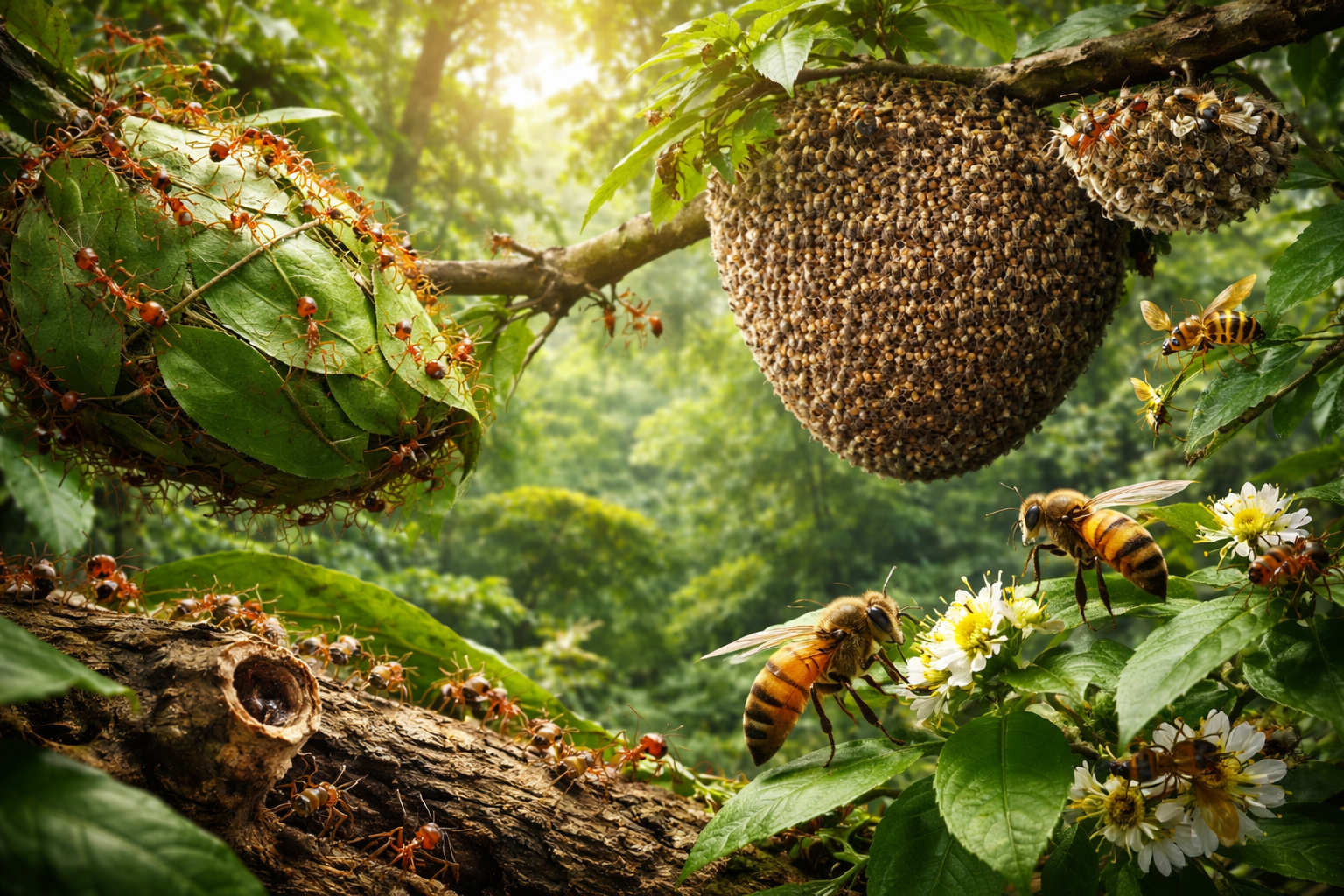
| Part 1 Ants, Bees & Wasps: Order in the Humidity In Malaysia, insect life does not pause or retreat. There is no winter reset, no dormant season to thin populations or slow biological momentum. Instead, life unfolds continuously, governed by rainfall patterns, humidity levels, and the physical structure of forests themselves. Growth, decay, reproduction, and predation overlap at all times, creating a living system that is busy, layered, and densely interconnected. Within this constant motion, ants, bees, and wasps act as some of the most important organising forces, bringing structure and regulation to environments that can otherwise appear unruly. Ants dominate the forest floor. Their trails cut invisible highways through leaf litter, roots, and fallen branches. In tropical forests where plants shed material year-round, waste accumulates rapidly. Ant colonies respond by breaking down fallen leaves, dispersing seeds, and recycling organic matter at a remarkable speed. This activity prevents forest floors from smothering themselves under their own productivity. What looks like disorder is, in reality, highly managed by countless small workers operating in coordination. Weaver ants are among the most visible examples of this organisation. Their leaf nests hang from branches, pulled together and stitched using silk secreted by their larvae. These aerial structures house aggressive colonies that actively defend territory. By reducing herbivorous insect numbers in the canopy, weaver ants influence which plants can flourish. Their presence can shape tree health, leaf density, and even the success of nearby crops, making them both ecological regulators and unintentional agricultural allies. Carpenter ants work at a slower, less visible pace. They excavate dead wood, hollowing out fallen trunks and decaying branches. This process speeds up decomposition and prevents forests from becoming rigid or clogged with material that no longer serves a living function. By weakening old structures, carpenter ants help make room for new growth, keeping forests flexible rather than fixed. Above and beyond the ants, bees add another layer of order. Stingless bees thrive across forest edges, villages, and cultivated land. They pollinate a wide range of plants, from jungle trees to fruit crops, often unnoticed. Their honey, produced in modest quantities, reflects the immediate landscape — a distilled record of local flowering plants and seasonal variation. Giant honeybees operate on a different scale altogether. Their exposed combs, suspended from tall trees or cliff faces, contain thousands of individuals. These bees travel vast distances each day, crossing rivers, farms, and fragmented forest patches. In doing so, they link habitats that would otherwise remain ecologically isolated. Paper wasps complete this system. Their open nests cling to branches, roofs, and walls, placing them directly alongside human activity. As predators, they respond quickly to population surges of other insects, helping prevent outbreaks that could destabilise local systems. In Malaysia, ants, bees, and wasps are not background life forms. They are active regulators, maintaining balance hour by hour in a landscape that never truly rests. |
| About our writing & imagery Many of our articles are written by us, drawing on real experience, reflection, and practical work in gardens and places we know. Some pieces are developed with the assistance of AI as a drafting and research tool. Featured images may include our own photography, original AI-generated imagery, or—where noted—images kindly shared by other creators and credited accordingly (for example, via Pixabay). All content is shaped, edited, and published by Earthly Comforts, and the views expressed are our own. |

