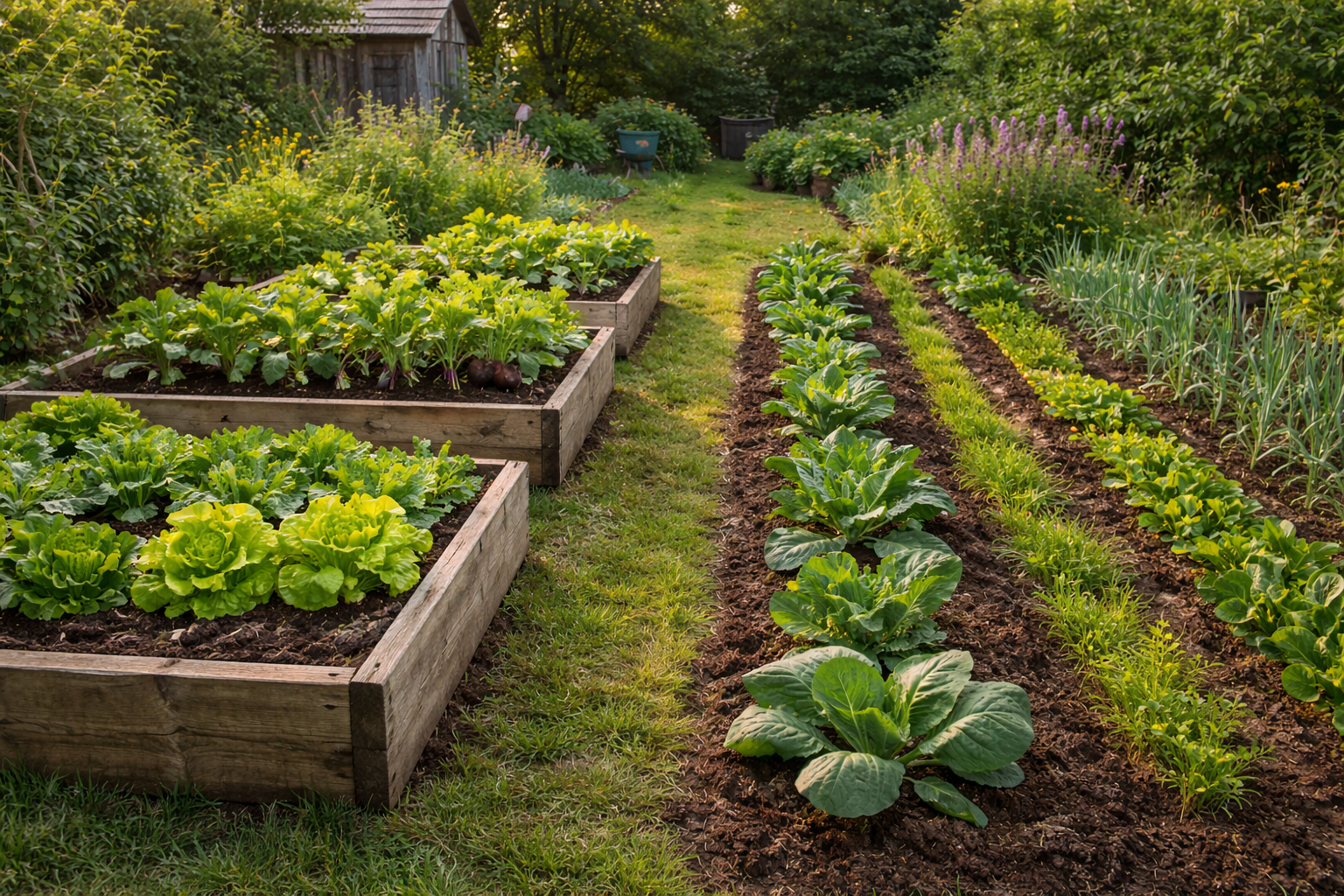
| Choosing What Truly Suits Your Garden |
| There is a quiet tension in modern vegetable gardening that rarely gets spoken about plainly. It surfaces in allotments, on social media, in garden design plans, and even in conversations with clients. The question arises sooner or later: Should I build raised beds, or grow directly in the ground? It is often framed as though one method were enlightened and the other outdated. Raised beds are presented as efficient, tidy, and progressive. Direct planting into native soil is sometimes treated as old-fashioned, labour-heavy, or naïve. Yet when you step away from fashion and look at the soil itself, the debate softens. Neither method is inherently superior. Both succeed, and both fail. The real difference lies in context — in soil type, drainage, climate, budget, scale, and temperament. The garden does not respond to ideology. It responds to conditions. |
| The Appeal of Raised Beds Raised beds offer something psychologically reassuring: definition. Timber-edged rectangles impose order on space. They create clarity where previously there may have been patchiness. In town gardens, especially, where lawns are removed, and vegetable growing begins for the first time, raised beds feel decisive. They say, “This is intentional.” Practically, they solve certain problems immediately. In heavy clay soil — and we have no shortage of that in parts of Kent — drainage can be transformative. By lifting the growing medium above the surrounding ground, you create air pockets, warmth, and freedom for roots that might otherwise sit in cold, dense earth until late spring. Water drains more readily. Soil warms earlier. Crops like courgettes, beans and cucumbers gain momentum faster. There is also the matter of compaction. Because raised beds are clearly bounded, gardeners tend not to step on them. Over time, this preserves structure. Roots encounter less resistance. Earthworms and microbial life work in soil that is not repeatedly compressed underfoot. From a working gardener’s perspective, raised beds also provide predictability. You know exactly where your growing area begins and ends. You can manage irrigation and compost distribution efficiently. For clients with limited mobility, the slight elevation reduces bending. For smaller gardens, particularly those built on old patios or poorly prepared ground, raised beds let you skip years of soil rehabilitation and start with something workable. All of this is real. Raised beds are not a gimmick. They are a practical response to particular conditions. The Hidden Costs of Control But control always comes at a price. Raised beds require materials. Timber, metal, brick — none of it is free, and none of it lasts forever. Softwood rots. Metal corrodes. Compost settles and must be replenished. Filling a single large bed with high-quality growing medium requires a significant volume. Multiply that across a garden, and the cost rises quickly. There is also the matter of water. The same improved drainage that protects roots in winter accelerates drying in summer. In dry spells — and we are seeing longer ones — raised beds often demand more consistent irrigation. The soil mass is shallower and more exposed to wind and sun. If watering is erratic, plants feel it sooner. In exposed sites, raised beds can also cool rapidly at night. While they warm quickly in spring sunshine, they lose that warmth just as fast once temperatures fall. In-ground soil, with greater mass and depth, often buffers these swings more effectively. Ecologically, raised beds can sometimes fragment soil systems. If your native soil is fundamentally healthy, isolating crops into constructed compartments may be unnecessary. Soil thrives on continuity. Fungal networks and microbial systems extend horizontally and vertically beyond the bounds of a timber frame. Raised beds offer clarity and speed. But they are not inherently more “natural” or sustainable. They are tools, not solutions. The Strength of Direct-to-Ground Growing Direct planting into the ground lacks visual drama. There are no crisp edges or new materials. It is quieter work. But in many gardens, it is entirely sufficient. When soil is gradually improved with compost and organic matter, it becomes remarkably productive. Roots travel deeply and laterally without constraint. Moisture remains more stable through summer because the surrounding earth acts as a reservoir and regulator. Crops such as parsnips, carrots, squash and even sweetcorn often perform better when their roots can explore without encountering wooden boundaries. In-ground beds also avoid construction. There is no timber to replace, no structural decay to monitor. Compost is added directly to the soil surface, drawn down by worms and weather over time. The improvement becomes cumulative rather than compartmentalised. From a soil-health perspective, direct planting maintains continuity. Fungal hyphae are not interrupted by frames. Microbial communities move freely. There is less separation between cultivated space and the surrounding ecology. For larger plots or allotments, direct growing scales naturally. You can expand without multiplying cost or infrastructure. The earth itself becomes the framework. And perhaps most importantly, direct growing demands patience. Soil that is initially poor can be rehabilitated steadily. Organic matter improves structure. Mulching protects the surface. Over seasons, heavy clay becomes workable; sandy soil gains resilience. Improvement is gradual but lasting. Where Direct Growing Struggles Yet it would be disingenuous to pretend that native soil always cooperates. Some gardens sit on compacted subsoil. Others suffer from decades of neglect. Heavy clay can remain saturated through winter and late into spring. In such cases, direct planting exposes weaknesses immediately. Seeds rot. Roots stall. The gardener becomes frustrated. Weeds may be more persistent in unstructured ground, particularly in areas previously lawned or unmanaged. Without clear bed boundaries, foot traffic can slowly compact soil again unless discipline is maintained. Direct growing requires confidence in soil improvement. It is slower to correct severe problems. Where contamination or rubble lies beneath the surface, raised beds can offer a safer, cleaner alternative. As with raised beds, the method itself is not inherently superior. It is conditional. Climate and the Changing Pattern of Weather One of the quieter influences on this debate is our shifting climate. Wetter winters followed by erratic springs and longer dry spells complicate simple answers. Raised beds handle heavy winter rainfall well. Excess water drains quickly. Roots avoid suffocation. But in prolonged summer heat, those same beds dry rapidly and demand vigilant watering. In-ground beds, conversely, may struggle in saturated months but offer moisture stability during drought. Neither approach insulates you from climate variability. Both require adaptation. In low-lying gardens prone to standing water, raised beds are a practical choice. In high, exposed plots where wind strips moisture quickly, ground-level planting may prove steadier. The “best” method is therefore geographical. It shifts with rainfall patterns, soil type, and exposure. Labour, Longevity and Temperament There is also a human dimension. Raised beds front-load labour. You design, build, fill, and then maintain. Direct planting distributes labour across years. You improve gradually rather than construct immediately. Some gardeners enjoy carpentry, structure, and visible transformation. Others prefer to work with what is already present, adjusting rather than replacing. Raised beds offer predictability. Direct growing offers flexibility. The question becomes less about horticulture and more about how you prefer to work. Do you favour defined spaces and controlled inputs? Or open soil and incremental change? Both approaches can be productive. But each suits a different temperament. Accessibility and Design Considerations Accessibility deserves honest attention. Raised beds can reduce bending and create clearly navigable paths. For gardeners with limited mobility, this can make the difference between continuing to grow food and giving up entirely. However, accessibility can also be achieved through thoughtful path design in ground-level systems — wide, stable paths, stepping stones, and careful bed spacing. Raised beds are not the only route to ergonomic gardening, though they can help. Design plays a role as well. In small urban gardens, raised beds create order and containment. In larger, rural settings, direct planting may feel more harmonious with the surrounding landscape. Aesthetic preference should not be dismissed. A garden must feel right to its caretaker. A False Binary What becomes increasingly clear, after years of working in varied gardens, is that the debate is often falsely binary. You might grow salad crops and herbs in raised beds for convenience and warmth, while planting potatoes and squash directly into the ground where space allows. You might rehabilitate one section of poor soil with raised beds while steadily improving the rest. Purity of method is unnecessary. Gardens evolve. What begins as raised beds may eventually merge into improved ground. What starts as direct planting may incorporate raised structures when drainage is required. Flexibility is more useful than allegiance. So, Which Is Best? The most honest answer remains: the one that responds to your soil and your life. If your ground drains poorly, if spring arrives late and cold, or if contamination or rubble lies beneath the surface, raised beds offer immediate relief. If your soil is already workable or can be improved, if the budget is limited, and if you prefer connection to native earth, direct planting is entirely sound. A raised bed filled with neglected compost performs poorly. Native soil enriched steadily with organic matter can outperform the most beautifully constructed box. Method sets the stage. Care determines the outcome. Closing Reflections Gardening trends rise and fall. Raised beds gained popularity because they solve genuine problems. Direct growing persists because it remains fundamentally effective. Rather than asking which method is superior, it is wiser to observe your own ground. Watch how water behaves after rain. Notice when the soil warms in spring. Consider your physical comfort and available time. The soil will often tell you more than any trend. Whether raised or grounded, the principles remain the same: improve structure with compost, avoid compaction, water consistently, and rotate crops thoughtfully. Healthy soil matters more than the frame around it. In the end, raised beds and direct planting are not opposing philosophies. They are tools. The real work lies beneath them — in the soil itself. |
| About our writing & imagery Most articles reflect our real gardening experience and reflection. Some use AI in drafting or research, but never for voice or authority. Featured images may show our photos, original AI-generated visuals, or, where stated, credited images shared by others. All content is shaped and edited by Earthly Comforts, expressing our own views. |

