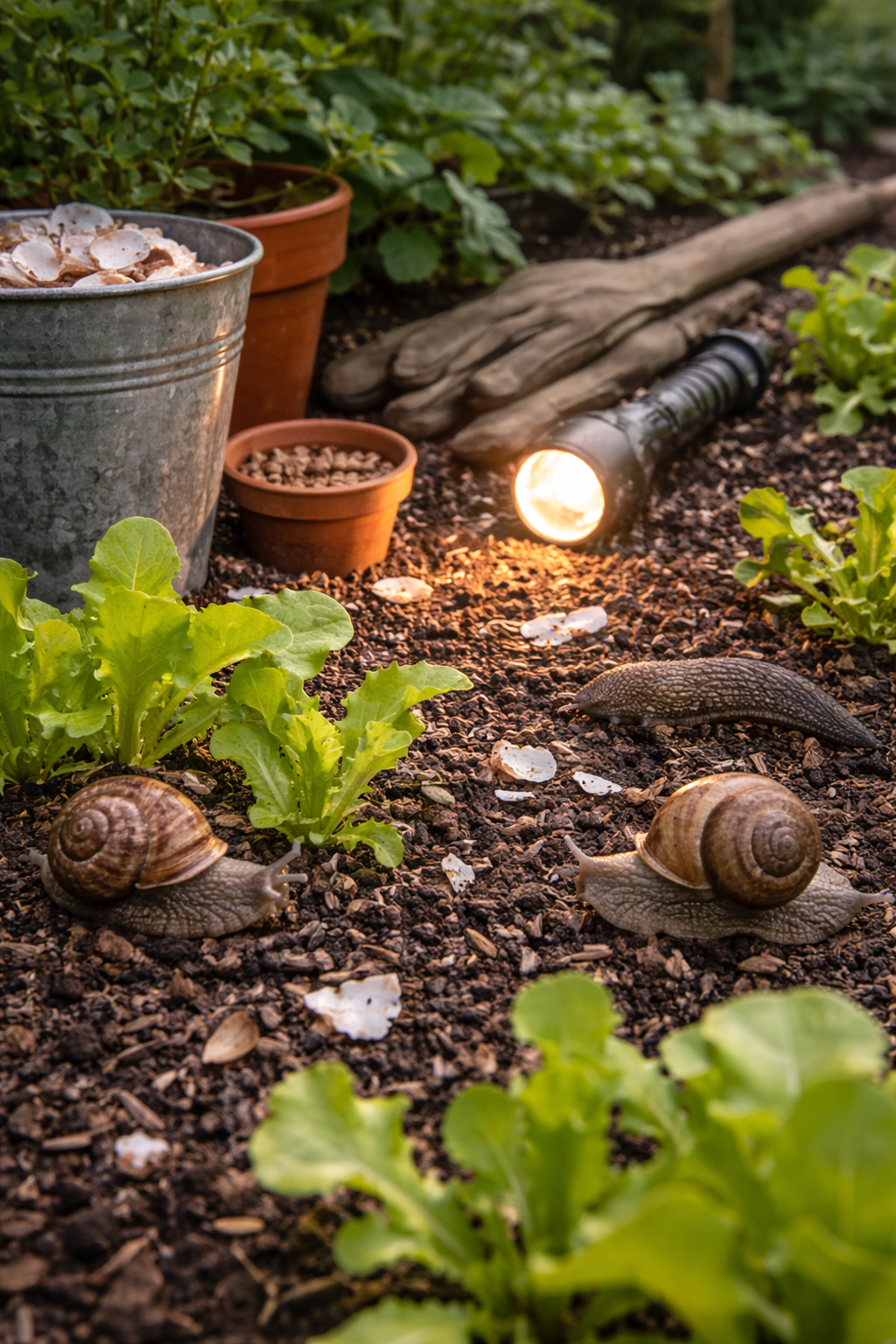
| Certain moments in gardening feel disproportionately personal. You step outside in the early morning, coffee still warm in your hand, and there it is: a row of newly planted lettuce reduced to lace. Hostas stripped to translucent ribs. Dahlias chewed with casual precision. It is rarely rabbits. Rarely do deer appear in town gardens. More often, it is the slow, silvered work of slugs and snails. Few subjects in gardening stir quite so much frustration. And yet, after enough seasons, I have come to see that dealing with slugs and snails is less about eradication and more about balance. You will not win outright. The aim is not annihilation. It is management with perspective. Slugs and snails are not intruders in a garden. They are residents. |
| Understanding the Conditions Slugs and snails thrive in damp, mild conditions. The UK offers both with generous regularity. Recent years of wetter winters followed by warm springs have created ideal breeding conditions in many regions. A mild February can lead to an energetic March. Before reaching for remedies, it is worth asking a quieter question: what in the garden is encouraging them? Dense groundcover, heavy mulching, debris left undisturbed through winter—all provide habitat. That is not inherently wrong. A wildlife-friendly garden supports complexity. But complexity includes molluscs. The key is to understand that population spikes are often environmental responses. A wet autumn. A gentle winter. A warm, still spring evening. Blaming the slug alone obscures the bigger pattern. The Myth of Total Control There is a persistent belief that, with the right method—be it pellets, beer traps, copper tape, crushed eggshells, nematodes, or sheep’s wool—you can eliminate slugs. In decades of gardening, I have never seen this achieved sustainably. What I have seen is this: gardens where slugs are present but do not overwhelm. Gardens where damage is occasional rather than catastrophic. Gardens where intervention is measured and responsive rather than frantic. The difference lies not in a miracle cure, but in a layered strategy. Cultural Controls First The simplest adjustments often yield the most reliable results. Water in the morning rather than the evening. Damp soil overnight is an invitation. Avoid overwatering in general; lush, overfed growth is particularly attractive. Clear dense hiding places near vulnerable seedlings in early spring. Lift pots occasionally to remove sheltering clusters. Remove decaying debris selectively around high-risk crops, such as lettuce and hostas. None of this eradicates slugs. It simply reduces favourable conditions at key moments. And timing matters. Protect seedlings when they are most vulnerable. Once plants are established and stems toughen, damage becomes cosmetic rather than fatal. Encouraging Predators A garden that supports frogs, toads, beetles, birds, and hedgehogs rarely suffers unchecked slug damage. Creating habitat—small log piles, undisturbed corners, shallow water sources—encourages natural predation. It does not remove the need for vigilance, but it shifts the dynamic from solitary defence to ecological balance. Ground beetles, in particular, are quiet allies. They hunt at night, precisely when slugs are active. Encouraging soil health and avoiding broad-spectrum pesticides supports these hunters. It is worth remembering that many creatures feed on slugs. The challenge is not their existence, but their dominance. Barriers and Deterrents Copper tape wrapped around pots can deter snails in some contexts, though results vary. Sharp grit or wool pellets may deter crossing temporarily but require maintenance. Raised beds can reduce access slightly, but slugs climb. Beer traps capture some individuals, but they rarely affect the overall population significantly. They are labour-intensive and somewhat grim. Iron phosphate pellets, when used sparingly and in accordance with guidance, are less harmful to non-target wildlife than older formulations. But they should be part of a broader strategy, not the first reflex. The quiet truth is that deterrents often work best in combination and when deployed thoughtfully, not reactively. Choosing What to Protect One lesson learned over time is the importance of strategic tolerance. Not every plant needs defending equally. Sacrificial planting can absorb attention. Let certain perennials tolerate minor damage while focusing protection on food crops and young seedlings. Some plants are naturally more resilient. Alliums, foxgloves, euphorbias, many Mediterranean herbs—these are rarely the first targets. Interplanting more vulnerable species with tougher companions can reduce visibility and attractiveness. Lettuce sown in modules and transplanted once sturdy stands a better chance than direct-sown seed in cold, wet soil. In essence, resilience can be built into design. The Role of Soil Health Healthy soil produces sturdier plants. Plants under stress—waterlogged, nutrient-poor, or weakly rooted—are more susceptible to damage. Improving soil structure with compost, avoiding compaction, and ensuring adequate drainage strengthen growth. While this does not repel slugs directly, it improves a plant’s ability to recover from grazing. A chewed leaf on a vigorous plant is an inconvenience. On a struggling seedling, it is terminal. Soil improvement is often overlooked in slug discussions, yet it significantly shapes outcomes. Night Patrols and Perspective There is a particular kind of determination that leads gardeners outside at dusk with a torch. Hand-picking slugs is effective in the short term. It reduces numbers quickly in concentrated areas. It is also a reminder that gardening sometimes involves confrontation. But even here, perspective matters. A few evenings of vigilance during peak vulnerability can spare weeks of frustration. Endless nightly patrols rarely prove necessary once plants are established. The aim is not to wage war indefinitely. It is to guide the balance at critical points. A Shift in Expectation Perhaps the most helpful reframing is this: perfection is not the goal. A garden without any slug damage is either highly controlled or short-lived. A leaf nibbled at the edges does not represent failure. It represents participation in a larger ecosystem. For food crops, of course, tolerance has limits. Yet even there, modest damage rarely ruins harvests entirely. The desire for untouched foliage can become disproportionate. Gardens are not sterile spaces. Recent Conditions and Ongoing Vigilance Mild winters across much of the UK in recent years have contributed to increased slug survival rates. Warmer, wetter springs extend breeding cycles. This is not anecdotal; it is observable across many gardens. As climate patterns shift, slug management may require earlier attention each year—February monitoring rather than waiting until April. Protective measures are in place before seedlings emerge. Adaptation, rather than outrage, becomes the productive response. Closing Reflections Dealing with slugs and snails is less about aggression and more about stewardship. Reduce favourable conditions. Support predators. Protect the vulnerable when necessary. Improve soil health. Accept minor damage as part of the system. You will never eliminate them. Nor should you attempt to. Gardening, at its most balanced, is an ongoing negotiation. And sometimes that negotiation leaves a silver trail across the path in the morning light—a reminder that you share the space. |
| About our writing & imagery Most articles reflect our real gardening experience and reflection. Some use AI in drafting or research, but never for voice or authority. Featured images may show our photos, original AI-generated visuals, or, where stated, credited images shared by others. All content is shaped and edited by Earthly Comforts, expressing our own views. |


Yes, we’ve been in a drought for a while here in Virginia but I understand all of this too well. Thank you for your thoughtfulness. The beer traps are grim but useful along with some other measures. Good luck to you!
LikeLike
Good morning, my apologies for the delay in getting back to you – comments keep disappearing from the directory. Globally with shifting the climate becoming irregular we have seen huge population increases in all sorts of bugs, critters and creatures. Winters becoming too wet, allow slugs and the like to mass populate which makes all of our lives challenging. Hey ho, life is never dull 🙂
LikeLiked by 1 person