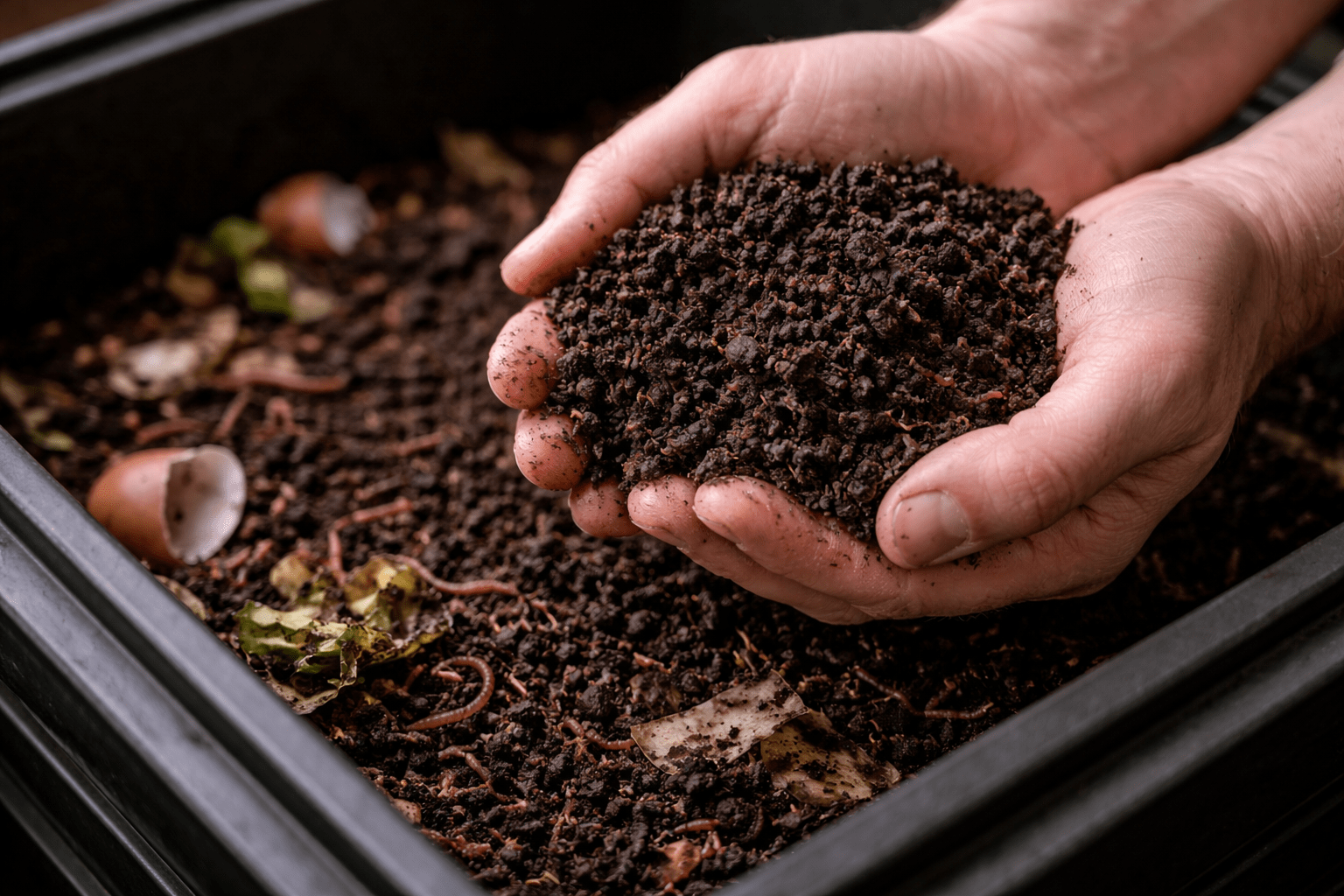
| Castings Worm castings arrive quietly. There’s no moment where a bin announces they’re ready, no clear line between bedding and outcome. They accumulate slowly, often unnoticed, until one day you realise the material in front of you no longer looks like what you put in. That slowness is part of why castings are so often misunderstood. People expect them to behave like a product. In reality, they’re a residue of a living process, shaped as much by restraint as by activity. One of the most common assumptions is that castings should look impressive. Dark, fine, uniform — preferably abundant. When they don’t meet that expectation, people worry something has gone wrong. But castings vary enormously depending on what’s been fed, how long material has remained in the bin, and how often the system has been disturbed. A bin that’s been left largely alone tends to produce castings that are crumbly and coherent, holding together without clumping. A heavily managed bin often produces material that looks finished but behaves poorly once used, breaking down unevenly or compacting too quickly. Texture tells you more than colour ever will. Good castings feel alive in the hand. They hold moisture without feeling wet, fall apart without dusting, and smell neutral — not rich, not sweet, not sour. There’s a temptation to read sweetness as fertility, but sweetness usually signals fermentation rather than stability. Castings that smell of very little are often the ones that integrate best into soil, because they’ve already passed through the most volatile stages of decomposition. There’s also the question of quantity, which is where expectations tend to drift furthest from reality. Worm farms are often set up with the idea that castings will accumulate steadily and visibly, something you can harvest on a schedule. In practice, castings form in waves. Activity slows in cold weather. It dips after disturbance. It rises when feeding and moisture align. Trying to harvest on a timetable rather than in response to the bin’s state usually leads to premature removal, which weakens the system rather than improving it. Harvesting itself is another point of tension. The desire to collect castings can override the needs of the worms, particularly in smaller bins where most of the material is still active. Removing too much at once strips the bin of structure and microbial continuity. Worms rely on existing castings as much as fresh bedding; they provide familiarity, buffering, and a stable environment. A bin repeatedly harvested to look tidy often becomes harder to manage over time, not easier. Once castings leave the bin, a second set of assumptions takes hold. They’re often treated as a fertiliser, something to be applied generously in the hope of visible results. But castings are not a feed in the conventional sense. They don’t push growth; they support processes. Used sparingly, they improve structure, microbial activity, and moisture retention. Used heavily, especially in containers or already rich soils, they can tip systems out of balance. More is not better. Appropriate is better. This is where comparisons with compost usually arise. People want to know which is superior, as if one must replace the other. Compost and castings do different work. Compost brings bulk, carbon, and long-term structure. Castings bring intimacy — close contact with roots, microbes, and fine soil particles. One doesn’t outperform the other so much as complement it. In many gardens, compost does the heavy lifting, and castings quietly fine-tune what’s already there. Expecting castings to carry the whole system places an unnecessary burden on both the worms and the gardener. There’s also an unspoken pressure to justify the effort of keeping worms by producing something visibly valuable. Castings become proof that the system is worth the trouble. That pressure can distort how they’re used. In reality, some gardens barely need them. Established soils, well-managed compost, and perennial plantings may show little response at all. That’s not failure. It’s context. Worm farming doesn’t guarantee dramatic outcomes; it offers subtle support where it’s needed. Over time, most experienced keepers become less concerned with harvesting and more concerned with continuity. They take small amounts when it makes sense, return unfinished material to the bin, and accept that some castings will always remain where they were made. The system stays stable. The worms stay settled. The output becomes secondary to the process. Castings are best understood not as a reward, but as a by-product. They appear when conditions allow and diminish when they don’t. Trying to force their production usually leads to disappointment. Allowing them to accumulate at their own pace builds systems that last. In that sense, castings reflect the wider lesson of worm farming itself: value emerges most reliably when you stop trying to extract it. |
| About our writing & imagery Many of our articles are written by us, drawing on real experience, reflection, and practical work in gardens and places we know. Some pieces are developed with the assistance of AI, used as drafting and research tools rather than as a voice or authority. Featured images may include our own photography, original AI-generated imagery, or—where noted—images kindly shared by other creators and credited accordingly (for example, via Pixabay). All content is shaped, edited, and published by Earthly Comforts, and the views expressed are our own. |

