| Part 16 |
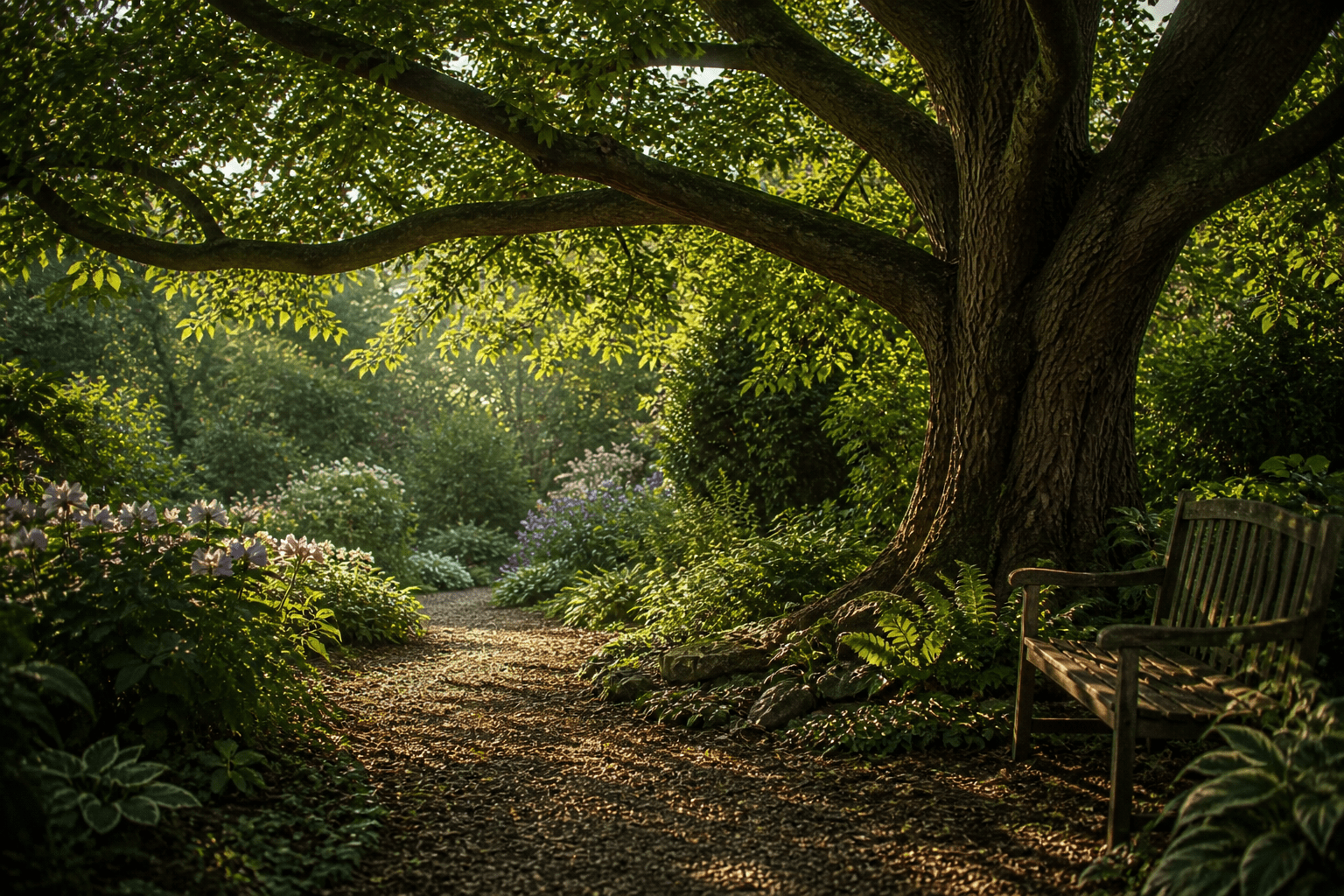
| By the time you have worked long enough within the patterns that shape a garden—those beneath the surface, those that pass through it, and those carried forward through habit—it becomes increasingly clear that not all presence within the space is experienced in the same way. Much of what has been observed suggests activity that operates beyond immediate control, shaping the garden in ways that are not always fully visible or fully understood. But alongside this, there are moments when a different kind of presence emerges, one that neither resists understanding nor entirely resolves into it. It is often a tree that introduces this shift, not simply because of its scale, but because of how it occupies the space. Trees shape conditions within a garden through their influence on light, soil, and movement, but occasionally one alters how the space is experienced beyond its physical characteristics. This is not a matter of age or size in isolation, though these factors contribute. A mature tree holds a level of stability that younger planting does not, and its presence is established in a way that does not shift with seasonal change. But the distinction here is not just in how long the tree has been there, but in how it is encountered. There are trees that dominate a space, casting dense shade and limiting what can exist beneath them, and there are trees that recede, allowing the garden to develop around them without imposing too strongly on the conditions. And then there are those who seem to hold the space in a more balanced way, neither restricting it nor dissolving into it. Working around such a tree feels different, even as tasks remain the same. The ground may present root competition and varying moisture, and the canopy may affect planting, but neither fully defines the experience. It feels as though the garden is arranged in relation to the tree, even unconsciously. This becomes apparent in the way movement shifts around the tree. Paths may curve slightly to accommodate its presence, or seating may be positioned to acknowledge the space it creates. These decisions are not always made with the tree as the central focus, but they tend to align with it, as though the garden’s structure has adapted over time to the conditions it creates. The result is not a space that feels constrained, but one that feels organised in a way that does not require explicit definition. Reading the space changes, too. Under these trees, light variation softens rather than obscures, creating depth without relying on contrast. The ground may be uneven, planting layered, but overall, there is continuity, not fragmentation. The eye moves smoothly, and the garden feels cohesively unified. Clients respond to these trees less for practical reasons and more for their effect on the space. They may call them focal points, or prefer spending time near them, often without knowing why. The space feels more settled and complete, even if not defined by symmetry or control. From a practical perspective, these trees are managed in much the same way as others. They are maintained, assessed for health, and, where necessary, adjusted to ensure they continue to function within the garden. But the approach tends to be more measured, not because the tree requires less attention, but because its presence is understood as something that should be worked with rather than altered unnecessarily. The aim is not to reshape the tree to fit a particular design, but to allow the design to accommodate the tree while maintaining the balance it creates. Nothing here can be explained by the interaction of structure, light, and growth. The tree shapes its surroundings, which respond in turn. Yet some trees consistently produce effects beyond simple description. The conditions are measurable; the response is not always fully captured by them. In contrast to the patterns that have been observed elsewhere—the circles that form without intention, the paths that are not yours, the changes that arrive overnight—this presence does not introduce uncertainty. It does not suggest hidden or difficult-to-trace activity, but rather a form of stability amid the garden’s broader variability. It is not static, as the tree continues to grow and change over time, but it provides a point of reference that shifts less than other elements. This introduces a different kind of balance. The space is defined by processes beyond direct observation and by elements that provide continuity. The tree does not control the garden, but it holds it in a way that makes the system easier to navigate. Over time, this becomes recognised rather than analysed. These trees stand out not by species or condition, but by how they shape space. Their presence brings a sense of completeness by establishing relationships among elements. And within that relationship, the garden moves further from the idea of a space maintained solely for observation. It becomes something experienced as a whole, not just through its individual parts, but through the way those parts are brought together. |
| About our writing & imagery Most articles reflect our real gardening experience and reflection. Some use AI in drafting or research, but never for voice or authority. Featured images may show our photos, original AI-generated visuals, or, where stated, credited images shared by others. All content is shaped and edited by Earthly Comforts, expressing our own views. |

