| What the Garden Has Always Suggested |
| If film tends to hint at woodland presence through atmosphere, then literature often does so in a quieter, still way. It does not need to show anything directly, nor does it rely on visual cues to suggest that a place holds more than its surface. Instead, it works through language, memory, and perception, allowing the idea of woodland folk to settle gradually rather than declare itself. In many cases, these books are not about fairies or spirits in any literal sense. Some are, certainly, but the ones that endure tend to operate closer to the edge—where landscape begins to feel significant in ways that are not entirely explained, and where human experience is shaped by something that sits just beyond it. What follows is not a list of fantasy stories in the usual sense, but ten books that engage with invisible presences similar to those traced in your series. They approach woodland folk not as literal beings but as powerful metaphors for how landscapes shape human experience—central to the thesis that meaning often emerges not from the seen, but from the barely noticed dynamics between person and place. |
| The Magic Faraway Tree It would be difficult not to begin here. Still, The Magic Faraway Tree needs to be approached carefully. As a child, the idea is simple enough: a tree that leads somewhere else, changing with each visit. But read later, it becomes less about the lands at the top and more about the tree itself—the sense that something rooted in one place might hold access to something not immediately visible. It does not hold as reality, but the feeling of it lingers longer than the story. |
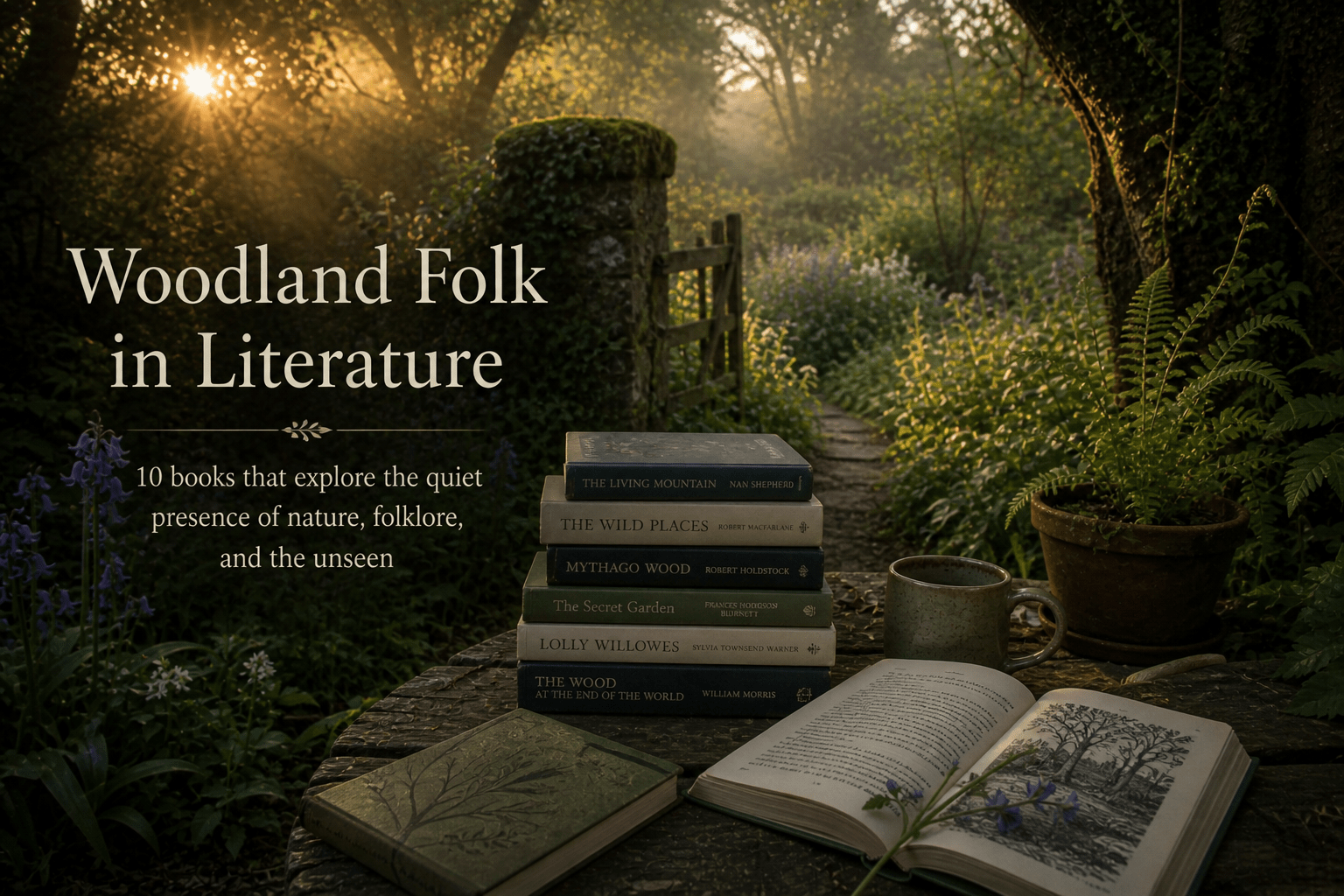
| The Secret Garden There is nothing supernatural here—and that is precisely why it matters in this context. The garden restores, changes, and settles those who enter it, but without explanation. It behaves differently, not because it is magical, but because it holds a set of conditions that allow for change to occur. It reflects the quieter side of woodland folklore—the idea that certain spaces carry something not immediately visible but consistently felt. |
| The Wood at the End of the World This is a more traditional folklore landscape, grounded in the land itself. The woods are not just a setting, but a condition that shapes what happens within them. Movement through the space is deliberate, and the sense of being within something older than the characters is constant. It captures the idea that woodland presence need not be directly visible to influence behaviour. |
| Lolly Willowes The next example is a quieter, more grounded work that still sits firmly within this theme. The countryside—and the woods in particular—offer something that is not available elsewhere. The shift is subtle, not dramatic, and it reflects a move away from imposed structure towards something less defined. It does not present woodland folk directly, but it suggests a form of belonging that is tied to place rather than explanation. |
| The Wild Places This next book is non-fiction, but remains very much within the same territory. Macfarlane writes about landscape in a way that acknowledges its presence without personifying it. The idea that certain places hold themselves differently is central here, and while there is no folklore in the traditional sense, the underlying suggestion is the same: that not all spaces are entirely neutral. |
| Mythago Wood This book sits closer to fantasy, but retains its roots in landscape rather than pure invention. The woodland generates figures from memory and myth, shaped by those who enter it. What makes it relevant is not the creatures themselves, but the idea that the land responds to human presence in ways that are not entirely predictable. It reflects the tension between what is known and what is experienced. |
| The Living Mountain Another non-fiction work, but with an essential tone. Shepherd writes about being within a landscape rather than observing it from a distance. The mountain is not described as something separate, but as something that must be entered and understood on its own terms. This aligns closely with the idea that woodland spaces cannot be reduced to surface observation alone. |
| The Owl Service This sits directly within folklore, but is grounded in place. The story is shaped by the landscape, and the landscape, in turn, seems to hold the story. Patterns repeat, not because they are forced, but because the conditions that produced them remain. It reflects the idea that certain places carry continuity that is not immediately visible, but can be encountered through repeated interaction. |
| Ring of Bright Water At first glance, this may seem out of place in this list, but it belongs here in a different way. The relationship between people, animals, and landscape is central, and wildlife is not framed as separate but as part of the same system. It reinforces the idea that the garden, or any managed space, is not isolated from what moves through it. |
| H is for Hawk Again, this may not be folklore in the traditional sense, but it remains deeply connected to it. The land, the bird, and the human experience are intertwined in a way that resists simple explanation. There is a sense that the natural world operates according to its own logic, and that engaging with it requires a shift in perception rather than an attempt to control it. |
| What These Books Actually Do Across all of these books, the pattern is consistent. Woodland folk need not be present as figures. Instead, what is explored is: The way certain places hold attention How landscape shapes behaviour How repeated observation becomes interpretation and how that interpretation settles into something that feels like meaning The stories are not the starting point. They are the result. |
| A Gardener’s Reading of It When working in gardens, the same conditions appear in a quieter form. You do not encounter anything that cannot be explained directly. There are no figures moving through the space, no visible confirmation of anything beyond the natural processes at work. But there are moments when the garden feels different, when patterns persist without clear cause, and when certain areas hold themselves in ways not entirely defined by structure alone. Yet these books do not directly confirm those experiences. They reflect them. They provide a language for something that is already present, not as a belief, but as a way of recognising that not everything within a space needs to be fully resolved in order to be understood. Closing Thought Woodland folk, in literature, are rarely about what is seen. They are suggested, not plainly seen. They occupy the quiet space between observation and explanation, where a place takes on a sense of depth beyond its visible structure. That feeling not only persists regardless of confirmation, but also continues to shape our experience, even when an explanation is possible. It remains not as something separate from the garden, but as a lasting part of how it is experienced over time. |
| About our writing & imagery Most articles reflect our real gardening experience and reflection. Some use AI in drafting or research, but never for voice or authority. Featured images may show our photos, original AI-generated visuals, or, where stated, credited images shared by others. All content is shaped and edited by Earthly Comforts, expressing our own views. |


Interesting post, Rory. Thank you for sharing the names of the books and your input. I think there is a little magic in every garden.
LikeLiked by 1 person