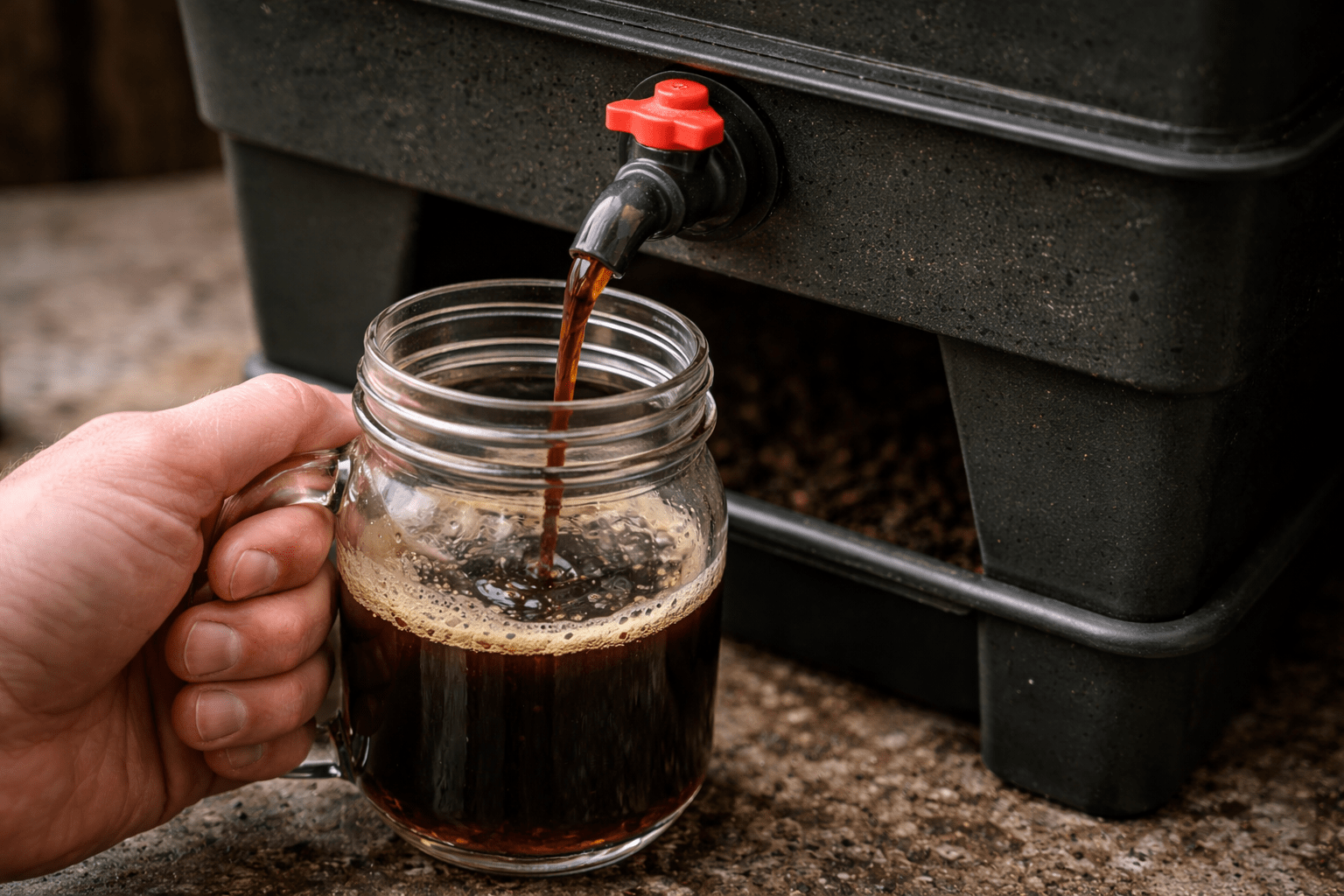
| Liquids Liquids are where worm farming becomes most confused, most quickly. They arrive quietly, often unnoticed at first, then suddenly command attention because they seem measurable. A tap, a tray, a bottle. Something you can collect, pour, dilute, and apply. In a practice otherwise defined by slowness and ambiguity, liquids feel reassuringly concrete. That is precisely why they are so often misunderstood. What drips out of a worm farm is not, by default, a gift. It is a signal. Liquids appear when moisture has somewhere to go, and they tell you more about the state of the system than they do about its productivity. In a well-balanced bin, moisture is held, shared, and slowly released through evaporation and biological use. When liquid accumulates and escapes, it usually means something upstream has tipped out of alignment. There’s a tendency to call all worm liquids “tea”, but this flattens several very different processes into one appealing idea. Most liquid draining from worm farms is leachate — water that has passed through decomposing material, carrying dissolved compounds with it. It has not been brewed, aerated, or stabilised. It is a by-product of gravity, not intention. Treating it as a tonic without understanding how it formed is a leap of faith rather than a grounded practice. Leachate reflects what’s happening inside the bin. Too much moisture, compacted bedding, fresh food breaking down faster than microbes can manage — all of these increase liquid output. In that sense, leachate is diagnostic. It tells you the system is under pressure, even if nothing else looks obviously wrong. Ignoring that message because the liquid feels useful is a common mistake. The bin doesn’t care what you do with the runoff; it cares that conditions inside remain workable. Smell matters here more than anywhere else. Fresh, neutral-smelling liquid is rare, and when it does appear, it’s usually fleeting. Sour, sweet, or sharp smells suggest anaerobic processes have taken hold. That doesn’t mean the bin has failed, but it does mean oxygen and moisture are no longer in balance. Pouring that liquid onto soil doesn’t correct the underlying issue; it simply moves the symptom elsewhere. Liquids don’t reset systems. They report on them. The internet is full of enthusiasm for liquid outputs because they promise immediacy. Dilute this, apply that, watch plants respond. Sometimes they do. Often they don’t. When they don’t, the assumption is usually that the dilution was wrong, or the timing is off, or the crop is unsuitable. Rarely is the question asked whether the liquid was appropriate in the first place. Worm farming attracts people who care about soil life, but liquids tempt them to think in terms of feed rather than conditions. There is also a quiet risk in becoming too attached to what drains away. Bins designed to capture large volumes of liquid can inadvertently encourage wetter conditions than worms prefer. The system adapts to the design, not the other way around. Bedding stays heavier. Air movement reduces. Decomposition shifts. Over time, the bin becomes dependent on drainage rather than balance. Liquids increase, but stability decreases. The keeper feels productive, while the system quietly works harder than it should. Properly made worm tea — brewed, aerated, intentional — is a different thing entirely. It requires time, control, and restraint, and even then, its effects are subtle and context-dependent. It is not a shortcut to soil health. Like castings, its value lies in support rather than stimulation. Used occasionally, thoughtfully, it can complement existing practices. Used routinely, it often replaces attention to fundamentals with faith in outputs. One of the less discussed truths is that many worm farms don’t need to produce liquid at all. A bin with balanced feeding, appropriate bedding, and steady conditions may release very little. This can feel disappointing if you’ve been led to expect litres of something useful, but it’s often a sign the system is holding together. Moisture is where it needs to be. Nothing is being pushed out prematurely. Absence, in this case, is evidence of success. Over time, experienced keepers stop chasing liquid. They empty trays when necessary, notice changes, and adjust conditions upstream rather than celebrating what collects below. Liquids become part of the bin’s language, not its output. They are read, not harvested. The question shifts from “what can I do with this?” to “why did this appear at all?” Liquids sit at the edge of worm farming because they sit at the edge of control. They are tempting precisely because they feel manageable, portable, and useful. But worm systems don’t thrive on extraction. They thrive on containment, continuity, and restraint. When liquids are understood in that light, they stop being mysterious or magical. They become what they’ve always been: information moving downhill. |
| About our writing & imagery Many of our articles are written by us, drawing on real experience, reflection, and practical work in gardens and places we know. Some pieces are developed with the assistance of AI, used as drafting and research tools rather than as a voice or authority. Featured images may include our own photography, original AI-generated imagery, or—where noted—images kindly shared by other creators and credited accordingly (for example, via Pixabay). All content is shaped, edited, and published by Earthly Comforts, and the views expressed are our own. |

