| What the Garden Already Knows |
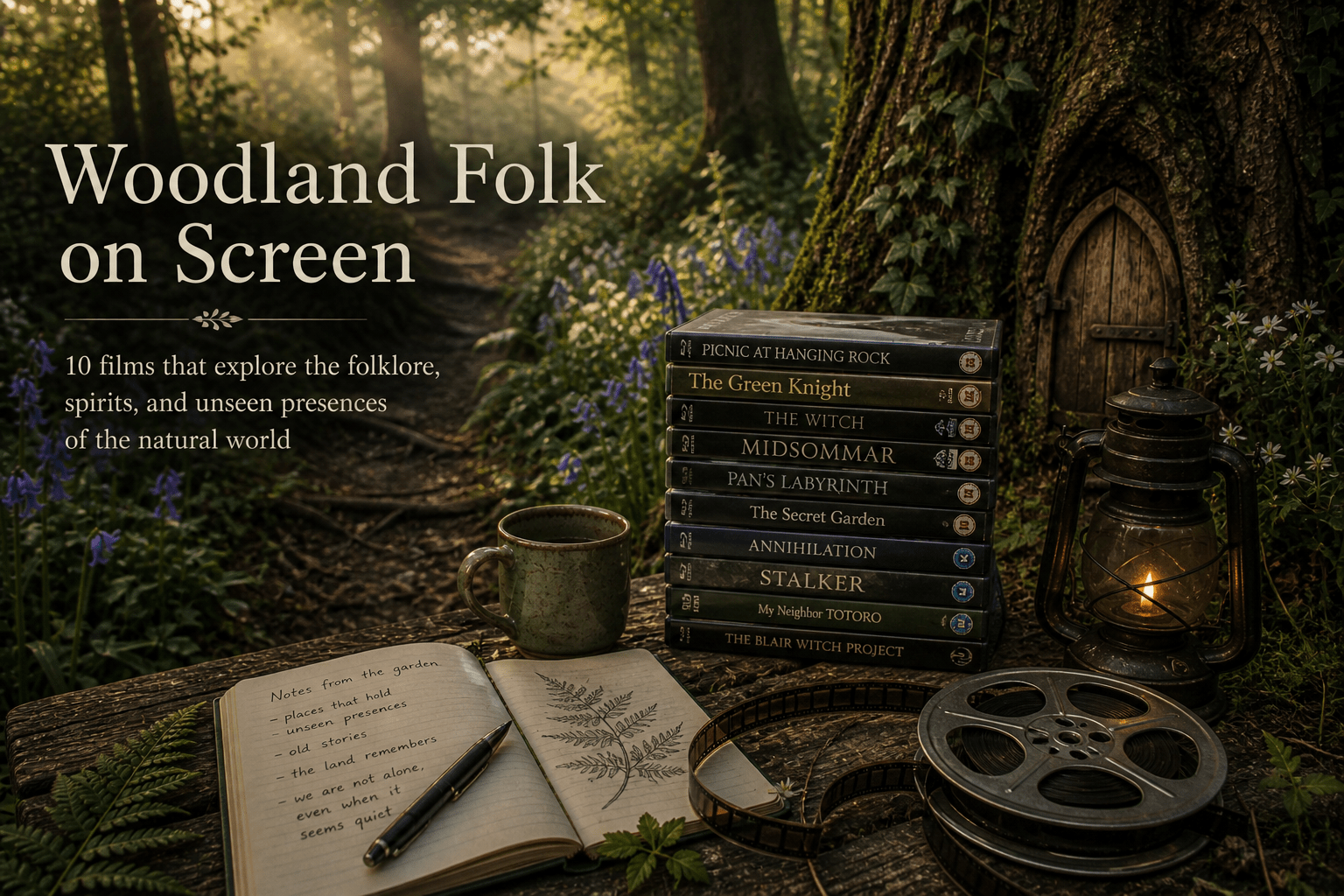
| There is a tendency, when people talk about woodland folk—fairies, spirits, watchers, things that sit just beyond sight—to move quickly into fantasy. Bright colours, exaggerated characters, neat explanations. The idea becomes something decorative, something removed from the actual experience of being in a garden long enough to notice that not everything within it feels entirely neutral. Film, at its best, does something slightly different. It does not always try to show woodland folk directly. Instead, it leans into the conditions that give rise to the idea in the first place—the sense that certain landscapes hold themselves differently, that presence can be implied without being seen, and that the boundary between observation and interpretation is not always fixed. What follows is not a list of films about fairies in the literal sense, but eleven films that sit closer to the same territory the series occupies. They approach woodland folk not as characters, but as a feeling—something suggested through land, light, behaviour, and absence. |
| The Magic Faraway Tree Unlike many modern films that treat woodland folklore as something unsettling or psychologically unstable, this adaptation returns to an older interpretation: that the woodland world exists alongside the human one as a parallel layer rather than a threat. The tree itself behaves less like fantasy architecture and more like a living threshold. Different worlds arrive and recede according to their own logic, and the characters accept this with surprising calmness. That calmness matters. It reflects an older folkloric instinct in which strange landscapes are not automatically evil—they are simply not organised around human expectations. What makes the story relevant here is not the fantasy mechanics themselves, but the underlying idea that certain places contain shifting conditions of reality. The woodland becomes a site of permeability, where behaviour, time, and possibility feel less fixed than they do elsewhere. Like much folklore, it treats the extraordinary not as spectacle, but as something woven quietly into ordinary life. |
| Picnic at Hanging Rock This is perhaps the closest cinematic equivalent to what you’ve been writing. Nothing is explained. A group of girls enter a landscape that feels only slightly different from what surrounds it, and something happens—or perhaps nothing happens at all. The land itself holds the tension. It does not act, but it does not feel passive either. It is not about woodland folk directly, but it captures the exact point where the idea begins: When a place no longer feels entirely available to you. |
| The Green Knight This film sits in a world where the landscape feels older than the people moving through it. The forest is not hostile, but it is not neutral. Encounters occur that are never fully explained, and figures appear who seem to belong to the land rather than to any narrative structure. It reflects the idea that woodland presence does not need to announce itself—it simply exists within the conditions of the place. |
| The Witch Set on the edge of a forest, this film explores what happens when that edge begins to feel uncertain. The woodland here is never fully entered, and that is part of its strength. It remains just beyond reach, shaping behaviour without needing to reveal what lies within it. The idea of woodland folk is present, but always through suggestion rather than confirmation. |
| Midsommar This is not a woodland in the traditional sense, but it deals directly with land-based belief systems. What makes it relevant is how it removes darkness from the equation. Everything is visible, bright, floral—and still deeply unsettling. It challenges the assumption that woodland or folk presence must be hidden to be effective. Sometimes it is simply accepted. |
| Pan’s Labyrinth Here, the woodland world is more literal, but still ambiguous. The creatures may exist, or they may be a way of interpreting what cannot be faced directly. The film never fully resolves this, which is what keeps it grounded. The woodland becomes a parallel system of meaning rather than a separate reality. |
| The Secret Garden At first glance, this feels far removed from anything unsettling, but it sits closer than expected. The garden is not magical in a literal sense, yet it behaves differently from the rest of the world. It restores, holds, and alters those who enter it. It reflects the quieter side of woodland folklore—the idea that certain spaces carry something restorative, even if that cannot be explained. |
| Annihilation This takes the idea further into the unfamiliar. Nature begins to behave differently, not aggressively, but incorrectly. Patterns form that do not align with expectations. It is not about woodland folk, but it explores what happens when the natural world no longer follows the rules we understand—something that lies at the core of many older folklore traditions. |
| Stalker This is less about woodland and more about landscape as a responsive system. The “Zone” is not explained. It changes, it reacts, and it cannot be approached with fixed assumptions. This aligns closely with the idea that certain places are not static and that they require a different kind of attention to move through them. |
| My Neighbour Totoro This is perhaps the gentlest expression of woodland presence. The creatures are visible, but they are never fully explained. They exist alongside the human world without conflict, reflecting a more balanced interpretation of woodland folk—not as something to fear, but as something that shares space without needing to dominate it. |
| The Blair Witch Project Stripped of its reputation, what remains is a study in unseen presence. The forest is never shown to contain anything directly. All tension comes from sound, disorientation, and the gradual breakdown of certainty. It reflects the darker end of the same idea: that once a landscape stops behaving predictably, the mind fills in what cannot be seen. |
| What These Films Actually Show Across all of these, there is a common thread. Woodland folk are rarely the focus. Instead, what is explored is: a shift in how a place feels a loss of certainty in how it behaves a recognition that not everything within it is immediately available to observation The figures themselves—fairies, spirits, watchers—are often secondary. They are ways of describing something that is already present in the landscape. A Gardener’s View of It Working in gardens regularly, you do not encounter anything that cannot be explained. There are no figures moving through borders, no visible presence that confirms the idea of woodland folk in any literal sense. But you do encounter: spaces that feel different without obvious cause patterns that form without intention areas that resist certain approaches and moments where the garden seems to hold itself in a way that is not entirely neutral These films do not prove anything about woodland folk. What they do is reflect the conditions under which the idea becomes plausible—not as belief, but as interpretation. Closing Thought Woodland folk, as a concept, do not begin with stories. They begin with observation. Stories come later, as a way of explaining what has already been noticed. Film, when it works well in this space, does not attempt to show the explanation. It returns to the observation, allowing the landscape to sit as it is—unchanged, but not entirely simple. And that is where it aligns most closely with the garden, not as something magical, but as something that does not always resolve into a single, fixed understanding. |
| About our writing & imagery Most articles reflect our real gardening experience and reflection. Some use AI in drafting or research, but never for voice or authority. Featured images may show our photos, original AI-generated visuals, or, where stated, credited images shared by others. All content is shaped and edited by Earthly Comforts, expressing our own views. |

