| A 5-Part Series |
| A curated exploration of Europe’s most iconic, curious, and ecologically important insects |
| Part Three Beetles & Ground Insects: The Hidden Workforce |
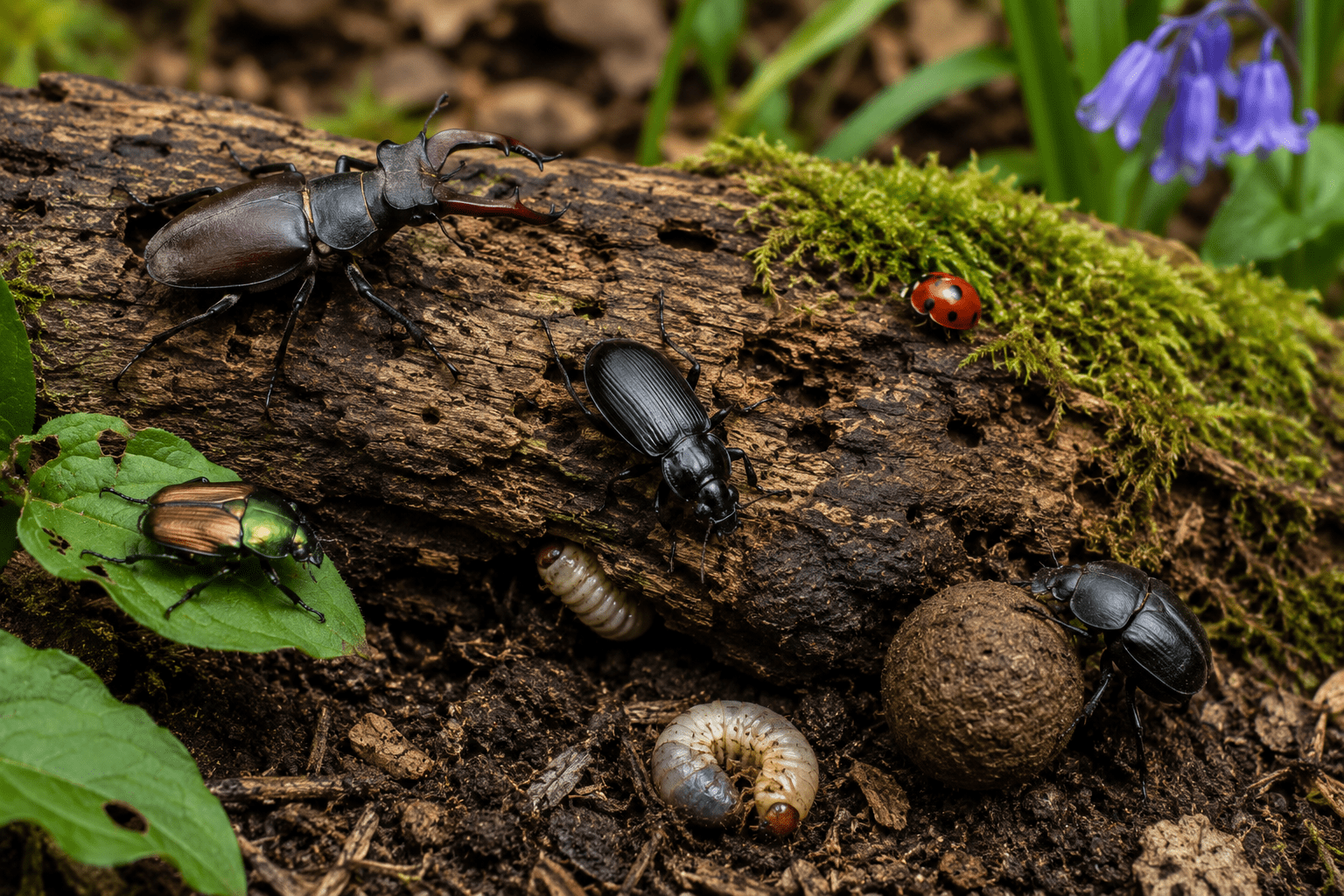
| Most gardeners notice the obvious signs of life first. A butterfly drifting across a border, a bee visiting a flowering shrub, or perhaps a blackbird pulling worms from a freshly turned bed. These are the visible moments that draw our attention and often shape how we think about wildlife. Yet much of the work that keeps a landscape functioning happens out of sight. Beneath leaves, within soil, under logs, inside decaying wood and across the ground after dark, an enormous community of insects is constantly active. They recycle organic matter, regulate populations, move nutrients and influence the structure of the very soil beneath our feet. Without them, many of the landscapes we admire would gradually begin to unravel. Among the most important members of this hidden workforce are the beetles. Europe is home to thousands of beetle species, inhabiting almost every imaginable habitat. Some are predators, some are recyclers, some are pollinators, and some are scavengers. Collectively, they represent one of the most successful groups of animals on Earth. Yet despite their importance, most people rarely notice them. Perhaps this is because beetles tend to work quietly. Unlike butterflies, they do not advertise their presence with colourful wings. Unlike bees, they are not associated with flowers and pollination. Their contribution often becomes visible only when it is absent. Like many of nature’s most important systems, they function best when nobody is paying attention. The Life Beneath the Surface Over the years, one thing that has become apparent when working in gardens is that healthy soil rarely sits still. Dig into a thriving border or lift a piece of old timber, and there is almost always movement. Tiny creatures scatter into cracks and shadows. Small tunnels become visible. Layers of decomposition reveal themselves. This activity is not disorderly. It is a sign that biological processes are functioning as they should. Ground beetles are among the most important participants in this hidden world. Often emerging after dusk, they patrol soil surfaces and garden edges searching for prey. Slugs, insect larvae and countless smaller invertebrates form part of their diet. Many gardeners spend considerable time trying to manage slugs, often assuming that intervention is the only solution. Yet healthy populations of predators can provide substantial assistance. Ground beetles are part of an ecological balancing system that has existed long before gardening products appeared on shop shelves. Their presence is often associated with good soil structure, reduced chemical disturbance and a degree of habitat diversity. A garden does not need to be wild to support them, but it does need places where life can persist between periods of human activity. A perfectly tidy landscape may look orderly, but nature often prefers something slightly more complicated. Nature’s Long-Term Investments One of the most fascinating beetles in Europe is the stag beetle. Even people with little interest in insects tend to recognise it, particularly the males with their distinctive antler-like jaws. What makes stag beetles remarkable is not simply their appearance but the timescale on which they live. Adult stag beetles are relatively short-lived. Their most visible phase occupies only a brief period. Beneath the surface, however, their larvae may spend several years feeding on decaying wood before eventually emerging. This creates an interesting contrast with modern gardening, where results are often expected quickly. We plant a hedge and want privacy within a season. We sow seeds and look for flowers within months. Stag beetles remind us that some ecological processes operate on entirely different timescales. Their survival depends upon dead wood remaining in place long enough for larvae to complete development. For many years, gardeners and land managers were encouraged to remove every fallen branch, stump and decaying log. Tidiness became associated with good management. Today, understanding has shifted. Many gardeners now recognise that dead wood can be one of the most valuable habitats within a landscape. What appears lifeless often supports a remarkable range of organisms. Beetles, fungi, microorganisms and countless other species all participate in the gradual transformation of wood back into soil. Decay is not failure. It is simply another stage in the lifecycle of a landscape. The Small Predators Among the Flowers Not all beetles operate in the dark or in hidden corners. Ladybirds are among Europe’s most familiar insects and perhaps one of the few beetles to enjoy widespread public affection. Their bright colours and distinctive appearance have earned them a reputation that most insects can only envy. Yet beneath that friendly image lies an efficient predator. A single ladybird can consume large numbers of aphids during its lifetime, helping to regulate populations that might otherwise overwhelm young plants. Gardeners often celebrate this relationship, viewing ladybirds as welcome allies in the ongoing challenge of maintaining healthy plants. What is interesting, however, is that ladybirds rarely succeed in isolation. Their effectiveness depends upon a wider ecological framework. Gardens rich in plant diversity tend to support a broader range of predators, pollinators and beneficial insects. This challenges another common assumption—that individual species provide simple solutions to complex problems. Nature generally prefers networks to shortcuts. A healthy garden supports ladybirds not because it has been designed specifically for them, but because it contains the diversity that allows entire systems to function. The Importance of Recycling Few insects illustrate the importance of recycling more effectively than dung beetles. At first glance, they are not especially glamorous. They rarely appear on greetings cards or wildlife calendars. Yet their contribution to European landscapes is immense. Across grazing land, dung beetles break down animal waste and return nutrients to the soil. In doing so, they improve fertility, reduce parasite burdens and contribute to healthier grassland systems. Without them, organic matter would accumulate far more slowly and efficiently. It is easy to overlook gradual processes. A butterfly attracts attention because it is visually striking. Nutrient cycling attracts little attention because it occurs quietly over time. Yet landscapes depend far more heavily upon the latter. Gardening itself offers countless examples of this principle. Compost heaps transform waste into valuable material. Fallen leaves enrich the soil. Pruned stems decompose and release nutrients back into the ground. Beetles participate in these same processes on a much larger scale. They are among nature’s recyclers, constantly ensuring that resources remain available rather than becoming locked away. Cycles We Sometimes Misunderstand Some beetles experience fluctuating populations that occasionally bring them into conflict with people. Chafer beetles are a good example. Adult chafers feed on foliage, while their larvae live underground feeding on roots. In certain years, numbers can increase noticeably, leading some people to view them as entirely pests. Yet nature rarely operates according to fixed numbers. Population cycles occur for countless reasons, including weather patterns, predation, habitat conditions and resource availability. What appears problematic during one season may simply represent part of a longer ecological rhythm. This does not mean gardeners should ignore genuine damage. Practical management sometimes becomes necessary. However, it is worth recognising that many natural fluctuations are exactly that—natural. Modern life often encourages us to seek immediate control over every perceived imbalance. Ecological systems are usually more patient. They have been regulating themselves for far longer than we have been observing them. A Landscape Held Together by Small Things One of the recurring themes in gardening is that visible results often depend upon invisible processes. Healthy plants depend upon healthy soil. Healthy soil depends upon biological activity. Biological activity depends upon countless organisms performing specialised roles. Beetles are central to many of these relationships. Some hunt. Some recycle. Some break down wood. Some regulate populations. Others help move nutrients through ecosystems in ways we are only beginning to fully understand. Individually, they may seem insignificant. Collectively, they form part of the machinery that keeps landscapes functioning. Perhaps that is why beetles deserve more attention than they typically receive. They remind us that ecosystems are not maintained by a handful of charismatic species. They are sustained by vast networks of organisms, many of which remain largely unseen. As gardeners, it is tempting to focus on the visible outcomes—the flowers, the harvests, the neatly maintained borders and lawns. Yet beneath every successful landscape lies an army of workers quietly and continuously at work. Most of them will never attract much attention. Most will never appear in wildlife documentaries or inspire the affection that butterflies enjoy. Nevertheless, they remain essential. The next time a log is lifted, a compost heap turned or a patch of soil disturbed, it is worth pausing for a moment to observe what appears. The movement may seem insignificant at first glance, but it represents something much larger. A hidden workforce, carrying out tasks that have shaped Europe’s landscapes for thousands of years. |
| About our writing & imagery Most articles reflect our real gardening experience and reflection. Some use AI in drafting or research, but never for voice or authority. Featured images may show our photos, original AI-generated visuals, or, where stated, credited images shared by others. All content is shaped and edited by Earthly Comforts, expressing our own views. |

