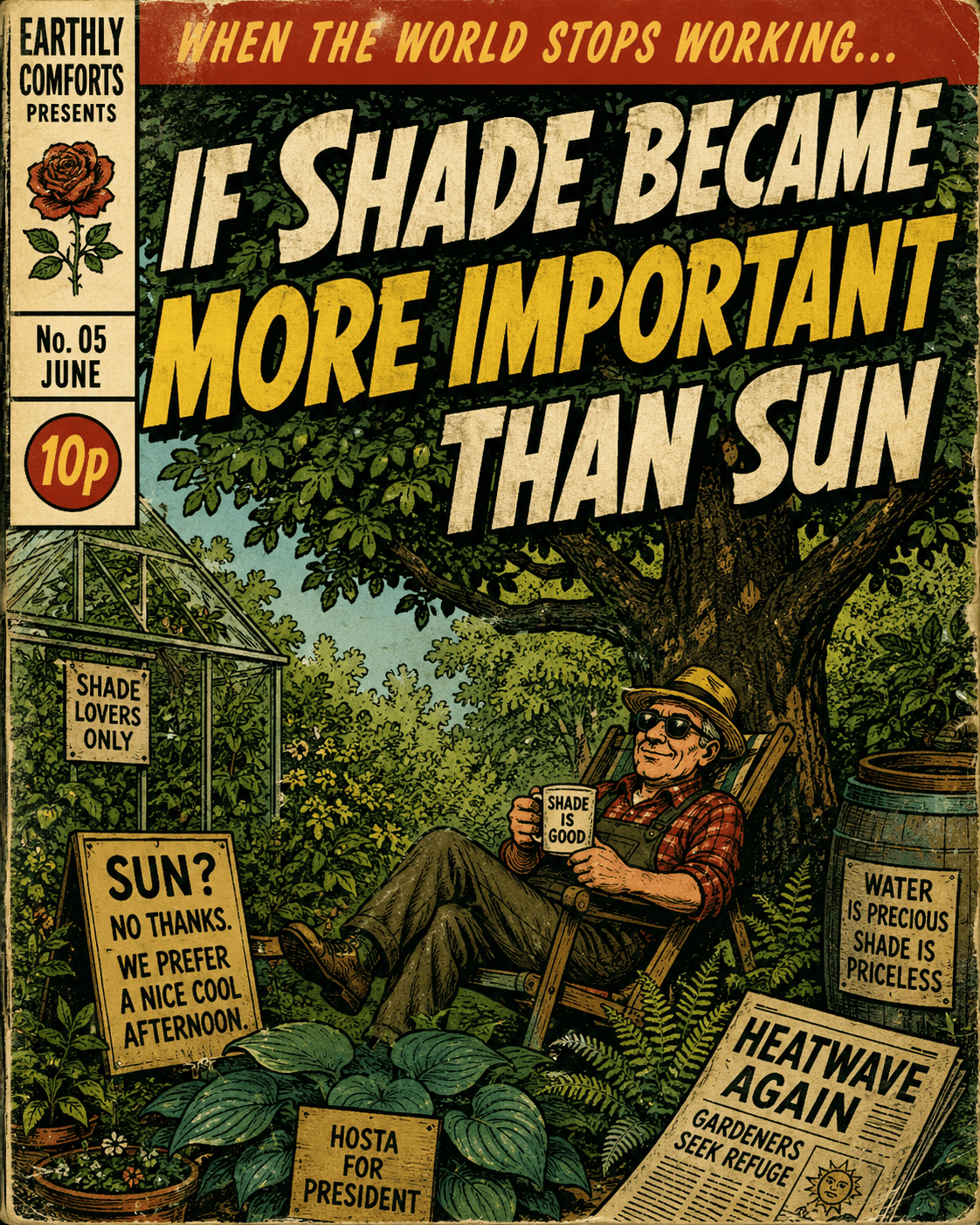
| There was a time when every gardener wanted more sunshine. South-facing gardens were spoken about with quiet admiration, estate agents highlighted them in bold print, and clients would often apologise for a north-facing border as though it were some unfortunate character flaw inherited with the property. We spent years chasing the sun, planting accordingly, pruning to let more light through and carefully positioning vegetables where they could squeeze every possible hour from a summer’s day. Sunshine wasn’t just desirable; it was something we measured gardens by. Then, almost without anyone agreeing to it, the conversations began to change. Instead of asking whether a border received enough sunshine, people quietly started asking whether it received too much. Clients who had proudly shown us their south-facing gardens only a few years earlier were now wondering how quickly a tree could grow, whether a pergola might provide relief, or whether there was any way to persuade a patio to stop behaving like a pizza oven. It is a subtle shift, but one that says rather a lot. What if that trend continued? What if sunshine, once considered the gardener’s greatest ally, gradually became something to negotiate with rather than celebrate? Not because the sun itself had changed, but because our climate had quietly moved the goalposts while we were busy admiring another long summer. The first signs wouldn’t be dramatic because, if we’re honest, many of them are already here. Plants wilt before lunchtime despite the soil feeling perfectly damp. Containers develop an extraordinary thirst, requiring water morning and evening as though they’d suddenly taken up endurance athletics. Lawns fade from rich green to the colour of old parchment long before anyone feels remotely ready for autumn. Most gardeners have witnessed these things already; we’ve simply treated them as unusual summers rather than the possibility of a new normal. Being gardeners, we’d probably respond in the way we always do. We’d water a little more, mulch a little deeper and convince ourselves that next year would be different. Gardeners are wonderfully optimistic people. We can lose the same plant three years in a row and still arrive at the garden centre convinced that this fourth attempt is surely the one that’s going to work. Hope, it turns out, is remarkably hardy. Eventually, though, patterns begin to emerge. The plants that thrive are not necessarily the ones we chose for the position, but the ones that quietly choose it for themselves. Foxgloves appear in the shelter of walls, ferns expand into forgotten corners, and moss, previously treated as an unwelcome guest, suddenly looks as though it’s the only thing in the garden enjoying itself. Even the weeds begin behaving with an irritating level of confidence. I’ve often suspected weeds hold committee meetings somewhere beneath the soil. Their agenda appears remarkably consistent. Wait until the gardener has finally finished weeding, then send everyone back out together. It’s an effective strategy and, judging by the results, one they’ve been refining for centuries. If the climate tipped further towards relentless heat, I imagine they’d simply add another item to the minutes: “Congratulate yourselves. The humans have started removing their own shade.” That, perhaps, would be the greatest irony of all. For generations, we removed trees to gain more light, thinned canopies to encourage stronger growth and celebrated open, sunny spaces. Then, almost overnight in gardening terms, we’d find ourselves planting trees as quickly as we once removed them. Pergolas would become less about displaying climbing roses and more about making it possible to sit outside after midday without feeling as though we’d wandered into a fan-assisted oven. The shady side of the garden would quietly become the most desirable part. The awkward border where little seemed to happen would transform into valuable growing space. Mature trees would command a new level of appreciation, not because of their autumn colour or elegant shape, but because they could lower the surrounding temperature by several precious degrees. Estate agents, never slow to recognise a changing market, would no doubt begin describing gardens as “wonderfully sheltered” and “rich in established shade”, words that once sounded suspiciously like polite apologies. Plants, of course, would adapt long before we did. They always have. Trees don’t panic during heatwaves; they simply continue being trees, drawing on root systems they’ve been extending for decades. Meanwhile, we’re standing beside a hanging basket that appears personally offended by another afternoon of sunshine, wondering why it has collapsed despite receiving enough water to float a canoe. The answer is usually rather straightforward. It’s trying to survive in a compost-filled bucket while the temperature around its roots resembles a freshly brewed cup of tea. Shade itself would slowly become a resource rather than an inconvenience. Garden designers would begin discussing canopy density with the same enthusiasm they once reserved for flower colour. Fast-growing trees would become investments, not because they looked particularly impressive, but because they offered relief. Companion planting would take on an entirely different meaning as taller crops protected smaller ones, and vegetables once celebrated for enjoying full sun would quietly retreat behind anything capable of casting a decent shadow. Suddenly, the best companion wasn’t the plant that improved flavour; it was the one carrying the biggest umbrella. The remarkable thing about gardeners is not that we avoid change, but that we adapt to it with surprising speed once we accept it has arrived. Complaining about the weather has never altered the forecast, but changing how we garden has always changed the outcome. Lawns would become smaller, mulch would become indispensable, containers would grow larger to protect their roots, and healthy soil would quietly become one of the most valuable assets any garden possessed because it would hold on to the one thing that is becoming increasingly precious: moisture. There is a gentle lesson hidden somewhere within all of this. Gardening has never really been about controlling nature. At its best, it is about understanding it well enough to make sensible introductions, timely interventions and, perhaps most importantly, knowing when to stop arguing with it. The more determined we become to impose yesterday’s solutions on tomorrow’s conditions, the harder the work becomes. The more willing we are to listen, the more the garden tends to meet us halfway. Perhaps that is the real story. If shade ever became more important than sunshine, it wouldn’t mean the garden had stopped working. It would simply mean that our assumptions had. Gardens have always rewarded observation over certainty, adaptation over stubbornness, and patience over panic. We’d grumble quietly, move a few plants, plant a few more trees, and carry on much as gardeners always have. After all, the weeds won’t care whether the temperature reaches thirty-five degrees or not. They’ll still arrive exactly where they’re least welcome, looking faintly pleased with themselves. And somewhere beneath the coolest tree in the garden, a gardener will be sitting with a mug of tea, wondering why everyone spent so many years chasing the sun when the shade had been trying to help all along. |
| About our writing & imagery Most articles reflect our real gardening experience and reflection. Some use AI in drafting or research, but never for voice or authority. Featured images may show our photos, original AI-generated visuals, or, where stated, credited images shared by others. All content is shaped and edited by Earthly Comforts, expressing our own views. |

