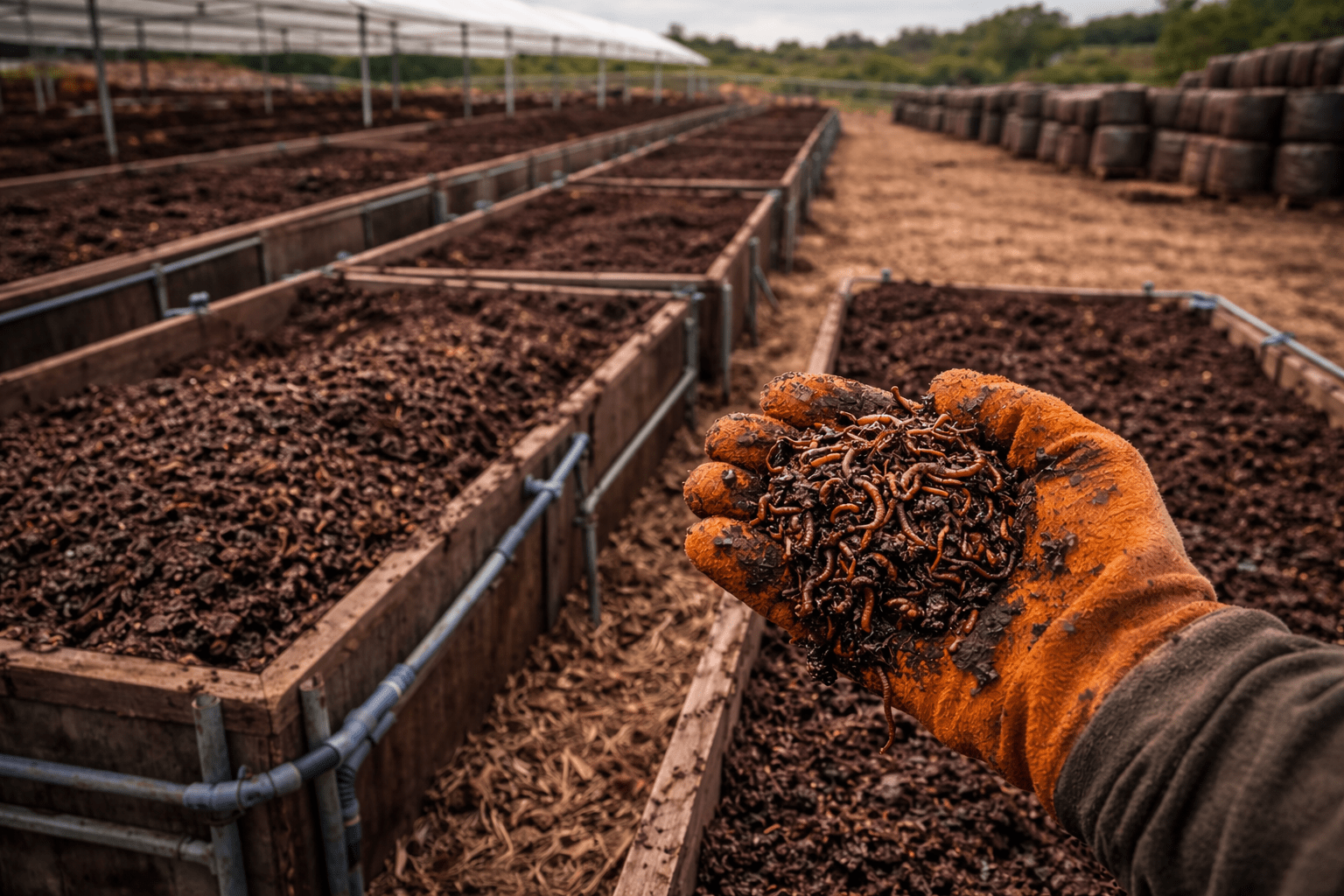
| Scale Scaling is the moment when worm farming changes character. What began as a quiet, domestic practice — a bin in a corner, waste disappearing slowly — starts to attract a different set of questions. How much could this produce? How efficient could it be? Could it pay for itself, or even become something larger? These questions are not unreasonable. They arise naturally once familiarity replaces uncertainty. But they mark a shift that deserves careful attention, because worm farming behaves very differently at scale than it does at home. Small systems benefit from intimacy. Conditions are easy to read, and adjustments are quick and proportional—mistakes stay local. As volume increases, so does momentum; moisture and heat behave differently, errors compound, and the system becomes less forgiving, not because worms change, but because margins shrink. One of the first surprises for people scaling up is how quickly labour replaces curiosity. At a small scale, feeding feels reflective. You notice textures, smells, and distribution. On a larger scale, feeding becomes repetitive. Lifting, tipping, and moving material. What was once observation becomes throughput. This shift matters because worm farming relies on attention to subtle signals. When attention is absorbed by volume, those signals are easily missed. There is also the question of smell, which rarely troubles small systems but becomes unavoidable as scale increases. Odours are not simply a matter of poor management; they are a function of density and flow. Large quantities of material breaking down in close proximity generate gases, whether we like it or not. Containing, dispersing, or neutralising those smells requires infrastructure, not just good intentions. This is where worm farming begins to intersect with regulation, neighbours, and limits imposed from outside the system. Heat behaves similarly. Small bins shed warmth; large masses retain it. Microbial activity becomes volatile, and cooling may require intervention. Scaling introduces risks that patience alone cannot solve—they require design, planning, and sometimes acceptance of limits. Economic expectations further complicate matters. The idea of a worm farm as a business often rests on optimistic assumptions: free waste in, valuable output out. In reality, inputs have costs — time, transport, storage, and handling. Outputs are inconsistent, seasonal, and often undervalued. Castings do not command high prices when supply increases. Liquids are difficult to standardise. The margin between effort and return narrows rapidly unless systems are tightly controlled, which in turn increases fragility. This is where the ethics of scale begin to surface. Worm welfare is easy to consider when numbers are small. You notice stress, migration, and withdrawal. At scale, worms become units within a process. Losses are expected. Endurance replaces comfort. This is not unique to worm farming, but it sits uneasily with the values that often draw people to the practice in the first place. Scaling forces a reckoning between intention and outcome. There is also a cultural narrative around growth that merits scrutiny. In many areas, scaling is seen as synonymous with success. But worm farming resists this: its strengths—slowness, locality, responsiveness—don’t translate upward. The main argument here is that scaling often undermines, rather than amplifies, what makes worm farming valuable. What thrives at the household scale can fail when stretched, not from a flaw, but because it was never meant to be scaled. Some people find a middle ground. Multiple small systems rather than one large one. Distributed bins rather than centralised masses. This approach preserves some of the readability of small-scale worm farming while modestly increasing overall capacity. It is still labour-intensive, but the labour remains observational rather than industrial. Problems stay compartmentalised. Learning continues. Scale increases without erasing the character. Others decide that worm farming does not need to scale at all. That its value lies in fitting a life rather than expanding it. Waste is processed where it is produced. Outputs are used locally. The bin remains in the background rather than the enterprise. This choice can feel anticlimactic in a culture that celebrates growth, but it often leads to longer-lasting engagement. Systems endure because they are not asked to justify themselves economically. It is also worth acknowledging that some large-scale worm operations do work, often under tightly managed conditions with clear commercial aims. However, these systems look very different from domestic worm farms. They rely on infrastructure, monitoring, and consistent inputs. They are closer to industrial composting than to the reflective practice most home keepers recognise. Comparing the two can create unrealistic expectations on both sides. Scale changes not just the system, but the relationship you have with it. At a small scale, you live alongside the worms. At a large scale, you manage them. That shift is neither good nor bad in itself, but it is consequential. It alters what you notice, what you care about, and what you are willing to tolerate. Many people discover, sometimes with relief, that they prefer the former. The fundamental question is not whether worm farming can scale, but whether it should—for you, your context, and your values. This is the main argument: scaling is optional, not obligatory. Choosing to remain small is not a lack of ambition, but a thoughtful act of alignment with what works. Worm farming ultimately teaches a countercultural lesson: value does not always increase with scale. Some systems are richest when small and closely observed. Scaling amplifies output but also amplifies consequences. Recognising the right scale is not a failure; it is a true understanding of the system’s purpose and potential. |
| About our writing & imagery Many of our articles are written by us, drawing on real experience, reflection, and practical work in gardens and places we know. Some pieces are developed with the assistance of AI, used as drafting and research tools rather than as a voice or authority. Featured images may include our own photography, original AI-generated imagery, or—where noted—images kindly shared by other creators and credited accordingly (for example, via Pixabay). All content is shaped, edited, and published by Earthly Comforts, and the views expressed are our own. |

