| Seeing What Others Walk Past |
| There is a moment at the beginning of almost every visit when nothing appears to happen. Clients rarely notice it because, to them, I’ve simply arrived. The tools are still in my hand, the day’s work hasn’t yet begun, and there isn’t anything particularly remarkable to see. Yet before I set a mower on the lawn or open a pair of secateurs, I usually spend a few quiet moments doing something that has gradually become second nature. I look. Not in any dramatic sense, and certainly not with the expectation of finding fault. I simply allow my eyes to wander around the garden, almost as though I were greeting an old friend after a week’s absence. The border beside the path seems a little fuller than it did last Tuesday. The bay tree has put on another flush of growth. A climbing rose that was only beginning to open now carries dozens of blooms. Somewhere near the compost bins, a blackbird has clearly been hard at work scattering mulch in search of breakfast. None of those observations is particularly important on its own. Together, however, they tell me how the garden has been living while I wasn’t there. People occasionally ask how I notice so much. It’s a question I’ve never found particularly easy to answer because I don’t think there is a single answer. Part of it probably comes from years spent working in hospitality, where good service often depended upon seeing small details before they became obvious to everyone else. My time working as a butler reinforced exactly the same lesson. A well-run household relies less upon grand gestures than it does upon quiet anticipation. Environmental work taught me to read landscapes rather than simply admire them, while years spent gardening have shown me that every season leaves its own collection of subtle clues for those willing to look. Then there is another part of the story, one that belongs simply to the way my own mind works. Being on the autism spectrum means I have always tended to notice details that other people sometimes overlook. I don’t regard that as a superpower, nor as an explanation for everything. It is simply one thread woven through many years of experience. Observation, at least in my own life, has never come from one place. It has grown from many different experiences, each quietly reinforcing the last. The more I reflect upon it, the less I think observation is merely a skill. Skills can be taught through repetition and practice. Observation certainly improves with experience, but I suspect it begins somewhere else. It begins with curiosity. You have to care enough to keep looking, even when there appears to be nothing new to see. A gardener who has visited the same property every week for five years can easily stop noticing it altogether if familiarity replaces curiosity. Perhaps that is one of the great paradoxes of gardening. Experience teaches us what to look for, yet it can also tempt us to believe we have already seen everything worth seeing. Whenever that happens, the garden quietly carries on changing without us. I’ve often noticed that clients apologise for missing things that seem immediately obvious to me. They’ll say they hadn’t realised the shrub was beginning to lean, that the paving had become uneven or that the gutter had gradually filled with leaves. It isn’t because they don’t care. More often than not, it’s because they see those things every single day. Human beings have an extraordinary ability to become accustomed to their surroundings. We edit the familiar until it almost disappears. That is why fresh eyes matter. It’s also why professionals, whatever their trade, often spot things that householders walk past without a second glance. An electrician notices a worn cable. A builder sees the first signs of movement in a wall. A chef tastes an imbalance in a sauce that most diners would never recognise. Experience teaches us what questions to ask of the world around us, and once you know those questions, it becomes remarkably difficult not to ask them. Gardening is no different. A new gardener often notices the obvious: the weeds that need removing, the hedge that requires trimming or the lawn that’s grown too long. An experienced gardener sees those things as well, but they are only part of a much larger picture. They begin to recognise patterns rather than isolated tasks. They remember how the border looked in spring, how the soil held moisture after heavy rain or how a particular shrub struggled during last summer’s drought. Their knowledge doesn’t replace curiosity; it deepens it. Looking back, I suspect that’s one of the quiet foundations of Garden Butlering. The work has never been simply about completing today’s jobs before moving on to tomorrow’s. It has been about building a relationship with a place until even the smallest changes begin to tell a story. That story isn’t written in dramatic events. It’s written in tiny details that accumulate over weeks, months and years. Perhaps that is why I enjoy walking between gardens so much. Those short journeys give me time to let one garden settle before arriving at the next with fresh eyes. Every gate I open offers another opportunity to begin again, to notice rather than assume and to remind myself that no matter how familiar a garden may feel, nature has almost certainly been busy since my last visit. In the end, I don’t think the art of noticing belongs only to gardeners. It belongs to anyone willing to pay attention. Gardens simply happen to reward that habit rather generously. The more carefully you look, the more they reveal, until you realise that the most remarkable things are often the ones that everybody else has quietly walked past. |
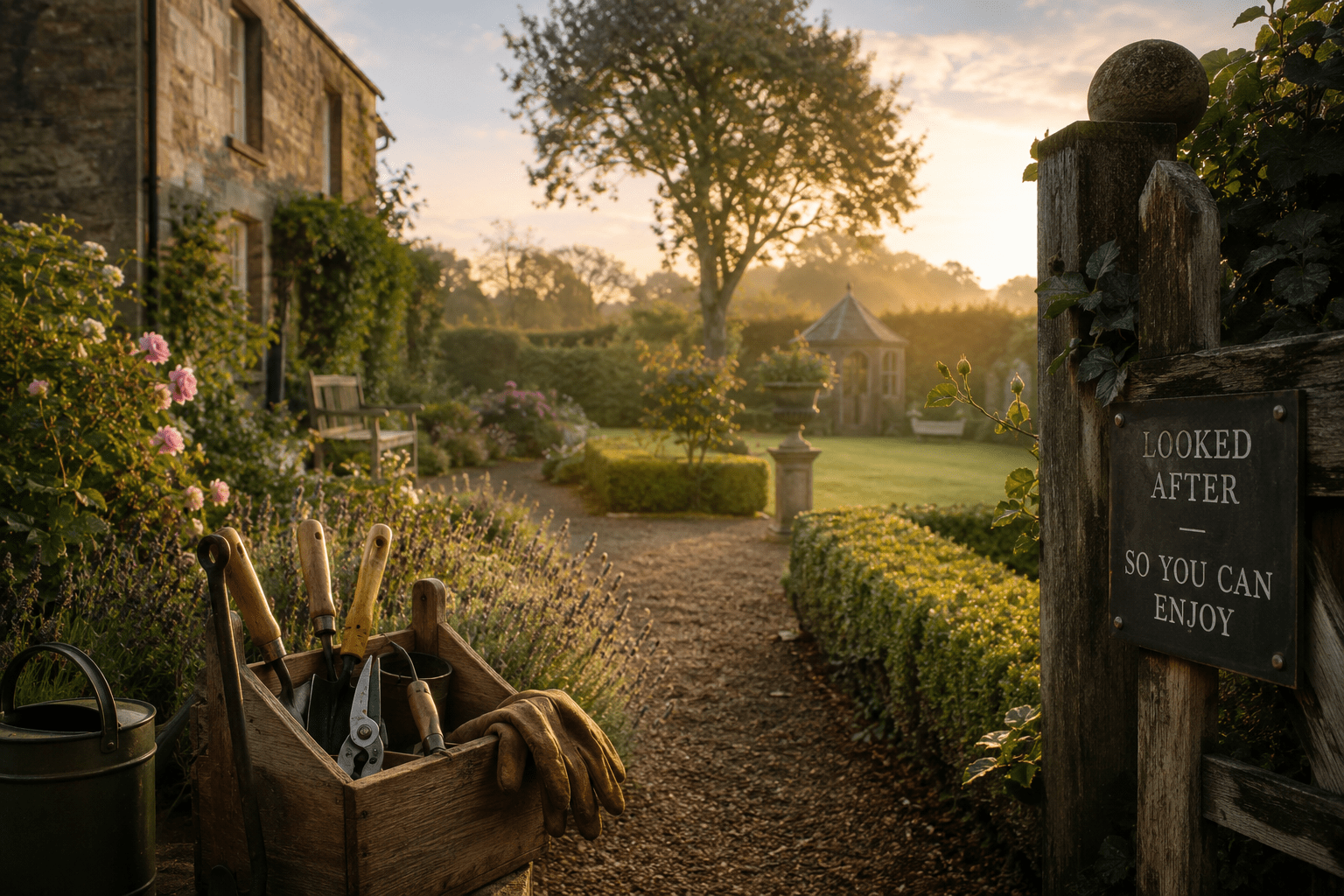
| About our writing & imagery Most articles reflect our real gardening experience and reflection. Some use AI in drafting or research, but never for voice or authority. Featured images may show our photos, original AI-generated visuals, or, where stated, credited images shared by others. All content is shaped and edited by Earthly Comforts, expressing our own views. |

