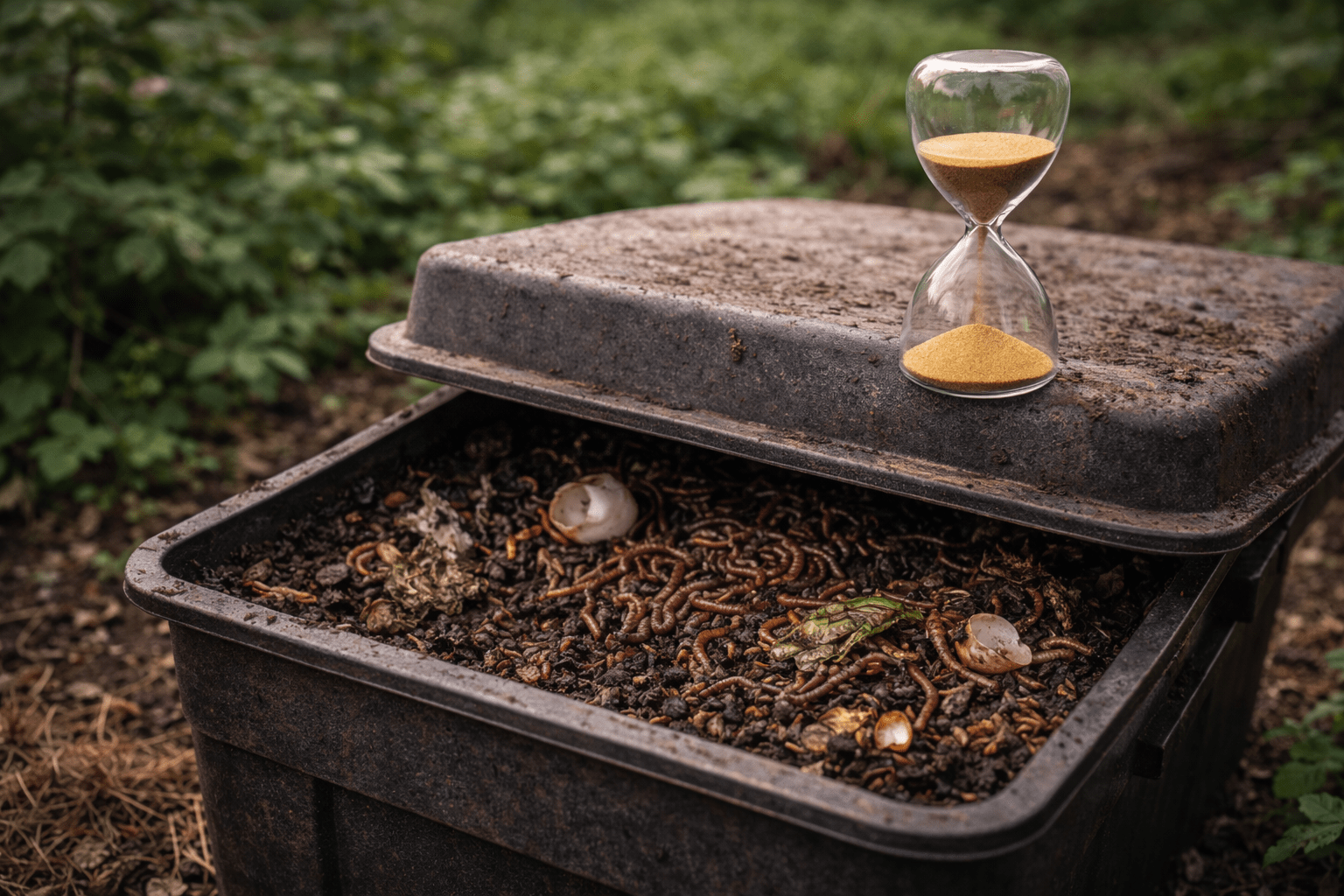
| Patience Patience is the quality that farming teaches most persistently, and the one people resist most strongly. It arrives not as a principle but as a friction — the moment when nothing seems to be happening, when outputs stall, when the bin looks unchanged week after week. In a culture accustomed to progress being visible and measurable, this absence of momentum feels uncomfortable. The temptation is to correct it, to intervene, to restore a sense of movement. Worm farming quietly insists that this instinct is often the problem. What patience asks for here is not passivity. It is attentiveness without urgency. Worm systems move according to biological time, which differs from human time. Microbial communities establish themselves gradually. Worm populations adjust in response to conditions that may have been set weeks earlier. Moisture and structure settle unevenly, then stabilise. None of this responds well to being hurried. The more pressure is applied, the less legible the system becomes. One of the most misleading ideas people bring to worm farming is that effort should correlate with outcome. Feed more, get more. Adjust more, improve more. In practice, the relationship is often inverse. Systems pushed too hard become volatile. They produce short bursts of apparent success followed by longer periods of correction. Systems allowed to settle produce modest outcomes consistently. Patience here is not about waiting for a reward; it is about not undermining the conditions that make any reward possible. Patience also reframes how failure is understood. A worm farm that smells briefly, slows down, or produces uneven material is not necessarily failing. It may be responding to a change that has not yet worked its way through. Acting too soon interrupts that response. This is why experienced keepers often appear calm in situations that alarm beginners. They recognise patterns that unfold slowly. They have seen systems recover without intervention. That confidence is built not from success alone, but from having waited long enough to see outcomes resolve themselves. There is a deeper discomfort at work here, one that extends beyond worm farming. Waiting feels unproductive. It does not generate evidence of care. Closing the lid and doing nothing can feel negligent, especially when advice elsewhere insists on constant optimisation. Patience asks you to trust processes you cannot fully observe. That trust is earned over time, as familiarity replaces anxiety. You learn what stability looks like. You learn what fluctuation feels like. You learn which changes matter and which simply pass through. Patience also exposes the limits of knowledge. No amount of reading prepares you fully for how a particular bin behaves in a particular place, under particular conditions. Books and guides offer ranges and principles, but lived systems develop their own rhythms. Waiting allows those rhythms to surface. Rushing suppresses them. The more you try to force alignment with abstract ideals, the less you learn about the system in front of you. This is why worm farming rarely rewards comparison. Seeing someone else’s outputs, timelines, or setups can distort expectations. Patience resists benchmarking. It insists on local understanding. Your bin does not need to resemble anyone else’s. It needs to function where it is. Time spent waiting is time spent gathering information about that context, even if it does not feel like it. There is also a seasonal dimension to patience that becomes clearer over the years rather than the months. Activity rises and falls. Winter slows everything. Summer accelerates, sometimes dangerously. Spring and autumn are transitional, often uneven. Patience allows these cycles to play out without being treated as problems to solve. Systems that are constantly corrected to maintain uniformity often lose the resilience that comes from having experienced variation. Patience is closely tied to restraint. Not adding food just because it is available. Not harvesting castings just because they are visible. Not adjusting the moisture just because it has shifted slightly. These choices feel counterintuitive at first because they withhold action. Over time, they become second nature. You begin to see that many interventions are responses to discomfort rather than necessity. Patience creates space between stimulus and response. There is also a quieter emotional shift that happens when patience takes hold. Worm farming stops being something you check for reassurance and becomes something you check out of curiosity. You are no longer asking whether it is working; you are observing how it is working now. This subtle change reduces pressure. The system is allowed to be what it is, rather than what it was supposed to become. Patience does not mean ignoring genuine problems. Anaerobic conditions, extreme temperatures, persistent imbalance — these require action. The difference lies in timing and proportion. Patient intervention is measured. It addresses causes rather than symptoms. It adjusts gently rather than resets dramatically. Impatient intervention tends to escalate, adding layers of correction that obscure the original issue. Over long periods, patience accumulates into understanding. You remember how the bin behaved after a heatwave, or during a winter when feeding nearly stopped. You recognise the smell of stability. You anticipate slowdowns without interpreting them as setbacks. This memory is not theoretical knowledge; it is embodied familiarity. It cannot be rushed. Patience also reveals that worm farming does not need to be constantly engaging to be worthwhile. Much of its value lies in being backgrounded. Waste disappears steadily. Soil is supported quietly. Nothing dramatic happens. In a world saturated with stimulation and urgency, this ordinariness can feel oddly restorative. The bin becomes a reminder that useful work does not need to announce itself. There is a philosophical edge to this lesson that is easy to overlook. Worms work by waiting. They wait for microbes to prepare food. They wait out conditions that do not suit them. They cluster, retreat, slow down. Their success comes not from force but from alignment. Worm farming invites you to adopt a similar posture — to move when conditions allow, to pause when they don’t, and to resist the urge to impose momentum where it cannot be sustained. For many people, this is where the practice either deepens or ends. Those who find patience intolerable often drift away, frustrated by the lack of control. Those who remain tend to carry the lesson elsewhere — into gardening, composting, even into how they relate to other slow systems. The bin becomes less a project and more a tutor. In the end, patience is not an optional virtue in worm farming. It is the medium through which everything else operates. Without it, feeding becomes excess, tools become crutches, scale becomes pressure, and absence becomes anxiety. With it, systems simplify. Decisions become clearer. Interventions become rarer and more effective. Patience does not promise reward. It promises coherence. It allows the system to express itself fully, without being constantly redirected. In learning to wait, you do not give up agency; you refine it. You act less often, but with better timing. And in that timing, worm farming finds its natural pace — one that is slower than we are used to, but far more durable. |


| About our writing & imagery Many of our articles are written by us, drawing on real experience, reflection, and practical work in gardens and places we know. Some pieces are developed with the assistance of AI, used as drafting and research tools rather than as a voice or authority. Featured images may include our own photography, original AI-generated imagery, or—where noted—images kindly shared by other creators and credited accordingly (for example, via Pixabay). All content is shaped, edited, and published by Earthly Comforts, and the views expressed are our own. |

