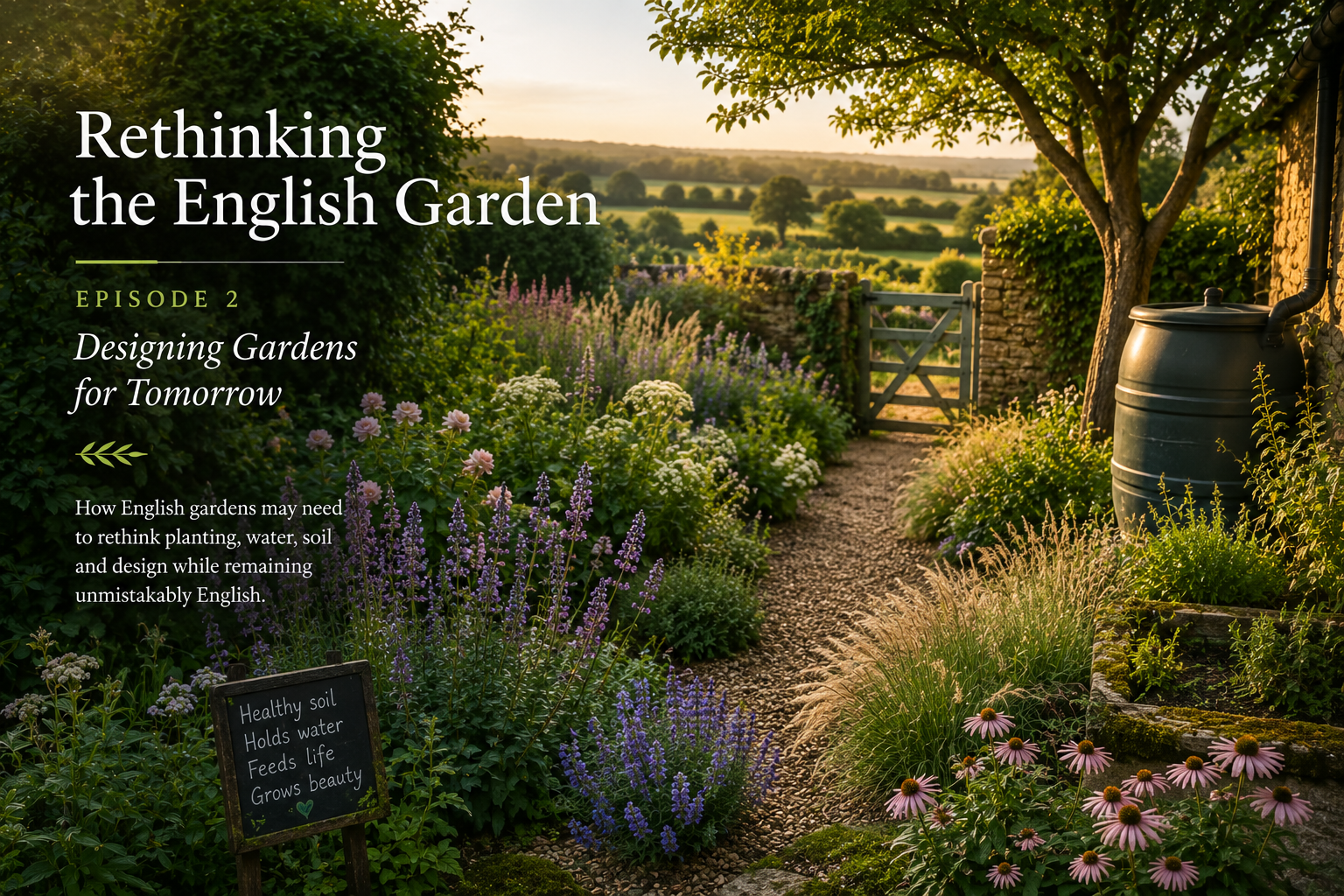
| Episode 2: Designing Gardens for Tomorrow |
| When I finished writing my thoughts after those conversations with clients last week, I realised something rather interesting. Neither of them had actually asked me for a list of plants. As gardeners, that’s often where our minds instinctively go. We hear someone say they want a more resilient garden and immediately begin thinking about lavenders, salvias, ornamental grasses or perhaps a few Mediterranean shrubs. Yet that wasn’t really what they were asking at all. What they wanted to know was whether their gardens needed to start thinking differently. The more I reflected on that question, the more I realised that it wasn’t really about changing gardens. It was about changing gardeners. For generations, we have inherited a particular way of looking at the English garden. There is nothing wrong with that tradition. In fact, much of it deserves preservation because it has given us some of the world’s most beautiful gardens. The problem comes when tradition quietly becomes habit, and habit convinces us that there is only one correct way to garden. Nature has never been quite so rigid. She adapts continually, often without drawing attention to it, while we are still trying to recreate the conditions we remember from years gone by. I sometimes think one of the greatest strengths of the English garden has always been its ability to evolve without making a great fuss. If you compare the gardens of Victorian England with those of the 1950s, or those of the 1950s with today’s gardens, you soon realise that every generation has quietly altered the way it gardens. New plants arrived from around the world, fashions changed, machinery improved, and our lifestyles evolved. Gardens adapted because the people who cared for them adapted. Looking back, those changes seem perfectly natural. Living through them, however, they probably felt far more significant. Perhaps we are standing at another of those moments now. When people talk about climate and gardening, the conversation often becomes strangely polarised. One side argues that nothing much is changing, while the other sometimes gives the impression that we should abandon everything and replace our borders with gravel overnight. My own experience, standing in other people’s gardens every day, suggests that reality is rather more sensible than either extreme. Most gardens don’t need to be reinvented. They simply need to become a little wiser. That wisdom often begins with accepting that water is becoming one of the garden’s most precious resources. For years, many of us have thought about water only when it wasn’t there. We dragged hoses around during dry spells, filled watering cans for containers and hoped for rain. Increasingly, I think we need to consider water long before the weather becomes hot. A garden that captures winter rainfall, protects the soil beneath its planting and loses less moisture during summer will always be more resilient than one that depends entirely upon the nearest outside tap. Interestingly, that doesn’t necessarily mean spending thousands of pounds on complicated irrigation systems. Sometimes the simplest ideas prove to be the most effective. A generous layer of organic mulch spread over a border in spring can make a remarkable difference by midsummer. The soil remains cooler, evaporation slows, and earthworms quietly continue their work beneath the surface. It isn’t particularly glamorous. Nobody visits a garden and admires its mulch with quite the same enthusiasm they reserve for a magnificent rose. Yet one often makes the other possible. The same can be said for trees. For many years, we have tended to think of trees as individual features within a garden, admired for their blossom, autumn colour or elegant shape. I suspect we may begin valuing them for something rather different. A mature tree creates its own environment. It cools the air beneath its canopy, slows drying winds, shelters wildlife and helps the surrounding soil retain moisture. In many respects, a well-placed tree becomes part of the garden’s climate control system. Future generations may plant trees not simply because they are beautiful, but because they make every other plant around them more comfortable. That way of thinking extends naturally into planting itself. I don’t believe the English border is about to disappear beneath a sea of cacti and agaves, despite what some headlines occasionally suggest. The character of our gardens matters. We should never lose sight of that. What may change is the balance. Gardeners may gradually choose plants that cope gracefully with occasional periods of drought rather than those that demand constant attention whenever the thermometer climbs. There is no shortage of beautiful choices. The challenge isn’t finding suitable plants; it is giving ourselves permission to move beyond familiar favourites when experience tells us they are becoming harder to grow well. Perhaps one of the greatest shifts will concern lawns. Few subjects seem capable of causing quite so much anxiety among British gardeners. Every prolonged dry spell produces the same worried conversations about brown grass, damaged turf and the desperate search for a greener appearance. Yet grass has survived British summers for thousands of years without the assistance of oscillating sprinklers. Much of what we interpret as failure is simply dormancy. The lawn pauses, waits patiently for rain and then quietly gets on with growing again. It seems to understand resilience rather better than we do. Maybe that tells us something important. Perhaps our expectation of permanent perfection is becoming harder to sustain than the lawn itself. Healthy gardens have never been static. They breathe with the seasons. They rest when conditions demand it and flourish when circumstances improve. We admire that resilience in ancient woodlands and wildflower meadows, yet somehow expect our own gardens to remain visually unchanged regardless of what the weather decides to do. There is a certain irony in that. Of all the changes I can imagine over the coming decades, I suspect the most significant will take place beneath our feet. Healthy soil may become the defining feature of successful gardening. Rich organic soils retain moisture, support thriving microbial life, encourage deeper root systems and recover more quickly after periods of stress. They become increasingly alive with every year they are cared for. The gardener who spends time improving the soil may ultimately achieve far more than the gardener who spends the same amount on replacing plants. There is something rather satisfying about that thought because it reminds us that gardening has never really been about buying success. It has always been about creating the conditions in which success becomes more likely. As I have reflected on these conversations over recent weeks, I keep returning to one simple observation. The finest English gardens of the future may not look dramatically different from those we admire today. Visitors may still wander through herbaceous borders, pause beneath old trees, sit beside ponds and enjoy the changing seasons exactly as they always have. What will have changed is the thinking behind those gardens. Every decision, from the choice of a tree to the way the soil is managed, may be made with a deeper understanding of how the garden can thrive in a climate that is becoming a little less predictable. That, to me, feels encouraging rather than worrying. It reminds us that good gardening has never been about resisting change. It has always been about observing carefully, learning continuously, and working alongside nature rather than insisting that she follow our plans. If English gardens are entering a new chapter, then perhaps the greatest compliment we can pay those who created the wonderful gardens we inherited is not to preserve them exactly as they were, but to care for them thoughtfully enough that future generations inherit gardens just as beautiful, equally resilient and every bit as unmistakably English. |
| About our writing & imagery Most articles reflect our real gardening experience and reflection. Some use AI in drafting or research, but never for voice or authority. Featured images may show our photos, original AI-generated visuals, or, where stated, images credited to others. All content is shaped and edited by Earthly Comforts, expressing our own views. |

