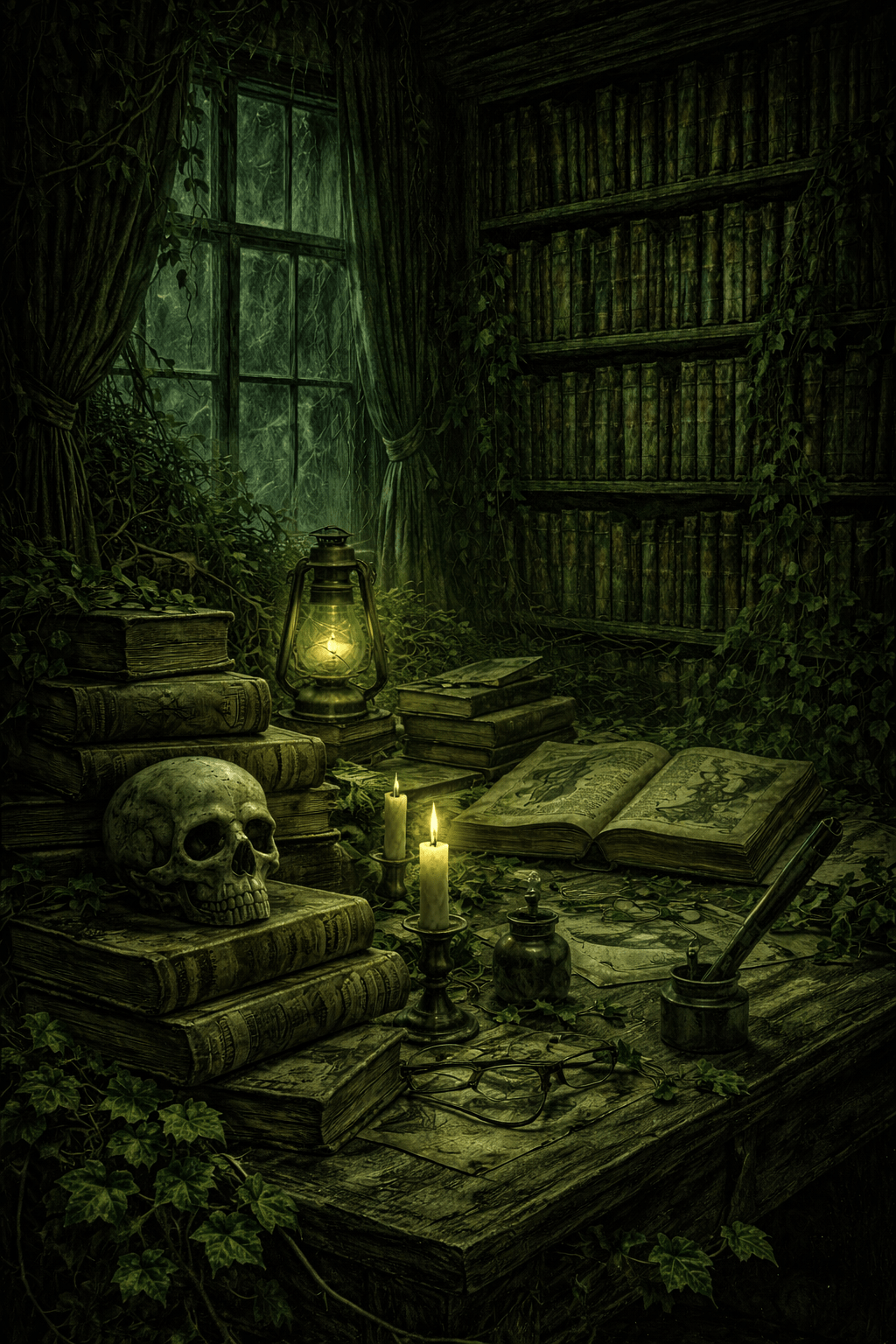
| The Paper That Let the Darkness In |
| Fontana, Pan, and the Quiet Education of Horror Readers Before horror occupied aisles and franchises, it arrived in quieter forms. It slipped through book clubs, railway kiosks, and second-hand shelves. It wore restrained typography and matte covers. It promised “great stories,” not spectacle. For many readers, that education came through two paperback institutions: Fontana and Pan. Alongside them, a parallel visual schooling unfolded in British and American horror comics — serial, unsettling, and formative in a different register altogether. Together, they did more than publish horror. They trained readers how to sit with it. Fontana rarely announced itself as dangerous. Its ghost and horror anthologies ran for decades, accumulating steadily rather than loudly. Horror sat beside detective fiction and sea stories, suggesting that fear was simply another human condition — no more exotic than mystery or suspense. The stories unfolded in drawing rooms, boarding houses, and half-remembered landscapes. Evil was rarely named outright. Resolution was optional. Unease lingered without instruction. Fontana did not shock you into fear. It taught you how to recognise it when it was already present. Pan operated differently. Its annual volumes arrived like appointments — numbered, anticipated, and increasingly ritualised. Where Fontana dispersed horror among its neighbours, Pan concentrated it. The Pan Book of Horror Stories ran for thirty volumes, from 1959 to 1989 — a quiet institution in its own right. Pan’s selections were broader, sometimes crueller. It welcomed the grotesque alongside the psychological. Where Fontana hinted, Pan occasionally stared. Yet even here, the editorial discipline mattered. Stories endured because of craft, not simply effect. Readers learned to accept variation. Some stories unsettled intellectually. Others lingered as images. A few resisted coherence altogether. That, too, was part of the lesson. Running parallel to these paperback educations was another curriculum entirely — one delivered in panels and ink. Tales from the Crypt, The Vault of Horror, Creepy, Eerie, Misty, Scream! — These comics taught visual grammar how dread accumulates across frames, how silence can be drawn. How endings can snap shut without explanation. British readers, in particular, were drawn to Misty and Scream! almost by stealth — learning that horror could be psychological, emotionally disquieting, even restrained. Taken together, these publications created something rare: a graduated encounter with fear. Readers were not overwhelmed. They were apprenticed. There were no cinematic universes. No franchise mythology. Just paper, ink, and the persistent sense that some stories understood human unease better than polite conversation allowed. And once you learned to read that language, it never entirely left you. |
| When Horror Found Its Modern Voice The horror of the 1970s through the 1990s did not arrive as spectacle. It arrived as proximity. These were books read late, often alone, sometimes too young. The covers promised violence or dread, but what lingered was something subtler: the feeling that the ordinary world was only temporarily stable. The writers of this period did not merely frighten readers. They retrained attention. They taught horror to speak in familiar accents — to inhabit recognisable streets, jobs, marriages, and friendships. What made their work influential was not shock alone, but recognition. Horror Moves In Next Door When Stephen King emerged in the 1970s, horror stopped pretending it belonged elsewhere. His stories folded supernatural threat into schools, laundromats, small towns, and childhood loyalties. The fear was rarely the monster itself. It was a structural vulnerability — the idea that the familiar could fail. King’s influence lay in duration. He allowed dread to accumulate across pages of ordinary behaviour. Readers learned that horror required more time than spectacle. That lesson echoed outward. In Britain, horror developed a sharper social edge. The settings were closer. The violence is less allegorical. The voice is colder. James Herbert confronted readers directly. His work felt invasive rather than suggestive. Where King invited readers inward, Herbert destabilised them. Guy N. Smith embraced pulp without apology, expanding the genre’s emotional bandwidth. Horror did not have to be restrained to be legitimate. By the 1980s, writers such as Shaun Hutson removed distance altogether. Violence carried weight. Consequence became unavoidable. Horror stopped being a puzzle or metaphor and became endurance. At the same time, Graham Masterton expanded imaginative scale without retreating into gothic nostalgia. Folklore, history, and transgression coexisted. The past was not decorative. It was active. The Quiet Intelligence of Dread Not all influence arrived through noise. Ramsey Campbell reshaped readers through atmosphere. His horror was dislocating, often unresolved. Fear emerged not from the event, but from misalignment — from things slightly wrong in ways that resisted explanation. Campbell taught readers to trust unease. Peter Tremayne, in a different register, demonstrated that terror did not require the supernatural. Belief systems, power, and certainty, when pushed too far, were sufficient. Across these decades, readers absorbed something quietly transformative: That horror could be domestic. That violence had consequences. That fear could be political, internal, or structural. That dread need not announce itself loudly to endure. By the 1990s, attentive readers were no longer waiting to be frightened. They were already listening for instability beneath ordinary life. That attentiveness did not disappear when the books closed. It stayed. |
| When Horror Moved From Page to Screen When I wasn’t reading horror, I was watching it — wherever and however I could. For a long time, horror wasn’t something you streamed casually. You found it. Late-night reruns of Hammer films. Plastic VHS cases in video shops. Covers that promised more than they delivered. The act of choosing mattered. The eighties made this easier. VHS dissolved scarcity. Films could be rented, rewound, and passed between hands. Horror circulated the way books always had — quietly, persistently. I watched constantly—afternoon, evening, sometimes all night. It never frightened me. That isn’t bravado. It is simply how it was. Martin taught me that horror could be intimate and ambiguous — less about blood than belief. The Texas Chain Saw Massacre surprised me with heat and exhaustion rather than spectacle. Halloween taught me restraint — that space and pacing do more work than event. Hammer films, especially, shaped my understanding of tone. Their horror was architectural. Rooms existed before anything happened in them. Colour, silence, repetition — these mattered more than body count. Christopher Lee and Peter Cushing treated horror with seriousness rather than irony. That seriousness left an impression long before I had language for it. As the years passed, horror fragmented and evolved. It became domestic, industrial, psychological, and ironic. It disguised itself. It matured. And still, it did not frighten me. Then, in 2015, at ten in the morning, in broad daylight, I sat down and watched Annabelle. Nothing extraordinary. A film about a doll. Conventional. Familiar. And something in me folded. Completely. There was no build-up. No gradual retreat. After decades of exposure — after chainsaws, demons, possession, cosmic horror — it was this small, contained film that closed the door. I have not been able to watch or read anything remotely terrifying since. The conclusion did not feel dramatic. It felt physiological. As though something that had been open for years decided it had had enough. Three things remain clear. First: horror ages with the viewer, not the other way around. What once felt manageable can become intolerable without warning. Second: atmosphere outlasts shock. The films that endure are rarely the loudest. They are the ones who trust space, silence, and implication. Third: fear is not cumulative. You do not build immunity. You change shape. The assumption that exposure hardens you is comforting — and wrong. I do not miss horror itself. I miss the place it once occupied: a space where curiosity outweighed caution, where fear was something explored rather than avoided. What remains is respect. For craft. For restraint. For the strange fact that something modest could undo what decades of extremity did not. That feels worth recording. |
| Taken together — the paperbacks, the comics, the films — they formed a long apprenticeship in attention. They trained the eye to notice imbalance, the ear to register tonal shifts, and the mind to tolerate consequence without flinching. I do not inhabit horror in the way I once did, and I do not feel compelled to return to it for its own sake. But if dark writing surfaces again, it will not be in castles or corridors. It will arrive through landscape — through atmosphere, through systems under strain, through the quiet dread of things tipping out of alignment. Not spectacle. Not nostalgia. Something environmental. Something earned. Until then, the education stands absorbed, internal, and sufficient. |
| About our writing & imagery Most articles reflect our real gardening experience and reflection. Some use AI in drafting or research, but never for voice or authority. Featured images may show our photos, original AI-generated visuals, or, where stated, credited images shared by others. All content is shaped and edited by Earthly Comforts, expressing our own views. |

