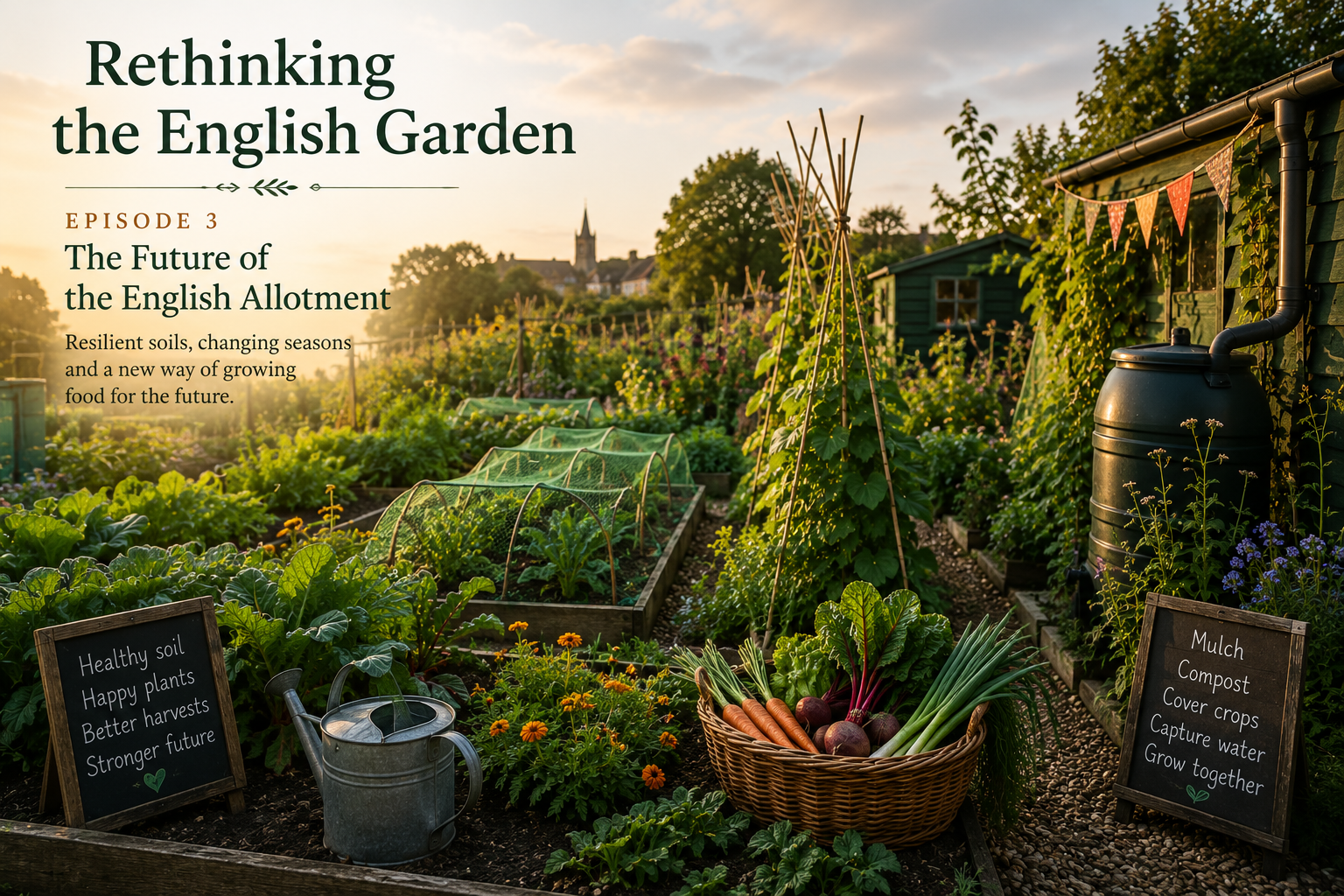
| Episode 3: The Future of the English Allotment |
| There is something wonderfully optimistic about an allotment. Every spring, hundreds of people walk through their gates carrying packets of seeds with complete confidence that this year will be the year everything grows exactly as planned. It’s a lovely thought, and one I have shared many times myself. Of course, nature usually has other ideas. The pigeons arrive before the brassicas have properly settled in, slugs appear as though they’ve received a personal invitation, and weeds somehow manage to germinate with an enthusiasm that our carefully chosen vegetables rarely seem able to match. Yet despite all of that, allotment gardeners remain among the most optimistic people I know. Every season begins with hope, and perhaps that is one reason allotments have remained so popular for generations. Over recent months, however, I have noticed a slightly different conversation beginning to emerge. It isn’t one of disappointment or frustration. It is simply a growing awareness that the conditions in which we grow our food may be changing, and that we may need to change with them. Much of that awareness has come through Suze. While I spend much of my working week looking after ornamental gardens, she has been quietly observing what is happening on our allotment. Over countless cups of tea, we’ve found ourselves discussing vegetables rather differently from how we might have done only a few years ago. The conversations have become less about individual crops and more about the environment in which those crops are expected to grow. One of the first things we’ve both noticed is that watering no longer feels like the whole answer. It is certainly necessary during prolonged dry weather, but it often feels as though we are treating the symptom rather than addressing the cause. Water can disappear remarkably quickly during periods of hot sunshine and drying winds, leaving the soil thirsty again within hours. There comes a point where you begin asking yourself a different question. Instead of wondering how much more water the vegetables require, you begin wondering why the soil is struggling to hold onto the water it has already been given. That single observation changes the conversation entirely. For many years, compost has been viewed as something useful. A welcome addition to the vegetable plot. A sensible way of recycling garden waste. Something every allotment holder tries to produce if they have the space. Increasingly, I suspect we shall come to see compost rather differently. Healthy organic matter may become one of the allotment’s most valuable assets, not simply because it feeds plants, but because it transforms the soil itself. Rich soils retain moisture for longer, encourage deeper root systems and remain workable even when the weather becomes less forgiving. In many ways, the future of vegetable growing may have less to do with watering cans and far more to do with what lies beneath them. That thought has led me to reconsider something else we have perhaps taken for granted over the years. Allotments have traditionally been organised around crops. One bed for potatoes, another for onions, another for beans and so on. Perhaps, in future, we shall begin organising them around the health of the soil first and the crops second. After all, every vegetable we grow depends upon exactly the same foundation. If we care properly for the soil, the vegetables usually reward us. If we neglect it, no amount of feeding later in the season quite makes up the difference. I also wonder whether our relationship with the calendar is beginning to change. Gardeners have always enjoyed certainty. There is something reassuring about opening an old gardening book and finding neat tables telling us precisely when to sow carrots, when to plant runner beans or when to harvest onions. Those guides remain enormously valuable, but I suspect they may become just that—guides rather than rules. Nature rarely owns a calendar. She responds to temperature, moisture, daylight and opportunity. Perhaps we should do the same. There have already been seasons where vegetables sown slightly later have overtaken earlier sowings simply because the conditions suited them better. Equally, crops planted at what the calendar described as the perfect time have occasionally struggled because the weather had other intentions. That doesn’t mean the old advice has become wrong. It simply reminds us that observation has always been the gardener’s greatest teacher. Another interesting change may concern the vegetables themselves. For decades, many allotment growers have favoured varieties because they were familiar, reliable or simply because that was what everyone else grew. There is nothing wrong with tradition, but gardeners have always been wonderfully inventive people. We enjoy experimenting. We try a new tomato one year, a different bean the next, and occasionally discover something far better than we expected. I suspect that spirit of experimentation will become increasingly valuable. Some varieties will naturally cope better with periods of heat, while others may prove surprisingly resilient during unpredictable seasons. Instead of searching endlessly for the perfect vegetable, we may simply discover that diversity itself becomes one of the allotment’s greatest strengths. If one crop struggles, another may thrive. Perhaps that is exactly how nature intended it. There is another feature of allotments that I think deserves rather more attention than it often receives: shelter. We frequently think about sunshine when choosing where to grow vegetables, yet wind can be just as influential. A drying breeze on a warm day can remove astonishing amounts of moisture from both soil and foliage. Young plants become stressed, watering requirements increase and growth slows. It makes me wonder whether future allotments will contain more hedging, more carefully positioned fruit trees and more natural shelter than they do today. Not because we wish to hide our vegetables, but because creating a gentler environment may ultimately prove just as important as feeding them. Even shade, which gardeners have often regarded as something to overcome, may begin to earn a little more respect. There was a time when the ideal allotment was imagined as an uninterrupted rectangle of full sunshine from dawn until dusk. Increasingly, a little afternoon shade during the hottest weeks of summer may prove rather helpful. Just enough to reduce stress, conserve moisture and allow vegetables to continue growing without quite so much hardship. Nature, as she so often does, quietly reminds us that balance usually works better than extremes. As these thoughts have developed, I find myself becoming increasingly convinced that allotments are not facing a crisis. They are facing another evolution. That distinction matters. Gardeners have adapted for centuries. They have responded to new pests, changing tastes, different tools and improved varieties. Every generation has quietly handed something useful to the next. I see no reason why today’s gardeners should be any different. Perhaps the greatest difference is that we now have the opportunity to think more carefully about resilience than previous generations ever did. We can improve our soils before they become exhausted. We can harvest rainwater while it is plentiful. We can choose varieties with greater diversity. We can create habitats that support pollinators and other beneficial insects rather than focusing solely on production. None of these ideas represents a dramatic revolution. They are simply thoughtful refinements to the way we already garden. As I look across our own allotment, I don’t see a place that needs rescuing. I see a place that continues to teach us. Every season reveals something new. Sometimes it rewards us, sometimes it humbles us, and occasionally it makes us laugh at our own confidence. That, after all, is gardening. We make plans, nature negotiates, and somewhere between the two, we usually manage to produce something worth harvesting. I suspect the English allotment fifty years from now will still be recognisable to anyone who loves growing vegetables today. There will still be rows of beans reaching for the sky, tomatoes ripening in greenhouses, gardeners comparing successes and failures over mugs of tea, and the inevitable debate about whose courgettes have become embarrassingly large while nobody was looking. What may have changed is the way those gardeners think. Perhaps they will spend a little less time trying to master nature and a little more time understanding it. Perhaps they will measure success not simply by the weight of the harvest but by the health of the soil that made the harvest possible. And perhaps they will come to appreciate something gardeners have quietly known all along. We never really grow vegetables. We grow healthy soil. The vegetables are simply kind enough to thank us for it. |
| About our writing & imagery Most articles reflect our real gardening experience and reflection. Some use AI in drafting or research, but never for voice or authority. Featured images may show our photos, original AI-generated visuals, or, where stated, images credited to others. All content is shaped and edited by Earthly Comforts, expressing our own views. |


I find myself listening to, and obeying Natures ideas. She does know best, after all…
That’s a brilliant idea about the compost though, Rory…
LikeLiked by 1 person
Compost will be our saviour Jaye.
LikeLiked by 1 person
Since my collapse earlier this year, I must admit to allowing Nature to more or less do as she pleases. And so far, she’s not doing too badly. I am slowly managing to do more jobs around the garden, especially with my bonsai…
LikeLiked by 1 person
I didn’t know you had Bonsai, such a wonderful art skill.
LikeLiked by 1 person
I still have a lot to learn, but I love my little trees…
LikeLiked by 1 person
Healthy veg starts with healthy soil. My allotment has been fuelled by my offices coffee grounds for quite a while 🤣
LikeLiked by 1 person
Absolutely Jen, l used to use a lot of coffee grounds for composting, soil work and even feeding the worms 🙂
LikeLiked by 1 person