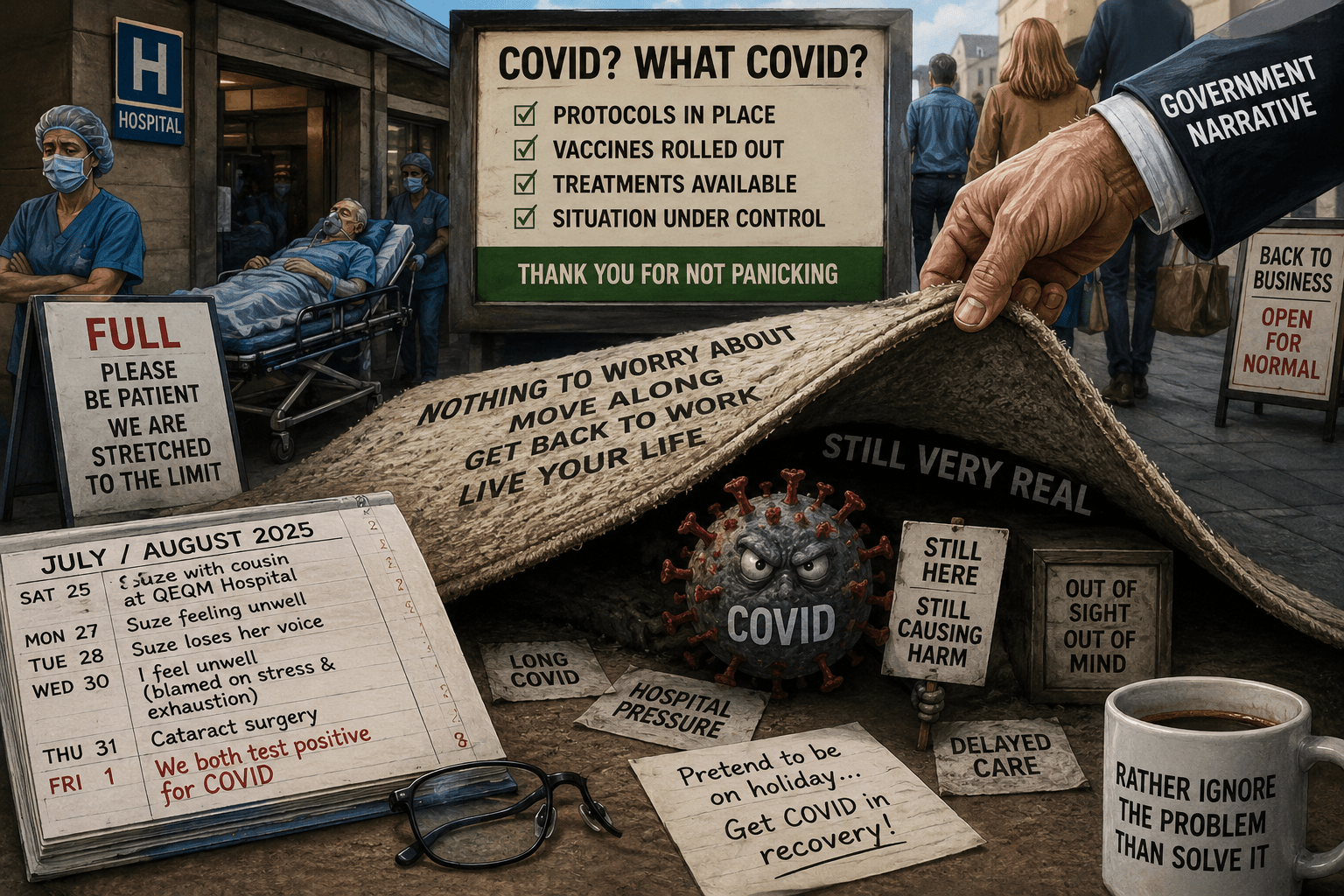
| There is something strangely ironic about COVID in 2026. Not because the virus has disappeared – it clearly hasn’t – but because the conversation around it has. There was a time when every cough, every temperature and every positive test became national news. Daily case numbers dominated television screens, entire countries reorganised their lives around infection rates, and we all became experts in masks, distancing, sanitiser and isolation periods. Whether you agreed with every decision or not, one thing was certain: COVID mattered. Fast-forward a few years, and the message feels very different. Catch COVID now, and the overwhelming response is almost a shrug. Stay home if you feel unwell. Get some rest. Drink plenty of fluids. It has become, in the eyes of many, little more than another seasonal inconvenience. Except it isn’t. This past week has been a reminder of just how quickly life can still be turned upside down by a virus many would rather not talk about anymore. On Saturday 25th July, Suzanne accompanied her cousin to the Queen Elizabeth The Queen Mother Hospital in Margate. It wasn’t a social visit. They were supporting Suzanne’s cousin’s husband, who had been admitted with a septic gallstone. Hospitals are places of care, compassion and healing, but they are also places where infectious illnesses inevitably circulate. By Monday 27th July, Suzanne was beginning to feel unwell. By Tuesday 28th she had completely lost her voice. Meanwhile, I was preparing for cataract surgery on my left eye. On Thursday 30th, I began to feel under the weather, although I convinced myself it was simply exhaustion. After months of relentless gardening through one of the hottest summers in recent years, together with the understandable anxiety before surgery, it seemed a perfectly reasonable explanation. On Friday 31st July I underwent the operation. Thankfully it went well. Then, on Saturday 1st August, both Suzanne and I tested for COVID. Suddenly everything made sense. There is an irony that is difficult to ignore. I had spent months trying to protect my eyesight, finally reached the point of corrective surgery, deliberately stepped away from work to recover, even joking that I was “on holiday” for the first time in years, only to spend this recovery period battling COVID instead. Suzanne caught it while doing something most of us would regard as entirely selfless – supporting members of her own family during a medical emergency. Neither of us caught COVID during the pandemic itself. Through all the lockdowns, all the restrictions and all the waves of infection, we somehow escaped it completely. Then, years later, when the world had largely stopped talking about it, it finally found us. That is what I find most curious. COVID has not vanished. It continues to infect people every single day. It continues to place pressure on GP surgeries, hospitals and care services. It still causes significant illness, particularly amongst older adults and those whose immune systems are already compromised. For many, recovery is measured not in days but in weeks, and some continue to experience symptoms for far longer. Yet the public conversation has shifted almost entirely away from prevention towards acceptance. Perhaps that was inevitable. Society cannot remain on emergency footing forever. Businesses must function. Schools must remain open. Hospitals must continue treating every other illness alongside COVID. Governments have to weigh many competing priorities. But somewhere along the way, the message changed from “this is serious” to something closer to “let’s not make too much of it.” There is a difference. Downplaying a risk does not remove the risk itself. It merely changes how willing we are to notice it. For those of us who are fortunate enough to recover fully, COVID may become little more than an unpleasant memory. For others, particularly the elderly, the clinically vulnerable and those already recovering from illness or surgery, it remains a very real disruption with potentially significant consequences. Perhaps that is the lesson. Viruses are remarkably indifferent to politics, headlines and public opinion. They neither know nor care whether society has grown tired of hearing about them. They continue doing what viruses have always done. The only question is whether we choose to remember that. |
| About our writing & imagery Most articles reflect our real gardening experience and reflection. Some use AI in drafting or research, but never for voice or authority. Featured images may show our photographs, original AI-generated artwork, or, where stated, credited images shared by others. All content is shaped and edited by Earthly Comforts, expressing our own views |


You are right! My family had Covid again this year. It’s the third time. It’s impossible to avoid with my husband and I both working at big corporates and my sons both at university. Each time it takes me at these six weeks to recover and I feel my health has been permanently undermined but no one asks or cares now. My mother has been very ill each time and it takes her months to recover. My dad has long covid and his health is very poor. Covid has made its mark and I believe it’s a permanent one.
LikeLiked by 1 person
Morning. I won’t say it’s a good one because, although the sun is shining, I’m not the happiest of bunnies. I’ve got a cough that’s wracking through my system, and I feel as though I’ve been run over by a bus. Thank you for sharing your experience. I’m so sorry to hear what COVID has put you and your family through.
Sue and I have always tried to be careful and mindful of others, especially since her cousin’s husband has been so poorly recently. Sadly, not everyone feels the same. For many people, Covid is no longer something they think about, even when they’re unwell.
I’ve never knowingly had Covid, and I was talking to a friend about it yesterday. He said, “Don’t worry, if you get it now it won’t be as bad. My wife and I had one of the original strains—that was much harder.”
But that’s not really the point, is it? The point is that people are still catching it, some are still becoming seriously ill, and for many others, like your dad, the effects haven’t gone away at all. We may have stopped talking about COVID, but COVID clearly hasn’t stopped affecting people’s lives.
LikeLike
You are right. Covid hasn’t gone away and it still kills people. The lack of consideration and care demonstrated by people is upsetting and selfish. I hope you recovery quickly.
LikeLiked by 1 person
Yes, people are selfish – sadly that is a human trait that never seems to fade away. Thank you, so do l.
LikeLike
🙏💚
LikeLiked by 1 person
so true. Covid is STILL out there, disrupting lives and making so many people sick. We just ignore it now. Now the focus is on AI taking over the world.
LikeLiked by 1 person
Hi Janet, it certainly feels that way sometimes. COVID hasn’t disappeared; we’ve become much less willing to talk about it. Like many things, once it stopped dominating the headlines, it quietly slipped out of the public conversation. Yet people are still catching it, some are still living with long COVID, and families are still dealing with the consequences.
LikeLiked by 1 person