| Perhaps It Is We Who Have Forgotten the Difference |
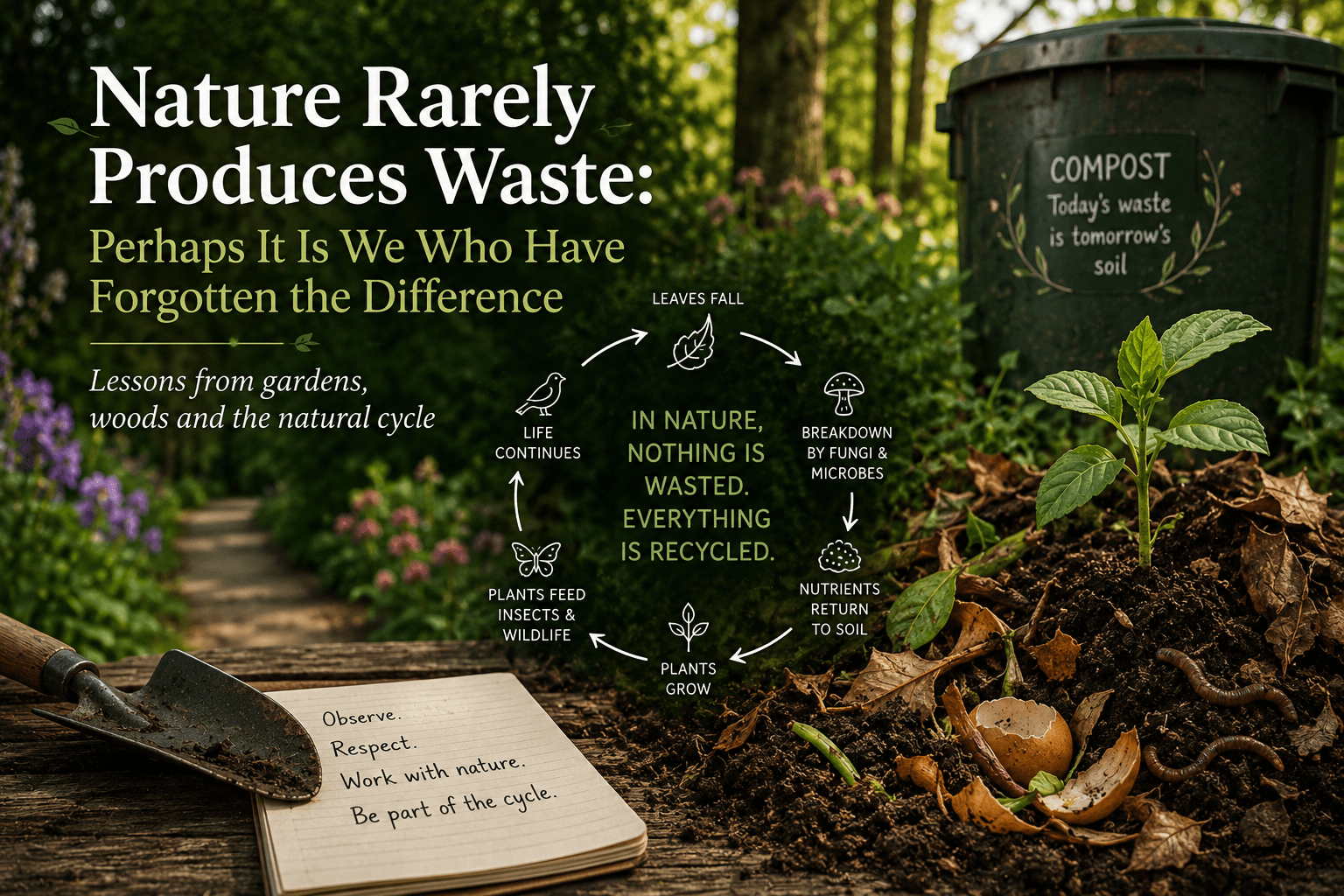
| One of the greatest privileges of spending a working life outdoors is that, over time, you begin to notice patterns. Not simply the obvious ones, such as the changing seasons or the arrival of spring flowers, but the quieter rhythms that govern how nature actually functions. One of those patterns has become increasingly obvious to me over the years: nature rarely produces waste. That may sound like an odd statement when standing beside an autumn woodland carpeted in fallen leaves, or looking across a meadow full of dead stems after winter. To the human eye it can appear untidy, neglected, even wasteful. Yet nothing could be further from the truth. What we see as waste is usually just the next stage in an endless cycle of renewal. It is one of the greatest differences between the natural world and the human one. Nothing Is Truly Finished Walk into an ancient woodland in October, and millions of leaves are falling from the trees. At first glance they appear to have been discarded. In reality, they are becoming tomorrow’s woodland floor. Fungi begin breaking them apart almost immediately, bacteria continue the process, and earthworms drag fragments underground. Beetles, woodlice, springtails and countless other tiny creatures reduce them further still. Over time, those leaves become humus. Humus becomes soil. The soil feeds the roots, and the roots grow another generation of leaves. Nothing has been thrown away. Nothing has been wasted. The system has changed form. The same pattern can be seen almost everywhere we look. A fallen tree becomes a nursery for mosses, fungi and insects before slowly returning its nutrients to the forest. The body of a dead animal supports scavengers before microorganisms recycle what remains into the soil. Even wildfire, often viewed solely as destruction, clears ageing vegetation, releases nutrients and creates opportunities for new life in ecosystems that have evolved alongside fire for thousands of years. Nature is remarkably efficient because it operates as a closed loop. We Live in Straight Lines Humans, by contrast, have become remarkably good at creating one-way journeys. We extract, manufacture, consume and discard. Too often, our systems end at the rubbish bin, whereas nature’s systems rarely do. When grass cuttings are sent to landfill instead of composted, valuable organic matter leaves the soil. When perfectly good food is thrown away, the nutrients that required farmland, rainfall, energy and time to produce often end up generating methane rather than feeding people or rebuilding soils. Timber is frequently burned or buried without considering whether it could have been repaired, reused or allowed to decay naturally. The irony is difficult to ignore. The more technologically advanced our civilisation has become, the more waste we seem capable of producing. The Gardener Sees It Every Day Professional gardening has taught me that what many people call rubbish is often simply a resource waiting for another purpose. Leaves become leaf mould. Grass becomes compost. Prunings become woodchip. Woodchip becomes mulch. Mulch feeds fungi, fungi feed the soil, healthy soil grows healthier plants, those plants support insects, the insects feed birds, and the birds disperse seeds. Quietly and without fanfare, the cycle continues exactly as it always has. Even weeds have their place. Recently, Suze and I have spent many hours pulling bindweed from clients’ gardens. It would be easy to see every stem as something to throw away, yet those stems contain nutrients gathered from deep within the soil profile. With a little time and patience, they can be transformed into a liquid fertiliser and returned to the garden rather than becoming another waste product. The bindweed still has to come out, but perhaps it doesn’t have to end its journey in a skip. We Often Damage Nature Before Calling It Waste One thought has stayed with me for many years. Much of what we describe as natural waste only becomes a problem after we have disrupted the system that would normally handle it. Flooding becomes worse after wetlands are drained. Soils become exhausted following years of intensive cultivation. Rivers carry increasing amounts of sediment because vegetation has been stripped from their banks. Algal blooms develop because excess nutrients escape from farmland into watercourses. Plastic becomes litter because it does not belong within the biological cycles that evolved over millions of years. Nature rarely invents these problems. More often than not, it spends decades trying to repair them. As gardeners, we witness this constantly. Leave a bare patch of soil and plants immediately begin reclaiming it. Remove vegetation from a bank and pioneer species arrive to stabilise the ground. Abandon an industrial site and, given enough time, grasses appear first, followed by shrubs and eventually young woodland. Nature is always attempting to heal. The real question is whether we allow it enough time. The Cost of Forgetting The greatest consequence of modern life is not simply that we produce more waste. It is that we have become disconnected from where things come from and where they go afterwards. A bin bag disappears from the kerb. A recycling lorry arrives. Food appears neatly wrapped in plastic. Garden waste vanishes into a collection vehicle. Very few of us now witness the complete journey. The gardener does. We see what healthy soil looks like. We know how long compost takes to mature. We understand that worms, fungi and microbes perform work that no machine can truly replace. Once you understand those cycles, it becomes increasingly difficult to think of organic matter as rubbish. It is simply future soil waiting for its next purpose. Learning From the World Beneath Our Feet There is a quiet lesson hidden beneath almost every garden. Nothing lasts forever, yet nothing is truly lost. Everything changes. Everything becomes something else. Perhaps we have spent too long believing that progress means producing more. Nature suggests something rather different. Its success lies not in endless production, but in endless reuse. For billions of years, the natural world has operated an economy without landfill. Every leaf, every branch, every flower, every creature and every fallen tree eventually becomes part of something new. That remarkable system has sustained life on Earth long before humanity arrived and will continue to do so long after we are gone. As gardeners, our role is not simply to cultivate plants. It is to remember how those natural cycles work and, wherever possible, become part of them rather than standing outside them. Nature has never really had a waste problem. Its greatest challenge has often been coping with ours. |
| About our writing & imagery Many of our articles are written by us, drawing on real experience, reflection, and practical work in gardens and places we know. Some pieces are developed with the assistance of AI, used as drafting and research tools rather than as a voice or authority. Featured images may include our own photography, original AI-generated imagery, or—where noted—images kindly shared by other creators and credited accordingly (for example, via Pixabay). All content is shaped, edited, and published by Earthly Comforts, and the views expressed are our own. |

