| A curated exploration of Africa’s most iconic, curious, and ecologically important insects |
| 2 Butterflies & Moths: Movement Across Vast Distances |
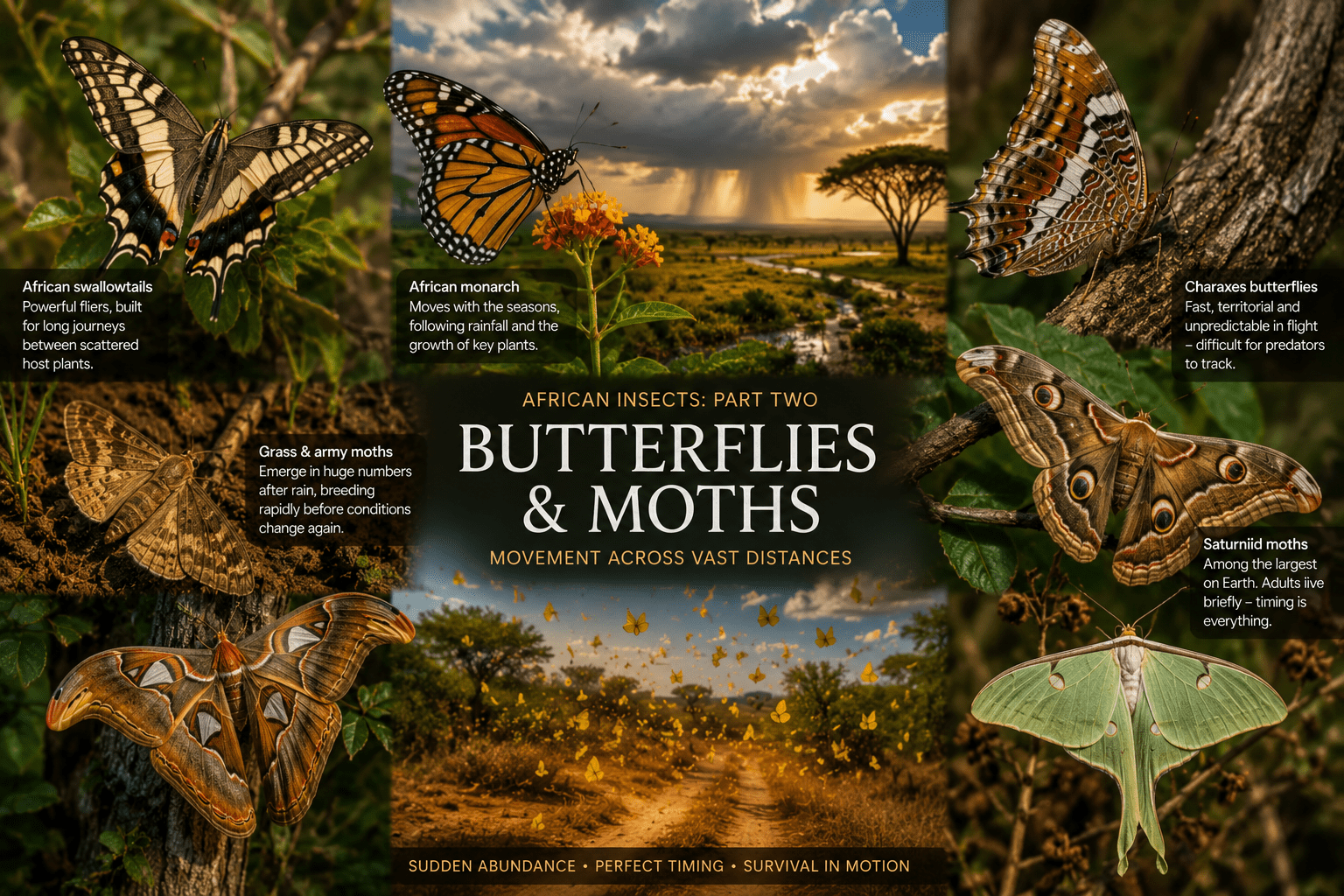
| Butterflies are often described in terms of colour and delicacy. In many parts of Africa, however, their most important quality is movement. The continent contains some of the most varied landscapes on Earth. Tropical forests give way to open woodland, savanna, mountain ranges, deserts and seasonal wetlands. Distances between suitable habitats can be enormous, while food plants and nectar sources may appear only briefly after rain. For butterflies and moths, flight is therefore more than a graceful means of travelling between flowers. It is a survival mechanism. A species that cannot locate new resources quickly may miss the short period in which plants are available. A caterpillar emerging too early or too late may find its food plant already dried or not yet grown. An adult arriving after flowering has ended may have nowhere to feed. Timing matters everywhere in nature, but in Africa it can become absolute. To miss the right moment may mean losing an entire generation. Following the rains Rainfall, rather than temperature alone, governs much insect movement across Africa. In many regions, the arrival of rain transforms the landscape within days. Dry ground begins to soften. Grasses emerge. Shrubs produce new leaves and flowers appear in places that seemed lifeless only weeks before. Insects respond almost immediately. Butterflies that were previously scarce may suddenly become visible in large numbers. Some have moved from other regions, following the rain. Others have waited through difficult conditions as eggs, caterpillars or pupae. The result is a rapid concentration of life around newly available resources. From a gardener’s perspective, we see a smaller version of this whenever a prolonged dry period is followed by warm rain. Plants respond, aphids appear, and pollinators seem to arrive from nowhere. In Africa, these changes operate over vastly greater areas and with far sharper consequences. The African monarch demonstrates this relationship particularly well. Its movements are tied closely to the growth of suitable plants following seasonal rain. Rather than migrating according to a fixed calendar, populations respond to conditions as they develop. The route may change. The timing may vary. Survival depends upon reading the landscape accurately. Swallowtails built for distance African swallowtail butterflies include some of the continent’s most striking species. Their size and powerful flight are not simply decorative features. They allow the insects to travel between host plants that may be widely separated. In fragmented or seasonally dry landscapes, a weak flier may remain trapped within a shrinking habitat. A strong flier has options. Swallowtails can cross open ground, move between woodland patches and locate flowering plants over considerable distances. Their flight is often direct and purposeful, especially compared with the gentler wandering movement associated with some smaller butterflies. This challenges the idea that butterflies are universally fragile. Their wings may appear delicate, but many are capable of remarkable endurance. A gardener watching a swallowtail move across a meadow may see only a few seconds of flight. Behind that moment may lie a journey shaped by weather, vegetation and the search for a plant suitable for the next generation. Charaxes and the value of unpredictability Charaxes butterflies offer a very different form of survival. They are fast, territorial and often difficult to approach. Their flight can appear erratic, with sudden turns and bursts of speed that make them difficult for predators to track. Rather than depending on camouflage or hiding, they rely upon unpredictability. This is particularly effective in open woodland, where there may be few places to shelter. A butterfly that follows a smooth, predictable path becomes easier to intercept. One that changes direction sharply is a much more difficult target. Charaxes also defend feeding sites and territories with surprising determination. Their behaviour feels almost at odds with the familiar image of butterflies as passive and gentle. Yet this is another reminder that beauty does not imply weakness. Insects cannot afford to behave according to our expectations of them. Every movement carries a cost, and every strategy reflects the conditions in which the species evolved. Moths working against the clock Moths dominate African insect life numerically, although much of their activity remains unseen. Many emerge at night, feeding, mating and laying eggs during the cooler hours. In dry regions, night offers relief from heat and water loss. For some moths, it is the only practical time to fly. Grass moths and army moths often respond rapidly after rain. Their larvae exploit the sudden flush of vegetation, developing quickly before conditions deteriorate again. This compressed lifecycle may appear frantic, but it is precisely matched to the landscape. Long development would be dangerous where grasses can dry within weeks. Speed becomes more valuable than longevity. Population increases can be dramatic. Large numbers of moths may appear within a short period, followed by an equally rapid decline as food disappears and predators respond. To human observers, this pattern may look unstable. Ecologically, it is entirely appropriate. The insects are not attempting to create permanence. They are using a temporary opportunity. Giants with little time Some African saturniid moths rank among the largest insects on the continent. Their broad wings and heavy bodies create an impression of strength and endurance, yet their adult lives can be extremely brief. Many adult saturniid moths do not feed at all. They emerge with energy stored during the caterpillar stage and devote their remaining lives almost entirely to reproduction. Within days, the adult phase is over. This seems wasteful only if we assume that a long life is always preferable. Evolution measures success differently. If an insect survives long enough to reproduce, its strategy has worked. The adult moth is therefore less an independent creature beginning a new life than the final expression of a process that began months earlier. The caterpillar gathered the energy. The pupa carried out the transformation. The adult completes the cycle. Everything depends upon timing. If emergence coincides with suitable weather and available mates, the next generation begins. If not, the opportunity is lost. What can gardeners learn from movement? Gardening encourages us to think about permanence. We plant trees that may outlive us, improve soil over years and establish borders intended to mature gradually. African butterflies and moths offer a different perspective. They demonstrate the value of movement, flexibility and responding to conditions as they arise. A landscape may not provide everything in one place. Survival may require travelling, waiting or developing rapidly when circumstances are favourable. This has practical relevance even within European gardens. A continuous succession of flowering plants is more valuable than a single spectacular display. Connected habitats allow insects to move safely. Untidy corners and overwintering stems provide shelter during periods when adults are absent. The visible butterfly is only one stage of a much longer story. What can gardeners learn from movement? Gardening encourages us to think about permanence. We plant trees that may outlive us, improve soil over years and establish borders intended to mature gradually. African butterflies and moths offer a different perspective. They demonstrate the value of movement, flexibility and responding to conditions as they arise. A landscape may not provide everything in one place. Survival may require travelling, waiting or developing rapidly when circumstances are favourable. This has practical relevance even within European gardens. A continuous succession of flowering plants is more valuable than a single spectacular display. Connected habitats allow insects to move safely. Untidy corners and overwintering stems provide shelter during periods when adults are absent. The visible butterfly is only one stage of a much longer story. Precision written across a continent Great distances, sharp seasonal changes and brief windows of abundance shape Africa’s butterflies and moths. Their colours may attract our attention, but movement is what allows them to survive. Swallowtails cross fragmented landscapes. Monarchs follow rainfall and new plant growth. Charaxes rely upon speed and unpredictability. Grass moths compress whole generations into a few favourable weeks. Giant saturniid moths emerge briefly, reproduce and disappear. Each species responds differently, yet the same underlying truth governs all: opportunity does not remain available for long. Their lives are not careless or fragile. They are precise. A butterfly crossing a dry plain or a moth emerging after rain is responding to signals that most people would never notice. Moisture, scent, wind direction and plant growth become part of an invisible map. To us, their movement may look spontaneous. In reality, it is the product of millions of years spent learning when to leave, when to wait and when to fly. |
| About our writing & imagery Most articles reflect our real gardening experience and reflection. Some use AI in drafting or research, but never for voice or authority. Featured images may show our photos, original AI-generated visuals, or, where stated, credited images shared by others. All content is shaped and edited by Earthly Comforts, expressing our own views. |

