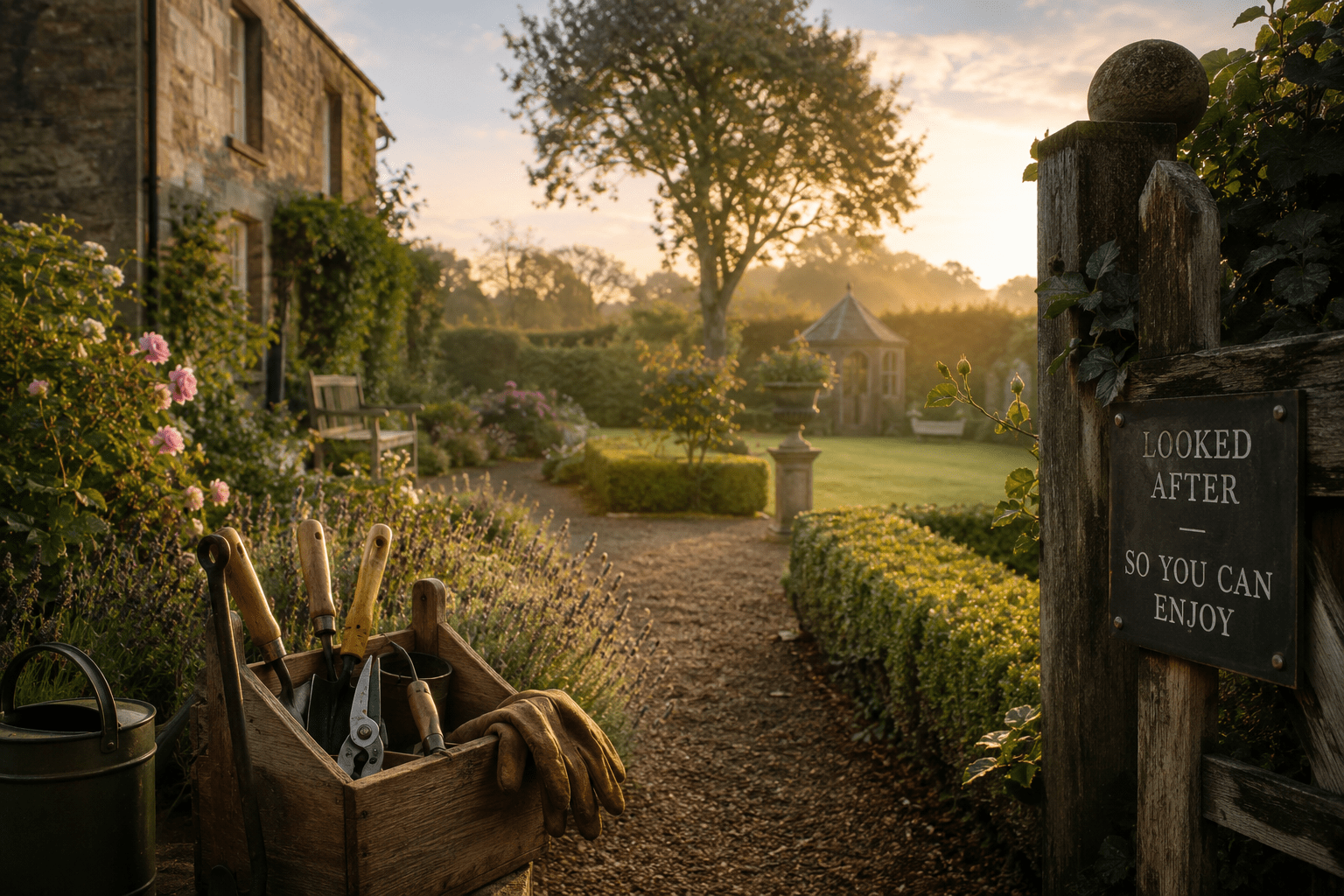
| Trust Is the Most Valuable Tool We Carry |
| Every gardener has experienced it. You arrive at a familiar garden, exchange a few words with the client and, almost without thinking, ask what they would like doing that day. They pause for a moment, smile, and reply with a sentence that has gradually become one of my favourites. “Whatever you think needs doing.” It is such an ordinary exchange that it would be easy to overlook its significance. There is no ceremony attached to it, no formal agreement and no dramatic handshake. Yet I have come to believe that those four words represent one of the greatest compliments a gardener can receive. They represent trust. When I first started Earthly Comforts, almost every visit began with a list. Clients quite naturally wanted reassurance that the work they considered important would be completed, and I entirely understood that. New relationships take time to establish. People are inviting somebody they scarcely know onto their property, often handing over keys, access codes or responsibility for a place that may hold years of family memories. Trust cannot reasonably be expected to appear on the first visit simply because somebody arrives wearing a branded fleece and carrying a pair of secateurs. Like most worthwhile things, it has to be earned. It is earned through arriving when you said you would, doing the work to the best of your ability and admitting mistakes when they occur. It grows through consistency rather than promises. One reliable visit is appreciated; fifty reliable visits quietly become a reputation. Somewhere along the way, clients stop wondering whether the work will be done and begin assuming that it will. That assumption is one of the strongest foundations any professional relationship can possess. The interesting thing is that trust changes the nature of the work itself. A gardener who receives detailed instructions every visit is primarily carrying out tasks. There is nothing wrong with that arrangement. Many clients quite rightly enjoy remaining closely involved in every decision concerning their gardens, and there are occasions when precise instructions are exactly what is needed. Some projects demand them. Yet there is another kind of relationship that gradually develops over time. The conversation becomes less about individual jobs and more about the overall wellbeing of the garden. Instead of deciding exactly what should happen every Tuesday morning, the client begins to rely upon the gardener’s judgement. They know the borders have been watched through the seasons, that the shrubs have been allowed to develop naturally and that any significant concerns will be discussed before action is taken. Responsibility has quietly shifted. Looking back, I suspect that is the moment when I stopped thinking of myself as someone who simply maintained gardens. It was also the point where the idea of Garden Butlering began to make complete sense. A butler is not constantly instructed to notice every loose hinge, every empty log basket or every flickering light bulb. They are trusted to observe, to think and to act with good judgement within the boundaries of that trust. The household functions smoothly because somebody has accepted responsibility for paying attention. The philosophy feels remarkably similar in a garden. Trust, however, should never be confused with independence. I have never believed that employing a professional means surrendering ownership of decisions. A garden belongs to the people who live alongside it, and their wishes, memories and preferences will always matter. Some roses were planted to celebrate anniversaries, certain trees have stood since childhood and particular corners may carry family stories that no visitor could ever understand without being told. Good judgement begins by listening. Perhaps that is why I dislike the idea of the gardener as an unquestioned authority. Experience certainly matters, and clients quite reasonably expect professional advice, but advice should remain exactly that. A relationship built upon trust is never one-sided. The client trusts my horticultural judgement, while I respect that they know the history and meaning of their own garden far better than I ever could. Some of the strongest professional relationships I have enjoyed have grown almost without either of us noticing. The conversations become easier, the need for detailed instructions gradually fades and the work settles into a comfortable rhythm. The garden itself begins to guide many of the decisions because both client and gardener have developed a shared understanding of what they are trying to achieve. That rhythm is surprisingly fragile. Trust takes years to establish and only moments to damage. A forgotten gate left open, an important conversation avoided or a careless assumption can unsettle something that has been patiently built over many seasons. For that reason, I have come to regard trust as something that needs tending in exactly the same way as a garden. It cannot simply be planted and forgotten. It grows through attention, honesty and the quiet habit of doing what you said you would do, even when nobody is watching. There are days when I carry expensive machinery, sharp tools and years of practical experience into a client’s garden. All of those things are useful, and they help me do my job well. Yet if I were asked which of those tools mattered most, I would choose none of them. The most valuable thing I carry into every garden cannot be bought from a supplier or replaced if it wears out. It is the trust that somebody has chosen to place in me. Without it, I cannot complete tasks. With it, I can help care for a place. For a Garden Butler, I have gradually come to believe that makes all the difference. |
| About our writing & imagery Most articles reflect our real gardening experience and reflection. Some use AI in drafting or research, but never for voice or authority. Featured images may show our photos, original AI-generated visuals, or, where stated, credited images shared by others. All content is shaped and edited by Earthly Comforts, expressing our own views. |

