| Astrantia Beauty That Refuses to Shout |
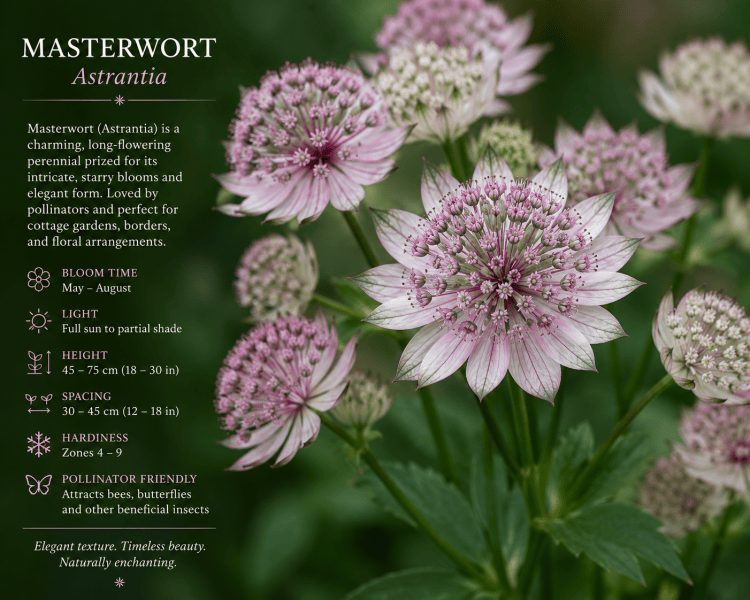
| Some plants announce themselves from the far end of a garden. Even if you know very little about flowers, your eye is drawn towards them almost instinctively. A rose in full bloom, a stand of foxgloves or a drift of dahlias can stop you in your tracks before you’ve even taken another step. Then there are the plants that wait. I’ve often noticed this when working in clients’ gardens. Someone will walk outside while I’m weeding a border and ask what I’m doing. I’ll point towards a clump of Astrantia, and they’re likely to look straight past it. Their eyes settle on something brighter or larger, convinced that’s what I must be talking about. Only when they move a little closer do they begin to see it properly, and once they do, they often wonder how they missed it in the first place. That seems fitting. Astrantia has never struck me as a plant interested in making a first impression. It is far more interested in making a lasting one. At first glance, the flowers appear almost restrained. They are neither fully star-shaped nor entirely rounded, with delicate papery bracts surrounding tiny central flowers that invite you to lean in rather than stand back. Depending on the variety, the colours wander quietly through whites, soft pinks, burgundy and muted reds, often changing slightly as the flowers age. It isn’t unusual to find several shades on the same plant at the same time, giving it a depth that photographs rarely manage to capture. Perhaps that’s why I think Astrantia is one of those plants that reminds us there is a difference between complexity and complication. Gardens are often designed with the assumption that bigger is better. Larger flowers, stronger colours and bolder contrasts promise greater impact, yet some of the most memorable planting I’ve seen has relied on almost the opposite approach. Subtle repetition, restrained colours and plants that complement rather than compete can create borders that remain satisfying long after the initial excitement has faded. Astrantia slips effortlessly into that role. It seems perfectly content to support the broader composition rather than dominate it. That doesn’t mean it lacks practical value—quite the opposite. Given moisture-retentive soil and a position that avoids the fiercest afternoon sun, it flowers generously over a long period. It is one of those perennials that rewards a little attention. Removing spent flowers often encourages another flush, while dividing established clumps every few years helps maintain their vigour. I’ve also found that it partners remarkably well with grasses, hardy geraniums and ferns, each allowing the other enough room to breathe without feeling crowded. There is a common assumption that subtle plants disappear in mixed borders. In my experience, they disappear only when the planting around them refuses to share the stage. Good planting isn’t simply about collecting beautiful plants; it’s about allowing each one enough space to express its character. Astrantia is surprisingly resilient in that respect. It doesn’t need to dominate to be noticed. Instead, it contributes texture, movement and rhythm, gradually drawing the eye through a border rather than demanding that it stop in one place. It asks the gardener to think less like a collector and more like a composer. That idea becomes clearer the longer you garden. When I first started creating borders, I was probably as guilty as anyone of choosing plants because each one looked wonderful in its own pot. Garden centres encourage that sort of optimism. You return home with a trolley full of stars, only to discover that a border made entirely of stars can feel strangely exhausting. Every plant is competing for attention, leaving the eye with nowhere to rest. Experience has slowly taught me that the quieter plants often provide the greatest sense of balance. They connect one flowering season to the next, soften stronger colours and bring a feeling of continuity that is difficult to achieve through spectacle alone. In many respects they perform the same role as silence in music. Without moments of calm, even the finest performance becomes rather overwhelming. That may explain why Astrantia has remained quietly popular for generations without ever becoming fashionable in the way some plants do. It doesn’t chase trends because it doesn’t need to. It simply carries on doing what it has always done, adding elegance without extravagance and proving that beauty doesn’t always have to raise its voice to be heard. The next time you find yourself walking through a border, resist the temptation to admire only the obvious performers. Spend a little longer with the flowers that don’t immediately catch your eye. You may discover they were the ones holding the whole garden together all along. |
| About our writing & imagery Most articles reflect our real gardening experience and reflection. Some use AI in drafting or research, but never for voice or authority. Featured images may show our photos, original AI-generated visuals, or, where stated, images credited to others. All content is shaped and edited by Earthly Comforts, expressing our own views. |

