| A curated exploration of Africa’s most iconic, curious, and ecologically important insects |
| 3 Beetles: Armour for Heat and Hard Ground |
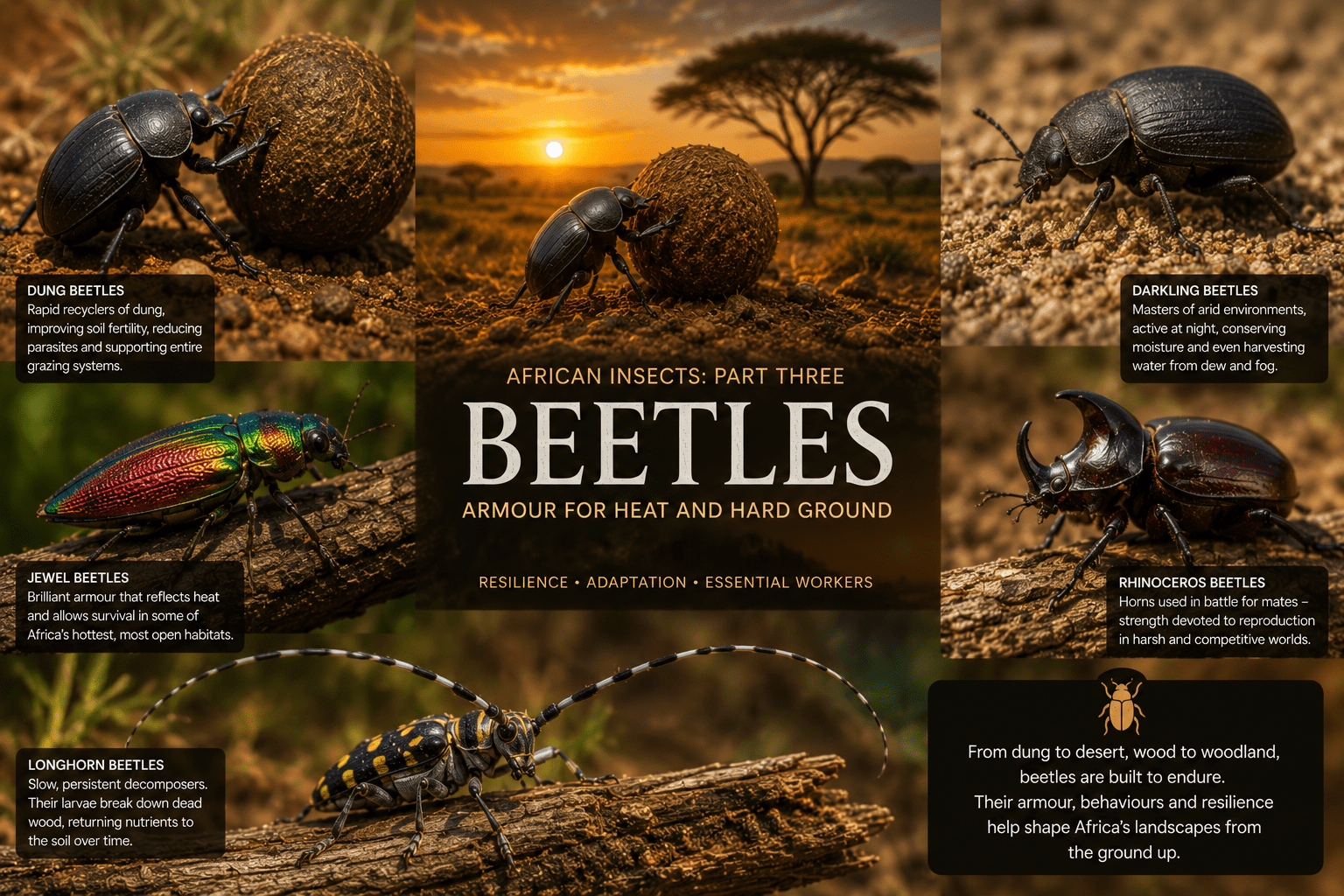
| Beetles appear almost designed for difficult conditions. Their hardened wing cases protect the softer body beneath. Their compact shape reduces water loss and damage. Many can burrow, fly, climb or disappear into cracks where heat and predators cannot easily reach them. Across Africa, these advantages have allowed beetles to occupy deserts, savannas, forests, mountains and cultivated land. Some emerge only at night. Others function in full sunlight where softer-bodied insects would quickly overheat. Their success lies not in avoiding pressure, but in carrying their own protection with them. Dung beetles and the movement of fertility Few beetles influence African landscapes more profoundly than dung beetles. Across grasslands and savannas, enormous numbers of grazing animals produce equally enormous quantities of waste. Without rapid recycling, dung would accumulate, smother vegetation and create breeding grounds for parasites and flies. Dung beetles prevent this. Some species roll portions of dung away from the main deposit, shaping it into balls and burying it. Others tunnel directly beneath the dung, dragging material underground. Still others live and breed within it. Each strategy moves nutrients from the surface back into the soil. For a gardener, the principle is immediately recognisable. Organic matter improves soil only when it is incorporated into the soil. Material left on the surface may eventually decompose, but burying accelerates its contact with microbes, moisture, and plant roots. Dung beetles perform this work on a continental scale. Their tunnels improve aeration and water penetration, while buried dung increases fertility. By removing waste quickly, they also reduce the number of parasites affecting grazing animals. The health of herds, grasslands and soil therefore becomes closely linked to the activity of insects that many people rarely notice. This is a useful reminder that large animals often depend upon very small ones. Darkling beetles and the art of conserving water In deserts and semi-arid regions, darkling beetles demonstrate a very different set of adaptations. Daytime temperatures can become lethal, while water may be absent for long periods. Many darkling beetles avoid the worst conditions by remaining hidden beneath sand, stones or vegetation until night. When temperatures fall, they emerge to feed and move across the surface. This simple shift in timing dramatically reduces water loss. Instead of battling the heat, they arrange their lives around it. Some species have taken water collection even further. In regions where fog or dew provides more reliable moisture than rainfall, beetles can collect droplets upon their bodies and direct them towards the mouth. The quantity may be tiny, yet in a desert it can mean survival. There is something almost gardener-like in this economy. Anyone who has worked through drought learns to value every drop of water and to understand the importance of shade, mulch and timing. Darkling beetles have refined those lessons to an extraordinary degree. They do not waste energy resisting the climate. They work with the cooler hours and use whatever moisture becomes available. Jewel beetles and reflective armour Jewel beetles are among the most visually striking insects in Africa. Their metallic surfaces reflect greens, blues, bronzes and golds, creating colours that appear almost manufactured. Yet this brilliance is not merely decorative. Reflective surfaces can help manage heat by reducing the amount of solar energy absorbed by the body. In exposed habitats, this may allow jewel beetles to remain active when other insects must retreat. Their hardened bodies also protect them from drying and physical damage. Many species are associated with trees and dead wood, where larvae develop over long periods. The contrast is interesting. The adult beetle may appear bright and conspicuous, while the larva spends much of its life hidden inside timber. As with so many insects, the stage we notice represents only a small part of the whole existence. Rhinoceros beetles and misplaced assumptions Rhinoceros beetles bring physical strength into focus. Males possess impressive horns used during competition for mates and access to breeding sites. To human eyes, these structures appear defensive. It seems natural to assume that such armour evolved to fight predators. In reality, the main contest is often between males. The horns allow individuals to push, lift or dislodge rivals. Their purpose is not to dominate the whole ecosystem, but to secure an opportunity to reproduce. This gently challenges one of our common assumptions about nature. We often interpret large horns, jaws or claws as weapons against enemies. Frequently, they are tools used in competition within the species itself. Reproduction remains the ultimate measure of success. A beetle may survive heat, drought and predators, yet if it cannot reproduce, none of those achievements continues into the next generation. The rhinoceros beetle’s strength is therefore highly specific. It is power directed towards a narrow purpose. Longhorn beetles and slow decomposition While dung beetles recycle rapidly, longhorn beetles work on much slower timescales. Their larvae develop within dead or dying wood, feeding through timber over months or years. In the process, they help break down material that would otherwise retain nutrients for decades. In tropical forests, where plant growth is rapid and fallen timber abundant, efficient decomposition is essential. Nutrients must return to the soil quickly enough to support new growth. Longhorn beetles form part of that system. Their tunnels allow fungi and moisture to penetrate deeper into wood. What begins as solid timber gradually softens, fragments, and returns to the ground. Gardeners sometimes view dead wood as waste or evidence of neglect. Yet a fallen branch supports an entire chain of life. Beetle larvae, fungi, microbes and other insects all contribute to the same transformation. Removing every piece of decaying wood may create neatness, but it also removes one of the most valuable habitats available. This does not mean every garden should become a woodland floor. It simply means understanding that decay is productive. Built for direct pressure African beetles reveal several ways of enduring difficult conditions. Dung beetles improve the landscape around them. Darkling beetles avoid heat and capture scarce water. Jewel beetles reflect sunlight. Rhinoceros beetles invest in strength for reproduction. Longhorn beetles work gradually within dead wood. What connects them is the hardened body plan that has made beetles so successful. Their armour provides protection, but it does not make them inflexible. Beetles are among the most behaviourally varied insects on Earth. They can roll, dig, swim, climb and fly. Some live entirely underground, while others remain in trees. Endurance does not come from one feature alone. It comes from combining protection with adaptability. As gardeners, we are often drawn towards softness: flowers, new leaves and fresh growth. Beetles remind us that ecosystems also need the creatures built for harder work. They push through compacted soil, break down waste, open timber and survive conditions that would overwhelm more delicate organisms. They are not always subtle, and many do not need to be. Across Africa, where heat and hard ground are daily realities, beetles meet pressure directly. Their bodies carry the evidence of that long contest. Armour, efficiency, and patience have made them among the most resilient insects on the continent. |
| About our writing & imagery Most articles reflect our real gardening experience and reflection. Some use AI in drafting or research, but never for voice or authority. Featured images may show our photos, original AI-generated visuals, or, where stated, credited images shared by others. All content is shaped and edited by Earthly Comforts, expressing our own views. |

