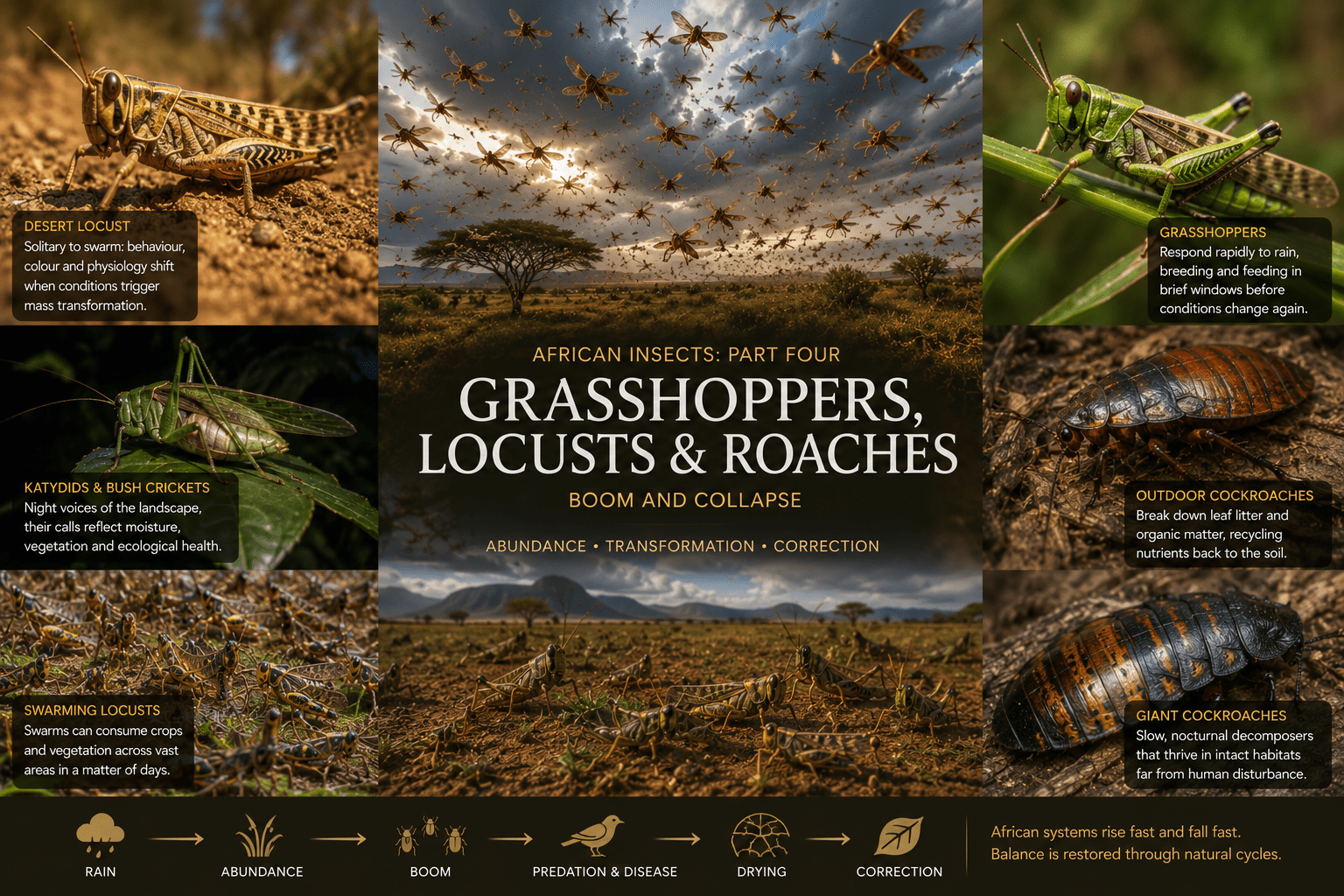
| A curated exploration of Africa’s most iconic, curious, and ecologically important insects |
| 4 Grasshoppers, Locusts & Roaches: Boom and Collapse |
| Few insects have influenced African history as dramatically as locusts. For thousands of years, swarms have crossed landscapes, consumed crops and altered the fortunes of entire communities. Their arrival has been recorded in stories, religious texts and farming records because the consequences could be immediate and severe. Yet the locust is not born as an unstoppable swarm. For much of its life, it may behave like an ordinary grasshopper. Only when environmental conditions combine in a particular way does the transformation begin. This ability to shift between relative obscurity and overwhelming abundance reflects one of the defining patterns of African insect life: long periods of restraint followed by sudden expansion. The transformation of the desert locust Desert locusts normally live in a solitary phase, scattered across dry landscapes where vegetation is sparse. After rainfall, conditions change. Plants emerge, and food becomes concentrated in areas that were previously barren. Locusts gather around these resources, bringing individuals into close contact. Crowding triggers changes in behaviour and appearance. The insects become more active, more social and increasingly likely to move together. Colouration may change, breeding accelerates, and groups begin to form. Eventually, these groups can develop into vast swarms. The shift is not simply an increase in number. It is a change in the way the insects behave. This is what makes locusts so extraordinary. The same species can exist in two radically different forms depending upon environmental conditions. For farmers, the distinction is devastatingly important. A scattered population may cause little noticeable damage. A swarm can consume vegetation across enormous areas. The scale is difficult to imagine from a garden. We may see caterpillars strip a plant or aphids gather on new growth, but a locust swarm affects entire landscapes. It is not eating for destruction. It is feeding because millions of insects have entered the same survival phase at once. Rain as the beginning of abundance The conditions that create locust swarms are the same conditions that restore life to dry regions. Rain produces grass, seeds and fresh leaves. Grazing animals benefit, birds breed, and insects multiply. Abundance brings opportunity, but also risk. Grasshoppers respond quickly to new vegetation, feeding and breeding while conditions remain favourable. Their populations can rise rapidly because the season may be short. Predators also increase. Birds, reptiles, mammals and other insects consume grasshoppers in large numbers. Disease spreads more easily through dense populations. As the landscape dries, food becomes scarcer, and numbers decline. What appears to be a boom followed by collapse is often the normal correction of a seasonal system. In European gardens, we are accustomed to aiming for stability. We water during drought, protect plants from frost and try to maintain growth over long periods. Many African insects operate differently. They do not expect stability. Their lifecycles are built around taking maximum advantage of favourable conditions before they disappear. The quieter grasshoppers Most grasshoppers never form destructive swarms. They live as part of the ordinary fabric of grassland and savanna, feeding on vegetation and providing food for countless predators. Their grazing influences plant growth, while their bodies transfer energy from grasses into birds, reptiles and mammals. They occupy an important position between plants and predators. It is easy to describe plant-eating insects purely as damaging. Gardeners often judge them by the holes they leave behind. Yet herbivory is part of how ecosystems function. Plants evolved under pressure from insects and grazing animals. Some respond to damage by producing new growth. Others invest in chemical defences, tougher leaves or different growth patterns. The relationship is not a simple battle in which one side must win. It is an ongoing exchange that shapes both plant and insect communities. Sound after dark Katydids and bush crickets contribute to another characteristic of African insect life: the night soundscape. In wetter regions, their calls can become a constant background noise after sunset. Different species produce different rhythms, creating an acoustic landscape that reflects vegetation, moisture and temperature. To people unfamiliar with it, the sound may appear overwhelming. To those who live within it, changes can be revealing. A sudden increase in calling may follow rain. Silence may indicate colder conditions, dryness or disturbance. These insects effectively broadcast the state of the ecosystem. Gardeners often rely on sight, but sound offers another way to read a landscape. Birdsong changes through the year. Frogs call after rain. Crickets become active during warm evenings. The living world is constantly reporting conditions, although we do not always recognise the language. Cockroaches beyond the kitchen Cockroaches suffer from one of the worst reputations in the insect world. Most people associate them with indoor infestations, poor hygiene and human disturbance. Across Africa, however, the overwhelming majority of cockroach species live outdoors. They inhabit leaf litter, soil, caves, rotting wood and forest floors, where they feed upon decaying organic matter. Their activity helps break down material and return nutrients to the soil. In tropical systems, decomposition must happen quickly. Plant growth is rapid, leaves fall continuously, and warmth supports constant biological activity. Outdoor cockroaches form part of this recycling network. Giant species may be slow-moving, heavy and nocturnal. Their size can make them appear alarming, but they are often harmless decomposers occupying intact natural habitats. Their presence may indicate a functioning forest floor rather than human neglect. This challenges the broad assumption that every cockroach is a household pest. As with wasps, flies and many other insects, a small number of troublesome species have shaped our opinion of an entire group. Nature is usually more complicated. Boom, correction and return Grasshoppers, locusts, katydids and cockroaches reveal different aspects of abundance. Locusts demonstrate how environmental pressure can transform behaviour. Grasshoppers show how quickly populations respond to rain. Katydids turn seasonal change into sound. Cockroaches continue the slower work of decomposition beneath the surface. Together they illustrate a system that expands and contracts rather than remaining constant. A wet season creates abundance. Predators, disease and drying conditions reduce it. Organic matter accumulates, and decomposers process it. Then the landscape waits for the next cycle. From a human perspective, these rises and falls can appear chaotic. We prefer predictable numbers and steady production. African ecosystems have evolved around fluctuation. The collapse is not necessarily a failure, just as the boom is not always a sign of permanent success. Both are parts of the same process. That may be the central lesson of this group. Survival does not always mean maintaining balance from one day to the next. Sometimes it means expanding rapidly when conditions allow and accepting decline when they do not. The landscape corrects itself, although not always gently. |
| About our writing & imagery Most articles reflect our real gardening experience and reflection. Some use AI in drafting or research, but never for voice or authority. Featured images may show our photos, original AI-generated visuals, or, where stated, credited images shared by others. All content is shaped and edited by Earthly Comforts, expressing our own views. |

