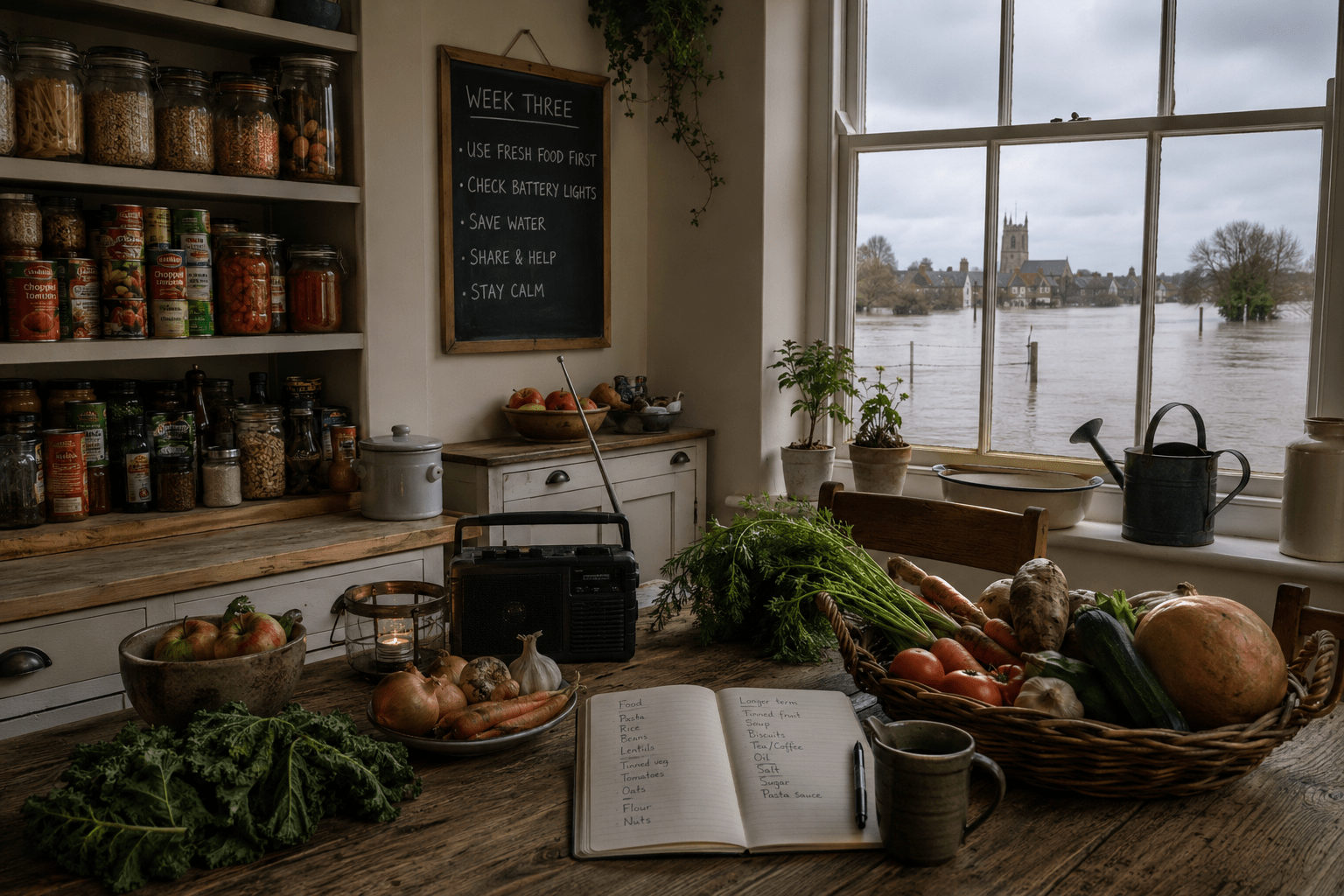
| Part Two: Life Inside the Walls The supermarket delivery didn’t arrive the following morning. Neither did the one expected later that day, although at first this seemed more irritating than significant. There was still food in the shop, there was certainly food in our house, and everyone had been told that engineers were working to restore the various routes into Sandwich. The rain had eased again and, looking outside, there was little about the town itself that suggested we were living through anything particularly extraordinary. People walked dogs, lights appeared in windows, and somewhere a church bell continued marking time with complete indifference to the fact that much of the surrounding countryside was now under water. By the third day, another limited delivery had reached one of the shops, although what arrived bore little relationship to what people actually wanted. This was our first lesson in the difference between food shortage and food choice. There was food, but you couldn’t necessarily decide what that food was going to be. Bread appeared briefly and disappeared. Milk did much the same. Fresh vegetables became increasingly scarce, which seemed faintly ridiculous when I knew perfectly well that our allotment lay beyond the flooded approaches, with vegetables growing on it. There were tins nobody appeared particularly interested in, unusual flavours of things that had presumably survived precisely because nobody normally bought them, and gaps where the everyday basics had once been. The authorities weren’t suggesting that Sandwich had been abandoned—quite the opposite. Emergency access was maintained, supplies were prioritised, and work continued reopening the roads. Some pedestrian routes remained possible when conditions allowed, although they were of limited use to anyone attempting to move substantial quantities of anything. We could leave the old town on foot by certain routes, but that didn’t mean we could conveniently reach the places we normally relied upon, and it certainly didn’t mean a forty-tonne supermarket lorry could follow us home. What had originally been described as disruption lasting a few days was now being discussed in terms of weeks. That single change of language altered everything. |
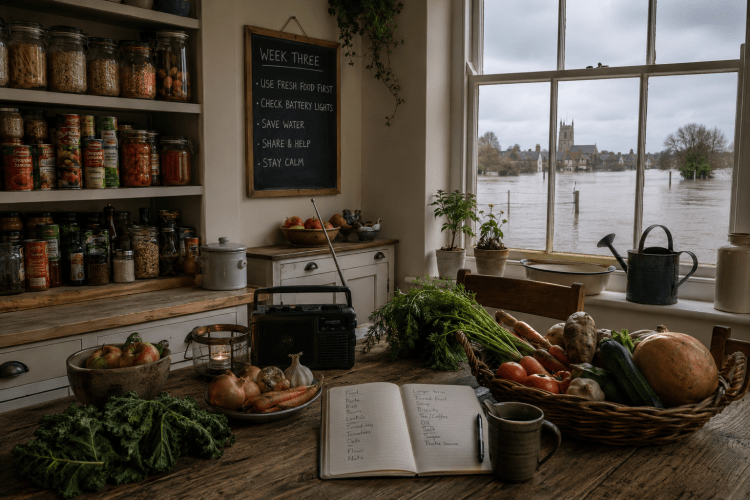
| What Do You Eat First? Until then we’d been eating fairly normally. There seemed little point in rationing food when the cupboards and freezer were full, and supplies were expected to resume shortly. Now we began looking at the kitchen rather differently, and the first problem wasn’t what we might eat in three weeks. It was what needed eating today. The fresh food became the priority. Tomatoes don’t care that the roads are closed. Bananas continue ripening. Courgettes soften, cucumbers deteriorate, and anything leafy begins reminding you that refrigeration slows nature rather than stopping it. Suddenly the sensible thing wasn’t to preserve our longest-lasting food but to consume the things most likely to become useless. That changed the way meals were planned. Instead of asking what we fancied for dinner, we started asking what needed using. It is a small distinction, but one that our grandparents and great-grandparents would have understood perfectly well. Modern abundance has allowed many of us to reverse the question. We decide what we would like and then obtain the ingredients. Once supply becomes uncertain, you look at what you have and decide what you can make from it. Fortunately, being non-meat eaters helped in some respects. We weren’t worrying about a freezer full of meat gradually thawing, and many of the foods we normally ate were already based around vegetables, pulses, grains and other ingredients that lent themselves reasonably well to improvisation. Unfortunately, fresh vegetables formed a large part of that diet, and our best source of them was currently on the wrong side of several feet of floodwater. The irony wasn’t lost on me. We had spent months growing food ourselves and were now more dependent on what happened to be in our kitchen than on someone who had never planted a seed. There was also the question of all that produce we’d given away before the flood. It would have been easy to start thinking that perhaps we should have kept it, but that would have been hindsight masquerading as wisdom. Food is grown to be eaten, not hoarded against disasters nobody expects to happen. The more useful lesson was simply that preserving some of a seasonal glut might have value beyond avoiding waste. A few jars, dried beans, bottled tomatoes or additional portions in a freezer aren’t evidence of expecting civilisation to collapse. They’re simply a way of moving August into November. The trouble was that our freezer was already full. And during the fourth night, the electricity went off. |
| When the Freezer Became a Problem The silence woke me before anything else did. Houses make a surprising amount of background noise when electricity is available, and when it disappears completely, something feels wrong even before you’ve worked out what it is. No hum from appliances, no tiny lights from chargers and routers, no refrigerator occasionally deciding to do whatever refrigerators do when nobody is paying attention to them. The power returned after about forty minutes. The following afternoon it went off again. This time it stayed off for several hours. Our little generator, bought for Earthly Comforts rather than the end of civilisation, suddenly became considerably more interesting. It could keep essential appliances going, but running it continuously would have been absurd. Petrol was now difficult to obtain and whatever fuel we had in the garage represented a finite number of hours of electricity. Once again, something that initially looked like independence turned out to be another form of dependency. We therefore began treating electricity rather as we were beginning to treat food: not as something unavailable, but as something worth thinking about before using. The freezer became the priority. We kept the door shut and resisted the almost irresistible urge to open it repeatedly to see whether everything was still frozen. When power returned, we allowed it to recover. If outages became longer, the generator could be used periodically to maintain temperature rather than running continuously. Phones could be charged while it was operating, along with rechargeable lights and anything else we genuinely needed. Television suddenly seemed rather less important. The internet was intermittent anyway. Mobile networks continued to function, although coverage became less reliable during power interruptions, and everyone appeared to be using their phones more than usual. Information had become valuable. So had rumours. One message claimed another road would reopen the following morning. It didn’t. Another said bottled water was arriving at a particular location and produced a queue before anyone had established whether the information was correct. Somebody else announced that the supermarket had received bread, which was true, though by the time most people heard, it had already gone. This was the strangest part of the whole experience. We weren’t cut off from information; we had too much of it, and nobody was entirely certain which parts deserved believing. The Town Begins to Change By the end of the first week, Sandwich still looked recognisably like Sandwich, but its rhythm had altered. There were fewer vehicles because there was nowhere particularly useful to drive them, while considerably more people seemed to be walking or cycling. Shops opened when they had something worth selling and occasionally closed early when they didn’t. Deliveries that did make it through became events rather than background activity, and people began learning approximately when supplies might arrive. Takeaways lasted longer than I expected. Some had stocks; others adapted their menus according to what they could obtain, but gradually the same supply problems that affected households reached them as well—having money and a telephone no longer guaranteed that somebody else could produce dinner. The extraordinary convenience of tapping a screen and having hot food appear at the door depends on an enormous, invisible chain of ingredients, packaging, electricity, fuel, workers, and transport. Remove enough links and the takeaway doesn’t fail dramatically; it simply stops answering the phone. The same applied to many other things we had barely considered. Refuse collections became irregular because vehicles couldn’t always reach the town—deliveries accumulated elsewhere. Pharmacies had to manage stocks more carefully, particularly for medicines that couldn’t simply wait until next week. Businesses whose employees lived outside Sandwich struggled to open normally. At the same time, residents who worked elsewhere discovered that being technically capable of leaving on foot wasn’t the same as being able to commute. Gradually, however, something else began happening. People adapted. Neighbours started asking one another whether they needed anything before going to the shops—someone who had managed to obtain milk shared it. People with vegetables growing in gardens suddenly had something useful to exchange. Apples began appearing in boxes outside houses. Those with rainwater storage found themselves surprisingly well equipped for jobs that didn’t require drinking-quality water. Bicycles acquired a usefulness beyond recreation, and wheelbarrows, trolleys, and old shopping carts began appearing in circumstances their manufacturers had probably never intended. Gardens became interesting in an entirely different way. As a gardener, I spend much of my working life thinking about gardens aesthetically and horticulturally. Does this plant belong here? Does that shrub need reducing? Is the lawn healthy? What should be flowering next? During those weeks, another question began to creep in: what does this garden actually provide? A mature apple tree suddenly looked rather magnificent. So did runner beans climbing somebody’s fence. Herbs, potatoes, tomatoes and squash had an obvious value, but even things we normally regard as slightly troublesome began looking useful. A rosemary bush wasn’t merely ornamental. Neither was a bay tree. Gardens that had spent years being judged largely on their appearance quietly revealed they could still serve an older function. Nobody dug up their lawn and planted potatoes on the eighth day. This wasn’t wartime Britain, and we weren’t starving. But I began looking at gardens differently, and I wasn’t the only one. Water Changes Everything Food occupied most of our thoughts initially, but water was the thing that changed behaviour fastest when problems eventually reached the supply network. It didn’t stop completely. That would have created an entirely different emergency, probably an evacuation, rather than the experiment we’re conducting here. Instead, pressure dropped in parts of the town, and short interruptions began to occur while pumping and treatment systems dealt with broader infrastructure problems. Residents were asked to conserve water and emergency bottled supplies were made available for those who needed them. That was enough. A tap that worked nine hundred and ninety-nine times out of a thousand suddenly became something you noticed every time you turned it. We stopped letting water run while doing things that didn’t require it. Washing-up water was used more thoughtfully. Rainwater, of which there was now an almost comic abundance outside, could deal with tasks for which treated drinking water was unnecessary. Containers were kept filled while supply was available, and the amount two people could use without ever consciously thinking about it became surprisingly apparent. Food can be stretched. Meals can become smaller, ingredients substituted and preferences abandoned. Water offers far fewer negotiations. That discovery changed us more quickly than anything else. Two Weeks In By the end of the second week, we weren’t hungry. We weren’t cold, and we weren’t sitting in darkness surrounded by empty tins. If somebody had photographed us eating dinner, there might have been very little indication that anything unusual was happening. But our behaviour had changed considerably. We knew roughly what food was left. We knew which things needed eating first and which could wait. We had become reluctant to waste anything. Petrol was measured not in litres but in potential generator hours. Charging a phone while the generator was already running seemed sensible; running it solely to charge one seemed ridiculous. Water containers were kept topped up. Trips outside the house tended to accomplish several things rather than one. Perhaps most significantly, the idea that normality would return tomorrow had disappeared. Officially, progress was being made. Water levels had begun falling in some areas, and engineers were assessing damage to roads, railway infrastructure and utilities. Limited supplies were reaching Sandwich via controlled routes, and nobody suggested the town faced anything resembling famine. Yet the surrounding floodwater wasn’t disappearing nearly as quickly as it had arrived. Saturated ground had nowhere to put it, further rain continued periodically, and some damaged infrastructure would need repairing rather than simply waiting for the water to recede. The estimate for something approaching normal access moved again—several more weeks. By then we’d stopped being surprised. What We Hadn’t Run Out Of One evening, perhaps somewhere around the third week, I looked again at the kitchen cupboards. They were noticeably emptier but nowhere near empty. The freezer still contained food, although its contents were being managed rather more carefully than before. The fresh allotment produce that had filled the kitchen at the beginning was largely gone, replaced occasionally by whatever could be obtained locally or arrived in limited shop deliveries. We were eating differently, but perfectly adequately. That wasn’t quite what I had expected when I first began this imaginary experiment. Beforehand, I’d assumed the interesting question would be how quickly our food disappeared. Instead, the more interesting discovery was how much ordinary consumption depends upon choice. Remove the ability to decide exactly what you fancy eating, and a surprisingly random collection of ingredients begins to last considerably longer. The half-used packets at the back of cupboards get noticed. Things bought for recipes that were never made finally acquire a purpose. Meals become combinations rather than plans. We had also discovered resources that weren’t visible in the photographs I’d taken on the first day. Neighbours. Knowledge. Tools. Gardens. The ability to repair something rather than replace it. The ability to cook from ingredients rather than instructions. The willingness to share something when you have too much of it and accept something when somebody else does. None of these appeared on my original inventory, yet by the third week they were beginning to look every bit as important as flour, rice or tins. That didn’t mean everybody behaved beautifully. There had been arguments in queues, rumours about hoarding, complaints that some households had received things others hadn’t and inevitable accusations that somebody somewhere knew more than they were admitting. Scarcity doesn’t magically make people virtuous any more than abundance does. But neither had Sandwich descended into the sort of chaos disaster fiction rather enjoys. Mostly, people got on with it. That was the least dramatic and most reassuring discovery of all. Day Thirty A month after the first road closed, the water surrounding Sandwich had begun to recede enough to reveal the landscape beneath. From above, fields reappeared in patches, hedgerows emerged, and stretches of road that had vanished beneath brown water became visible again. Seeing a road didn’t necessarily mean it was safe to drive on; however, inspections revealed damage caused by floodwater that had undermined surfaces and structures. The railway remained closed. One road was expected to reopen soon under restrictions. Nobody was prepared to say exactly when. Our allotment was still effectively beyond reach, although by now I thought about it less often. Whatever had happened there had happened. Some crops would have survived, others wouldn’t, and there was nothing particularly useful to be gained from imagining enormous marrows quietly taking over the plot in our absence. Inside the house, life had settled into something that would have seemed peculiar only a month earlier. We preserved what we could, wasted very little, kept water available, watched electricity use during periods of instability and regarded every reliable delivery into town as something slightly miraculous. The strangest thing was how quickly it had become normal. That evening there was another announcement. Engineers had completed an assessment of one of the main approaches and, provided water levels continued falling and temporary repairs held, controlled vehicle access might resume within the following week. A month earlier that would have sounded like dreadful news. Now it sounded extraordinary. But there was something else I hadn’t expected. After weeks spent learning how much we could manage without, I found myself wondering what would happen when everything came back. Whether we’d immediately return to buying whatever we wanted, whenever we wanted it, throwing away the occasional forgotten vegetable and letting the freezer fill with things we couldn’t remember putting there. Whether the water butt would once again become something useful mainly for plants. Whether the generator would return to the garage and become simply another piece of work equipment. Whether the gardens around Sandwich would go back to being judged by how they looked rather than by what they could provide. And perhaps most of all, whether we’d remember just how extraordinary it was that normally, without any of us thinking about it, thousands upon thousands of things found their way into this little town every day. We weren’t through it yet. But for the first time since the walls had effectively gone back up, we could see the possibility that they might soon come down again. |
| About our writing & imagery Most articles reflect our real gardening experience and reflection. Some use AI in drafting or research, but never for voice or authority. Featured images may show our photographs, original AI-generated artwork, or, where stated, credited images shared by others. All content is shaped and edited by Earthly Comforts, expressing our own views |

