| A curated exploration of Africa’s most iconic, curious, and ecologically important insects |
| 5 Mantids, Stick Insects & Predators: Patience Over Speed |
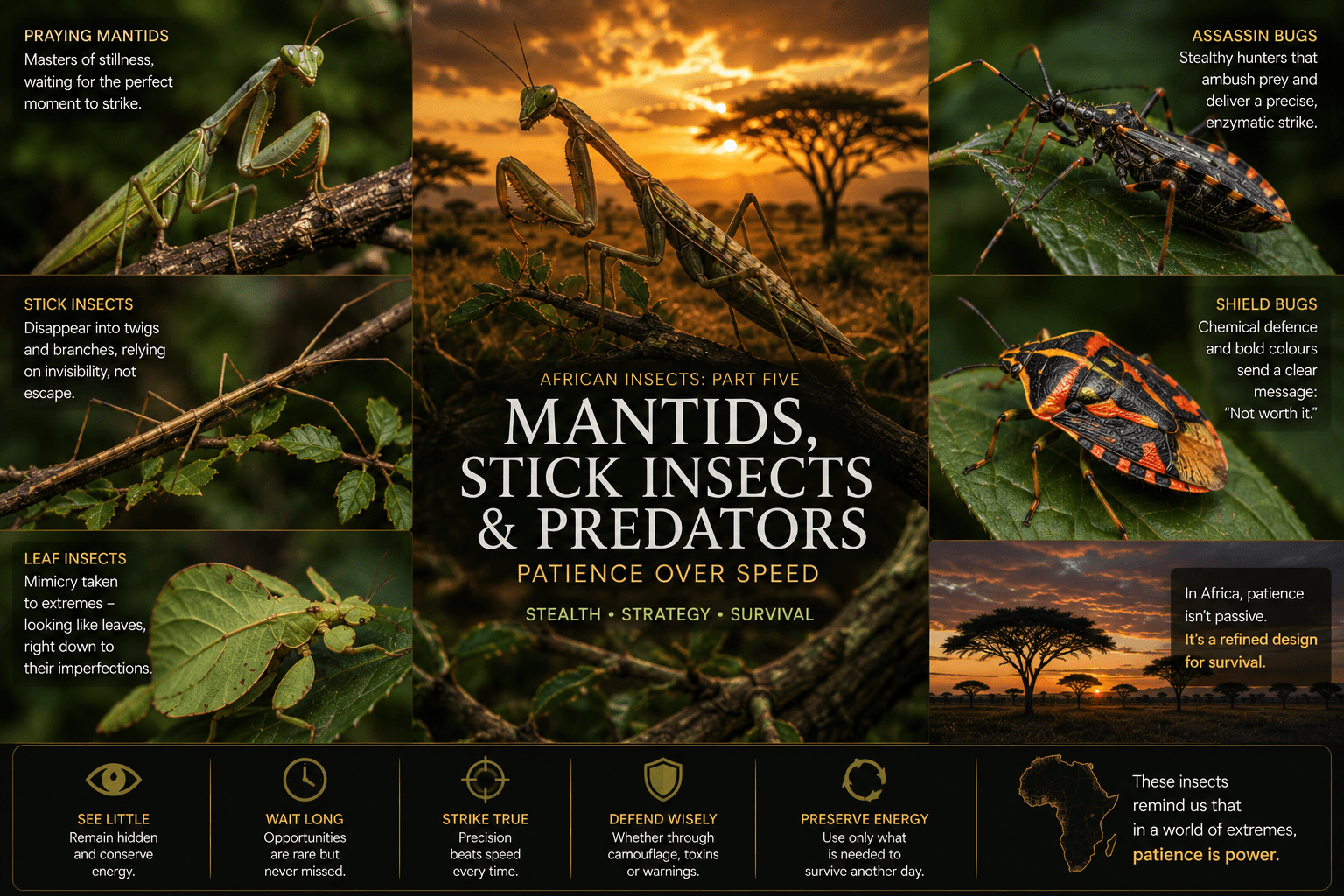
| Speed attracts attention in the natural world. A bird diving after prey, an antelope running across open ground or a dragonfly changing direction in mid-air creates an immediate impression of survival through movement. Many African insects succeed by doing the opposite. They remain still. In landscapes where heat is intense, and food may be unpredictable, unnecessary movement wastes energy and attracts danger. Camouflage, patience and precise action can therefore become more valuable than speed. Mantids, stick insects, leaf insects, assassin bugs and shield bugs all demonstrate different versions of this strategy. They survive by controlling when they are seen, when they move and when they strike. Patience, in their world, is not hesitation. It is efficiency. Mantids waiting within the vegetation Praying mantids are widespread across Africa and occupy habitats ranging from grassland and savanna to forest edges and gardens. Their upright posture and folded front legs give them an almost thoughtful appearance. In reality, the pose is one of readiness. A mantis may remain motionless for long periods, blending into stems, leaves or dry grass. When prey moves within reach, the front legs strike with extraordinary speed. The contrast is what makes the strategy so effective. Long stillness is followed by a fraction of a second of movement. This conserves energy and avoids the risks associated with pursuit. Rather than chasing insects across open ground, the mantis allows them to approach. Gardeners sometimes see stillness as inactivity. A border that is not flowering, a compost heap that appears unchanged or a plant waiting through winter can seem as though nothing is happening. Nature often works quietly before the visible result appears. The mantis embodies that principle. Its success depends upon doing almost nothing until action becomes worthwhile. Stick insects disappearing in plain sight. Stick insects take concealment even further. Their bodies resemble twigs, stems or narrow branches so closely that detection can be difficult even when the insect is directly in front of us. Some sway gently as they move, mimicking vegetation disturbed by the wind. Others remain still for hours, allowing predators to look straight through them. Their defence is not speed or aggression. It is invisibility. The effectiveness of this strategy depends upon context. A stick insect, when placed against the wrong background, becomes obvious. Among the plants it evolved alongside, it virtually disappears. This reveals an important truth about adaptation. Survival traits do not exist in isolation. They work because they match a particular environment. Camouflage is a relationship between the organism and its surroundings. When habitats are removed, or vegetation changes, that relationship can break down. The insect remains physically unchanged, but the background that once protected it has disappeared. Leaf insects and imperfect imitation Leaf insects, where present, refine mimicry to an extraordinary degree. Their bodies may resemble foliage complete with veins, irregular edges, blemishes and patches that look like decay. Perfect freshness would sometimes be less convincing. Real leaves are rarely flawless, so the insect copies both damage and structure. This is one of nature’s more subtle lessons. Survival does not always come from appearing ideal. Sometimes it comes from accurately reproducing imperfection. To a predator searching through vegetation, the insect becomes one damaged leaf among hundreds. Movement is kept to a minimum. Even the legs may resemble stems or leaf fragments. Detection depends almost entirely upon chance. Assassin bugs and precise attack Assassin bugs rely upon concealment for a different purpose. Rather than avoiding predators alone, they use stealth to approach or ambush prey. Their piercing mouthparts inject saliva containing enzymes that begin breaking down the prey internally. The insect can then feed upon the liquefied tissues. To human eyes, the process may sound brutal, but it is highly efficient. The assassin bug does not need to tear prey apart or engage in a prolonged struggle. Its success depends upon accuracy. During wet seasons, when insect populations increase rapidly, predators such as assassin bugs help prevent unchecked growth. They respond to abundance while conserving energy between opportunities. This makes them part of the broader regulating system within grasslands, forests and gardens. Aphids, caterpillars and other insects may multiply quickly, but predator populations follow. Balance is restored not by a single species, but through many specialised hunters acting at different levels. Shield bugs and learned avoidance. Shield bugs use another method entirely. Many possess chemical defences that make them unpleasant or harmful to eat. Rather than hiding completely, some species display bold colours that warn predators to leave them alone. The system depends upon learning. A bird or lizard that has an unpleasant encounter may remember the colour pattern and avoid similar insects in future. This reduces the need for repeated conflict. Chemical defence is therefore a form of communication. The insect advertises the cost of attack, while the predator learns to recognise the warning. There is a quiet efficiency in this arrangement. Both parties benefit from avoiding unnecessary injury. As with African honeybees, the behaviour makes sense only when viewed within the pressure surrounding it. Defence is not excessive when the alternative is constant predation. The discipline of using less What connects these insects is restraint. Mantids wait rather than chase. Stick insects avoid detection rather than escape. Leaf insects imitate ordinary foliage. Assassin bugs strike only when close enough to succeed. Shield bugs persuade predators that attack is not worthwhile. Each strategy reduces wasted effort. In hot or seasonally dry landscapes, this economy becomes essential. Movement increases water loss. Failed hunts consume energy. Exposure invites predators. The insect that acts constantly may be less successful than the one that knows when not to act. This gently challenges the assumption that survival always favours the fastest or strongest. In many situations, the decisive advantage belongs to the organism that spends the least energy achieving the necessary result. Gardeners understand this more than we sometimes admit. Good gardening is not constant intervention. It involves knowing when to prune, when to water, when to leave soil alone and when a plant needs time. Too much action can be as damaging as too little. Patience as an active strategy African mantids, stick insects and predatory bugs demonstrate that patience is not passive. Their stillness is deliberate and highly specialised. Every detail of body shape, colour and behaviour supports the same goal: survive without wasting resources. In environments where conditions can change rapidly, that restraint provides stability. An insect may wait through heat, scarcity or danger, then respond instantly when an opportunity appears. To us, a mantis resting on a stem may look inactive. A stick insect may appear to be nothing more than part of the branch. A shield bug may seem slow and vulnerable. Each impression is misleading. Beneath the stillness lies readiness. Africa’s insect predators do not always dominate through power or speed. Many survive through concealment, economy and the discipline to remain motionless until the precise moment arrives. Patience, in this setting, is not merely a virtue. It is a survival design. |
| About our writing & imagery Most articles reflect our real gardening experience and reflection. Some use AI in drafting or research, but never for voice or authority. Featured images may show our photos, original AI-generated visuals, or, where stated, credited images shared by others. All content is shaped and edited by Earthly Comforts, expressing our own views. |

