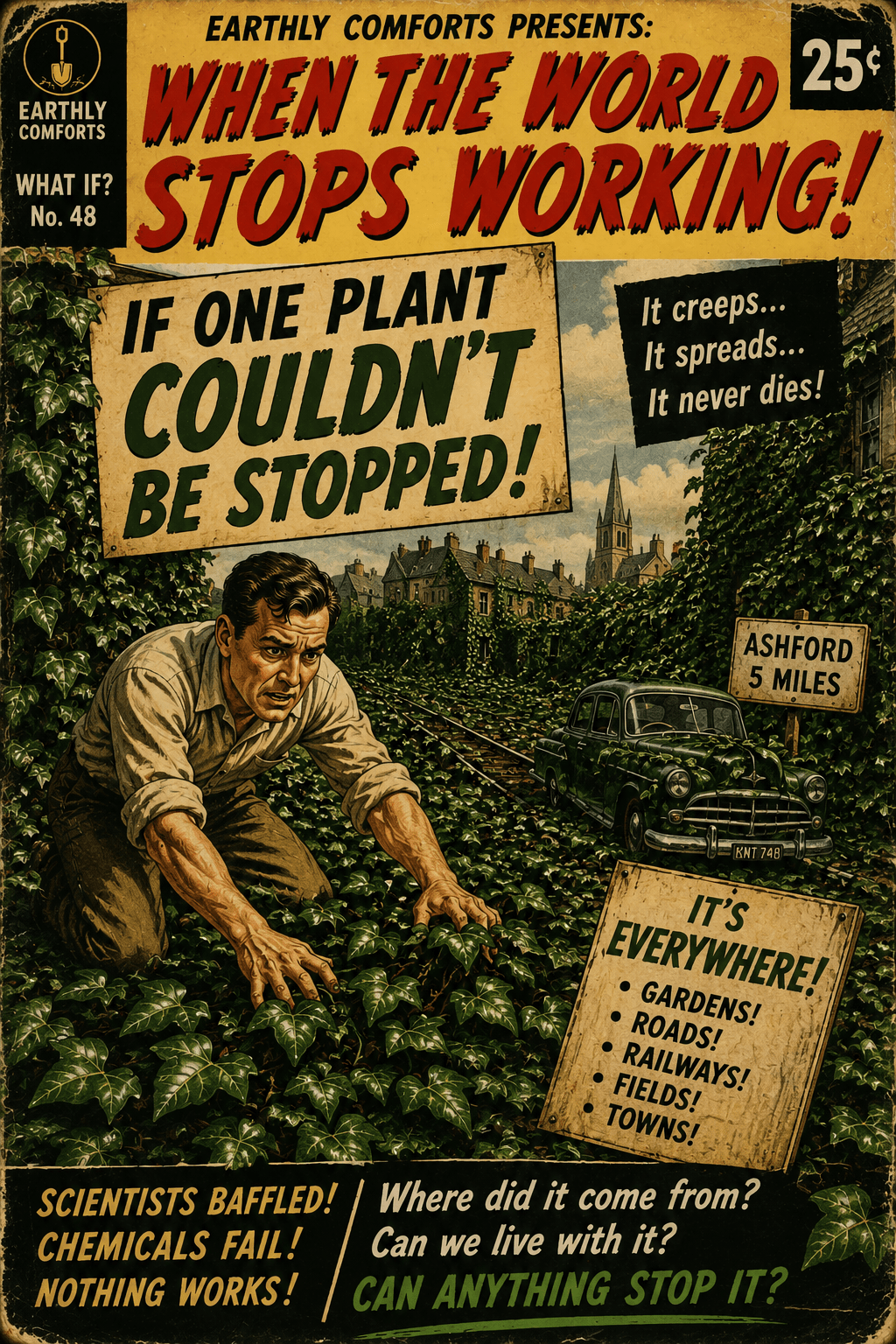
| Every gardener eventually encounters a plant that refuses to take a hint. You cut it back, and it returns. You dig it out and discover roots travelling in directions that suggest it had plans for neighbouring counties. You cover it, weaken it, remove every piece you can find and congratulate yourself on a job properly done, only to notice a small green shoot appearing three weeks later in precisely the place you cleared. Bindweed is particularly good at this. Ground elder has made something of a career from it. Ivy can spend years quietly establishing itself behind a shed before revealing that it now owns most of the fence. Gardeners become accustomed to persistence because persistence is one of the things plants do extraordinarily well. But imagine, just for a moment, that we encountered something rather more persistent than usual. Not a plant that grew particularly quickly, or one that attacked people, poisoned the soil or arrived dramatically from outer space. Just a plant that, once established, could not be stopped. I first noticed it in a client’s garden beneath an old hedge. There wasn’t much of it, perhaps a square metre at most, and nothing about it suggested that it deserved particular attention. The leaves were small, slightly rounded, and an unusual shiny green that deepened towards the edges. It travelled close to the ground on thin creeping stems, rooting wherever those stems touched soil. I didn’t recognise it, but that isn’t especially remarkable. No gardener knows every plant, whatever some may occasionally pretend, and gardens have a habit of producing things that have arrived from neighbouring properties, bird seed, compost or somewhere altogether unknown. The client didn’t remember planting it either and wanted the area cleared, so John and I pulled it out along with the other weeds, followed the stems back as far as we could and filled perhaps half a garden-waste bag. The soil underneath looked clean when we’d finished. I thought no more about it. Three weeks later we were back, and so was the plant. There wasn’t enough to be alarming, but there was certainly more than there ought to have been. Several brackish shoots had emerged beneath the hedge, and another had appeared almost two metres away beside the path. I assumed we’d left pieces behind, which is easily done with creeping plants, so this time I was more thorough. We loosened the soil with forks, traced every root we could find, and removed considerably more from underground than was visible above it. One root disappeared beneath a fence into the neighbouring garden, which at least explained where it might be coming from. I mentioned it to the client, suggested we keep an eye on it and left the border clean for a second time. When it returned, I became interested. Gardeners develop a relationship with difficult plants that sits somewhere between professional curiosity and personal irritation. Once something has resisted you twice, removing it becomes less a routine job and more a matter of principle. The third clearance was therefore comprehensive. We lifted nearby perennials, worked through the soil carefully and followed every strand we could find. Some roots were extraordinarily fine, almost threadlike, while others had thickened considerably in the few weeks since our previous visit. They ran beneath the hedge, beneath the path and into places where excavation wasn’t practical. I remember telling John that whatever the plant was, it certainly wanted to stay. Then, a few days later, I saw it in another garden. This one was two miles away. It was growing beneath a shrub beside a driveway, and there was no mistaking those shiny leaves. The client called it “that creeping green stuff” and said it had appeared earlier in the year. He’d already pulled it out several times. I dug up a section and compared it with what I’d seen in the other garden. Same leaves. Same fine travelling roots. Same peculiar ability to produce new roots wherever the stem touched the ground. Within a month, I was seeing it everywhere. At first, that wasn’t especially frightening either. New plants spread. Invasive plants spread particularly well, and Britain already has plenty that have escaped gardens and established themselves far beyond wherever somebody originally intended them to remain. Perhaps this was simply another. Photographs began appearing online from gardeners trying to identify it, and considerable disagreement persisted about what it actually was. Some thought it an unusual form of ground cover. Others suggested an escaped ornamental. Botanists became interested when samples failed to match anything convincingly, although even that wasn’t unprecedented. Plants hybridise, seedlings vary and imported species occasionally turn up where nobody expects them. The problem wasn’t identifying it. The problem was removing it. People tried everything. Digging worked temporarily, but the plant returned. Weedkillers damaged the leaves and sometimes appeared to kill entire patches, only for fresh shoots to emerge several weeks later. Heavy coverings suppressed it, but roots travelled beneath them and appeared beyond the edges. One local authority excavated a badly affected roadside verge and replaced much of the topsoil. The shiny green growth reappeared before the grass seed had properly germinated. Still, none of this amounted to disaster. It was simply another troublesome plant, and gardeners are used to troublesome plants. The advice was familiar: don’t allow it to establish, remove new growth promptly, avoid moving contaminated soil and dispose of material carefully. Garden centres began displaying notices. Councils added information to their websites. Gardening programmes discussed it. Somebody inevitably gave it a dramatic newspaper nickname, although most gardeners continued calling it the green creeper because that was easier. By the end of the first summer, however, the scale had changed. The plant had been recorded across much of southern England and increasingly further north. Railway embankments developed strange patches that expanded steadily along the tracks. Road verges became colonised. It appeared beside rivers and canals, along field margins, underneath hedges and through neglected industrial land. It wasn’t racing across the countryside overnight; that would almost have been easier to understand. Its progress was steady rather than spectacular. Every week there was simply a little more of it, and every place from which it had supposedly been eradicated seemed eventually to acquire it again. Winter should have helped. It didn’t. The visible growth died back after hard frosts, and for several months there was optimism that the plant might prove less formidable than feared. Then spring arrived. Across gardens, roadsides, railway lines and wasteland, millions of shiny shoots emerged almost simultaneously. Places cleared the previous year were shiny green again within weeks. Areas that had shown no visible growth before winter suddenly had it. That was when researchers began looking underground. What they found was considerably more unsettling than anything happening above it. The creeper produced a network of extraordinarily fine roots capable of travelling through tiny gaps in soil, broken masonry and gravel. More remarkably, detached fragments remained viable far longer than expected. A piece almost too small to see could, given sufficient moisture, begin again. But even this didn’t explain everything. Genetic testing from plants collected miles apart produced results so similar that researchers initially suspected contamination. Further samples produced the same result. Someone eventually asked a question that sounded ridiculous. What if these weren’t separate plants? Investigations followed root systems through gardens and beneath roads. Connections were found where nobody expected them. Roots passed underneath fences, travelled along drainage channels and followed disturbed ground beside pipes and cables. Nobody could trace them indefinitely because eventually they reached a point where excavation became impossible. Still, the possibility remained that what appeared above ground as thousands, perhaps millions, of individual patches was actually something much larger. One plant. Or at least something behaving remarkably like one. That was the moment public attitudes changed. Until then, the creeper had been a gardening problem. Now it became something closer to a national infrastructure problem. Railway operators cleared it from signalling equipment and trackside structures. Highways teams removed it from signs and drainage channels. Water companies discovered roots following damp ground around pipes. Farmers fought to keep it from cultivated fields, while councils concentrated resources on keeping roads, paths and public spaces usable. Gardeners found themselves doing exactly what we’d been doing from the beginning: cutting it back, digging it out and knowing perfectly well that we’d be doing the same thing again. There was never a dramatic moment when the country disappeared beneath shiny leaves. No city woke one morning to find itself completely engulfed. There were no screaming crowds fleeing advancing vegetation and no heroic scientist discovering the one chemical capable of destroying it five minutes before the end. Reality was considerably less theatrical and, in some ways, more unsettling. The plant continued. A wall that needed clearing twice a year eventually required monthly clearing. A railway cutting cleared in March required attention again in June. Footpaths narrowed. Empty buildings vanished gradually behind foliage. Every year more time, labour and money were spent maintaining the same boundaries. Yet something else happened that nobody had anticipated. Wildlife discovered it. The shiny creeper flowered late in the year, producing thousands of tiny pale flowers at precisely the point when many other sources of nectar were disappearing. Bees covered it. Hoverflies arrived in extraordinary numbers. Dense mats of stems provided shelter for insects and small mammals, while birds nested within thicker growth. Its berries, initially thought unimportant, became a valuable winter food source. In places where other habitats had been lost, the plant began supporting surprisingly complex communities. Suddenly the argument wasn’t simply about destroying it. Ecologists warned that removing vast areas simultaneously could now harm species that had begun to depend on them. Gardeners who had spent years fighting the plant were advised to leave some patches intact. Environmental organisations argued over whether something could still be considered wholly undesirable once the wider landscape had adapted to its presence. Farmers understandably took a different view when it was introduced into crops. Infrastructure operators cared considerably less about its ecological value when it blocked drains. The plant hadn’t changed. Our relationship with it had. Perhaps that was inevitable. Human beings are very good at fighting things when we believe victory is possible. Once victory becomes impossible, we become rather better at negotiation. Buildings began incorporating barriers designed to divert roots. New roads included wider vegetation margins. Railways developed permanent clearance zones. Gardens changed too. Instead of attempting to eliminate the creeper, people began maintaining boundaries. Deep edging appeared around borders. Certain areas were deliberately surrendered while paths, patios and buildings were defended. Gardeners became less concerned with eradication and more concerned with keeping the plant where we were prepared to tolerate it. There were still people determined to destroy every last piece on their land, and I understood them. There is something deeply irritating about being told to coexist with something you never invited into the garden. But eventually even the most determined discovered what the rest of us already knew. You could remove it. You couldn’t finish removing it. Years passed, and the countryside changed almost without anyone noticing the moment it happened. Old walls became shiny green. Neglected buildings disappeared more quickly into the landscape. Railway embankments acquired a colour that previous generations wouldn’t have recognised. Children grew up regarding the creeper as an entirely ordinary part of Britain, just as earlier generations had accepted plants that had themselves arrived from elsewhere centuries before. When older gardeners talked about the time before it appeared, younger people occasionally looked puzzled. I sometimes wondered about that first patch beneath the hedge. Had that really been where it began? Almost certainly not. By the time we’d noticed it, the plant must already have been elsewhere. Perhaps it had been spreading quietly for years. Perhaps there never was a single beginning anyone could identify. There was something strangely appropriate about that. Gardens are full of changes whose starting point we only recognise afterwards. Much later, I found myself back in that same garden, maintaining the boundary between the creeper and the path. The hedge was older, the garden had changed, and the plant now occupied an area nobody seriously attempted to reclaim. Birds moved through it. Bees worked the flowers. Somewhere beneath the leaves was an entire world that had learned to live with something we had once regarded only as an enemy. I finished cutting the edge and swept the path clean. For the moment there was a perfectly straight line between the paving and the shiny growth beyond it. It looked controlled, almost as though we’d finally established where the garden ended, and the plant began. I knew better. By the following week it would cross the line again, and I would cut it back again. Neither of us would win because, after all those years, winning was no longer really the point. Somewhere beneath my boots, it was probably already on the other side. |
| About our writing & imagery Most articles reflect our real gardening experience and reflection. Some use AI in drafting or research, but never for voice or authority. Featured images may show our photos, original AI-generated visuals, or, where stated, credited images shared by others. All content is shaped and edited by Earthly Comforts, expressing our own views. |


Sounds like the Kudzu vine that ate the South. It literally covers everything in its path.
LikeLiked by 1 person
There are some real nasty climbing vines around the world!
LikeLiked by 1 person
Yes, unfortunately.
LikeLiked by 1 person