
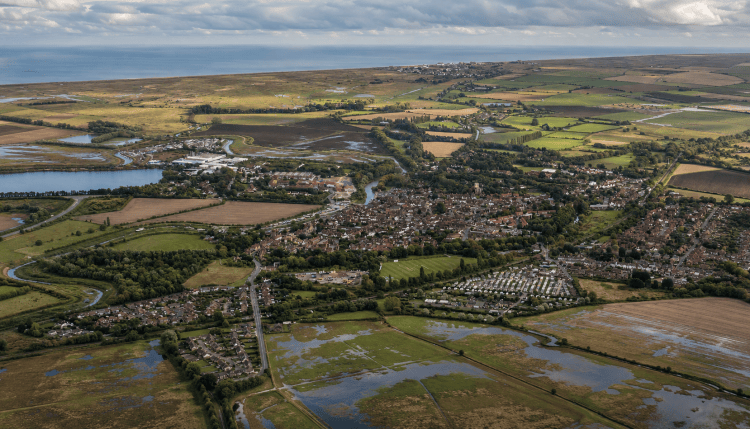
| Part Three: When the Roads Open Again By the time the first road reopened, nobody cheered. That may sound strange after several weeks of living in a town whose connection with the outside world had been reduced to controlled access, intermittent deliveries and whatever could be carried through by other means. I had imagined that the first proper vehicle entering Sandwich would feel momentous, that people might stand watching as though liberation had arrived in the form of an articulated lorry. In reality, it happened on an unremarkable morning beneath a grey sky. Temporary traffic lights controlled vehicles through a section of damaged road. Engineers remained stationed nearby, and the route could still be closed again if conditions deteriorated, but for the first time in weeks, ordinary traffic was being allowed through. It wasn’t normality, but it was a road towards it. The supermarket received a larger delivery that afternoon. Not everything ordered arrived, and there were still conspicuous gaps on the shelves. Still, there was bread, milk, fruit, vegetables and enough of the everyday things we’d stopped expecting to find reliably. People naturally bought more than they normally would, although by now there was considerably less panic about it. We’d learned that an empty shelf didn’t necessarily mean permanent shortage; sometimes it simply meant waiting. Over the following days other pieces of the town began reconnecting. Refuse collections became more regular, deliveries that had been sitting elsewhere finally arrived, and businesses started operating something closer to their usual hours. The railway remained problematic for longer, while some roads required substantial repairs before unrestricted traffic could return. The floodwater across the surrounding countryside retreated slowly, leaving mud, debris and fields that looked very different from those that had disappeared beneath the water weeks earlier. Sandwich had stopped being an island. What surprised me was how quickly that fact began to feel ordinary. |
| The First Proper Shop When we eventually went to buy food properly again, the supermarket seemed enormous. Of course, it hadn’t changed size. What had changed was our relationship with what was inside it. After weeks of looking at whatever happened to be available and constructing meals around it, being suddenly confronted with rows of different breads, dozens of sauces, and several varieties of essentially the same vegetable felt almost extravagant. Before the flood, I wouldn’t have thought twice about walking into a shop with an idea for dinner and buying whatever ingredients were required. During the isolation, that process had reversed. We looked at what we already possessed and made something from it. Now the old system had returned and with it came something I’d barely recognised as a luxury before: choice. We could have filled the trolley. Instead, we found ourselves doing something rather different. We bought what we needed. There was no particular virtue involved and several weeks of keeping a mental inventory of the kitchen had made us more aware of what was already there. I knew there was pasta in the cupboard, flour on the shelf and vegetables remaining in the freezer. Buying another packet simply because we were standing in front of one suddenly seemed unnecessary. The same applied to fresh food. Before the disruption, it was remarkably easy to buy something with every intention of eating it, only to discover it several days later, looking rather sorry for itself at the back of the fridge. Now, having spent weeks treating every fresh vegetable as something with a finite useful life, throwing food away felt different. I don’t imagine that feeling would last forever. Humans are extremely good at becoming accustomed to convenience. That was one of the things the experiment had demonstrated. Getting Back to the Allotment Reaching the allotment again was more emotional than reaching the supermarket. The supermarket represented the restoration of the system we’d always depended upon. The allotment represented something else entirely. For weeks I’d known that food was growing there while we were unable to reach it reliably. In my imagination, the courgettes had probably grown to the size of small submarines, the beans had gone beyond anything worth picking, and the tomatoes had either split, rotted, or staged a successful escape into neighbouring plots. Reality was less dramatic but considerably messier. Some crops had coped surprisingly well. Others hadn’t. Vegetables we’d normally have harvested at exactly the right stage had passed it, while weeds had taken full advantage of our absence. There was weather-related damage and plenty that would end up on the compost heap rather than the dinner table, but the allotment hadn’t failed because we weren’t there. It had simply continued. That struck me rather forcibly. During the weeks when roads, shops, electricity and water had all become things requiring management, the biological systems outside had carried on largely without reference to us. Seeds germinated, plants grew, fruit ripened and weeds occupied every opportunity we inadvertently provided. The allotment hadn’t needed a delivery schedule, an internet connection, or someone to coordinate logistics. It had needed soil, water, sunlight and time. Of course, that doesn’t mean an allotment could have fed us indefinitely. Ours certainly couldn’t. Growing vegetables is enormously useful, but there is a romantic tendency to confuse having a productive garden with being self-sufficient. We weren’t producing flour, rice, cooking oil, salt, coffee, tea or many of the other things sitting in our cupboards. Nor could two people suddenly transform a seasonal allotment into a complete food system simply because the supermarket stopped functioning. What it gave us was resilience, not independence. I think that’s an important distinction. What Sixty Days Actually Taught Us By around the sixtieth day, the emergency was effectively over. Not everything had been repaired, and the consequences of the flooding would remain visible for considerably longer, but Sandwich was connected again. Roads were open, deliveries were moving, utilities had stabilised, and the peculiar little economy that had developed inside the town was gradually dissolving as ordinary abundance returned. We hadn’t come remotely close to starving. That might sound as though the experiment had failed, because the question that started all this was essentially how long an ordinary household could survive if normal supplies stopped. Yet the opposite is true. Survival turned out to be much less dramatic and much more complicated than simply counting tins. The food we’d possessed at the beginning had lasted surprisingly well once we stopped assuming that every meal had to be exactly what we fancied eating. Fresh produce went first, cupboard ingredients became increasingly useful, and the freezer provided a substantial reserve. However, only because we retained enough electricity — and eventually generator fuel — to keep it running. We discovered that a full freezer is an excellent food storage option until the power supply becomes unreliable, at which point it becomes a race against the temperature. Water was more important still. Had the mains supply disappeared completely for any significant period, our situation would have deteriorated far more rapidly than it did through food shortages. A household can improvise meals from remarkably little, but nobody improvises their way out of needing safe drinking water. Of all the things I would think differently about afterwards, having a modest emergency supply of drinking water is near the top. The generator had been useful too, but it taught essentially the same lesson as the freezer. Technology doesn’t necessarily remove dependency; often it simply transfers it. The generator gave us electricity provided we had petrol. Petrol depended upon storage and eventual replenishment. A battery system would have depended upon charging. Solar panels would depend upon available daylight and sufficient capacity. Every solution has something standing behind it. The strongest resilience, therefore, came not from possessing a single miraculous piece of equipment but from having several imperfect options. The same was true of food. The allotment helped. The freezer helped. Cupboard staples helped. Shops helped whenever supplies reached them. Neighbours helped. None would have been enough indefinitely on its own, but together they provided layers. That may be what preparedness means—not preparing for the end of the world, preparing for one thing to stop working without everything else immediately falling apart. The People Inside the Walls There was another resource I’d completely failed to include when I first photographed our cupboards and freezer—other people. Disaster stories frequently assume that once resources become scarce, everybody immediately turns upon everybody else. There would undoubtedly be selfishness in any genuine emergency because people don’t suddenly become different creatures simply because the electricity goes off. Some would hoard, some would exploit shortages, and some would behave appallingly. But most people would do something much less cinematic. They would help somebody. During our fictional isolation, that became increasingly important. Someone had too many apples. Somebody else had batteries. One household had a useful tool, another knew how to repair something. Someone was walking to a shop and asked an elderly neighbour whether they needed anything. Vegetables were exchanged, information passed around, and people checked on those living alone. None of that made anyone self-sufficient. It made the town more resilient collectively. That is particularly interesting in somewhere like Sandwich because the old town isn’t simply a collection of houses. It is compact. People encounter one another. Streets connect, gardens back onto gardens, and the old walls form a surprisingly obvious boundary once you start thinking about them that way. For centuries those walls had been intended to protect the people within them from what might arrive from outside. In our experiment, survival depended upon getting things back through them. What Would We Change? This was the question I kept returning to once normal life resumed. Would I become a prepper? No. I have no particular desire to dedicate a room to twenty years’ worth of dehydrated meals, build a bunker beneath the garden or spend my evenings calculating how many tins of chickpeas civilisation requires. Preparing exclusively for catastrophe can become rather like living inside the catastrophe before it has happened. But would I look at our household differently? Absolutely. I’d want enough ordinary, long-life food to allow us to manage comfortably for a reasonable period without shopping, but, importantly, it would be food we already eat. Pasta, rice, flour, oats, pulses, nuts, seeds, sauces, tinned vegetables, preserves and similar staples aren’t emergency rations if they’re constantly being rotated through the kitchen. I’d probably preserve more from the allotment too. Not everything and certainly not to the point where August becomes an industrial operation involving every saucepan in the house, but enough that some of summer’s excess survives into winter. Freezing is convenient, although this experiment has reminded us why older preservation methods existed long before anybody owned a chest freezer. I’d keep some drinking water. I’d keep battery lights, power banks, and a radio somewhere sensible rather than having to find them individually in drawers during a blackout. If the business generator proved useful generally, we’d maintain a modest and legally appropriate fuel reserve rather than imagining that owning the machine alone had somehow solved the problem. Most importantly, I think I’d maintain options. Because the households most vulnerable to disruption aren’t necessarily those with the smallest cupboards. They’re the ones where every essential need depends upon a single system continuing to work. When Normal Became Invisible Again A few weeks after the roads reopened, a supermarket delivery van stopped outside a neighbouring house. I barely noticed it. That was the most revealing moment of the whole experiment. For weeks, the arrival of supplies had been noteworthy. Vehicles entering Sandwich carried things people were waiting for. A supermarket lorry represented food, a tanker represented fuel, and a utility vehicle represented someone trying to keep another invisible system running. Then normality returned, and the machinery of modern life became invisible again. That may be how it should be. Nobody wants to spend every morning feeling grateful that sewage systems function or marvelling at the fact that potatoes have arrived in a supermarket. Civilisation works partly because millions of complicated processes happen without demanding our attention. The danger is forgetting that they’re processes at all. COVID gave many of us a brief glimpse of that. Empty shelves, disrupted supply chains and restrictions suddenly exposed how much ordinary life depended upon systems we rarely noticed. They recovered, and most of us understandably returned to normal. The experience didn’t turn Britain into a nation of survivalists, nor should it have done. But it left a question worth occasionally asking. What if next time the interruption lasted longer? That was ultimately what The Last House made me wonder. Not whether I could survive some fantastical end of civilisation, but how quickly an ordinary household would have to change if the extraordinarily reliable systems surrounding it became unreliable for a while. Our fictional sixty days inside Sandwich suggest that the answer isn’t particularly frightening. We would adapt. We would waste less. We would eat differently. We would become extraordinarily interested in water, learn exactly what was lurking at the back of our cupboards and discover that a generator is only as useful as the fuel beside it. We’d probably complain, occasionally argue and spend far too much time reading rumours on our phones. We’d also share things, improvise, repair, grow, preserve and gradually become accustomed to circumstances that had seemed extraordinary only days earlier. And when the roads eventually reopened, we’d probably promise ourselves that we’d never again take any of it for granted. Then the supermarket shelves would refill. The taps would work. The lights would stay on. Deliveries would appear at the door, and the allotment would once again produce more courgettes than two sensible people could know what to do with. Life would become ordinary. Perhaps that’s the real answer to our question. Survival wasn’t hidden in a bunker or stored in a cupboard. It was spread across dozens of small things: some food put aside, water available, useful equipment, practical knowledge, a patch of productive ground and other people close enough to help when one household couldn’t solve something alone. The walls eventually came down again. But knowing what happened while they were up might change what we keep on our side of them. |
| About our writing & imagery Most articles reflect our real gardening experience and reflection. Some use AI in drafting or research, but never for voice or authority. Featured images may show our photographs, original AI-generated artwork, or, where stated, credited images shared by others. All content is shaped and edited by Earthly Comforts, expressing our own views |

