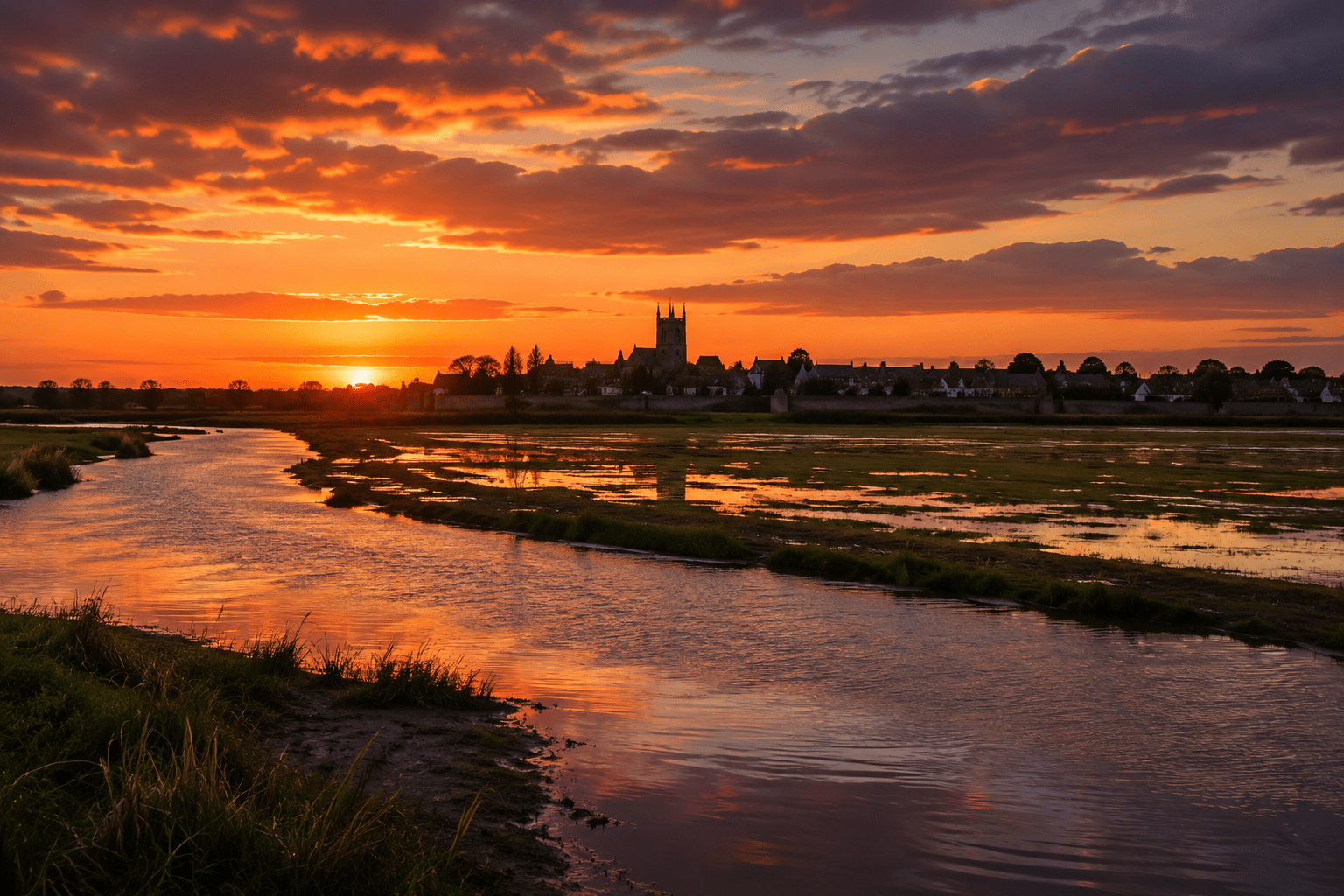
| Epilogue: What If the Rain Never Stopped There is a convenient assumption running through the three parts of this story. However difficult things became, somewhere in the background we always believed they would eventually be put right. Roads would reopen, electricity would stabilise, supermarket deliveries would return, and the floodwater would retreat. Even when the predicted few days became several weeks, we were still measuring the disruption against an ordinary world waiting for us on the other side. And after sixty days, that is essentially what happened. Sandwich gradually reconnected with everything beyond it; we returned to the allotment, and normal life began to reassert itself. Our experiment ended without anyone starving, society collapsing or the contents of our kitchen cupboards becoming particularly exciting. But what if it hadn’t? Suppose the rain continued, not endlessly every hour of every day, but as a succession of weather systems arriving before the landscape had recovered from the previous one. A few dry days would offer hope; water levels would begin to fall, and then another Atlantic system would arrive. Rivers would rise again, saturated fields would refill, and roads engineers had only just reopened would disappear beneath water for a second or third time. At first everyone would still talk about recovery. Eventually, I suspect, we would begin talking about adaptation. |
| Beyond Sixty Days By the third month, most of the food we photographed at the beginning of this experiment would have disappeared. The fruit bowl would have emptied during the first week, fresh vegetables would have been eaten or preserved where possible, and the comfortable abundance of the freezer and cupboards would have steadily diminished. The generator might still be useful, but petrol would by now be more important than the machine consuming it. Running it simply because we wanted electricity would seem absurd; fuel would be reserved for things that genuinely mattered. More importantly, our original experiment contained another comforting assumption: although Sandwich was isolated, the rest of the country wasn’t. Supermarkets elsewhere still had warehouses, fuel was available somewhere beyond the flooded roads, medicines could be prioritised, and engineers and emergency services could concentrate resources on the affected area. Now imagine that changing. Suppose the same relentless weather was affecting communities across Kent and then further afield. Rivers elsewhere were overflowing, railway embankments were failing, agricultural land was spending weeks underwater, and hundreds of towns were simultaneously asking for assistance. Government wouldn’t disappear and neither would the emergency services, but resources are finite. Sandwich would no longer be waiting for somebody to fix Sandwich; we would be one problem among many. That would change the nature of shortages. Money would remain useful, but money cannot purchase something that isn’t there. Medicines and drinking water would take precedence over luxuries, fuel for emergency services over unnecessary journeys, and the extraordinary range of choice we normally expect would contract long before food disappeared completely. Informal exchange would probably become increasingly common too. If somebody had more apples than they could use while somebody else had potatoes, eggs or something useful to offer, the solution wouldn’t require the collapse of sterling or the invention of some post-apocalyptic currency. It would simply require neighbours. Except by then, our summer abundance would also have disappeared. Winter Changes Everything We began our fictional disaster at the easiest possible time of year for somebody with access to productive land. Our allotment was overflowing with beans, courgettes, cucumbers, tomatoes, potatoes and squash. Gardens around Sandwich were producing fruit and vegetables and, even though we temporarily couldn’t reach our own plot, food was growing all around us. Move the experiment into November, December and January, and the landscape becomes considerably less generous. There would still be winter crops and stored produce, but the effortless abundance of August would be gone. This is where our grandparents and great-grandparents might recognise the problem rather more readily than we would, because for much of human history surviving winter meant carrying part of summer forward. Food was dried, bottled, pickled, fermented or otherwise preserved because January could never be expected to provide what August had. Today, our freezer performs much of that function until the electricity becomes unreliable. Then the older methods suddenly stop looking quite so old-fashioned. Jars and bottles become useful, preserving becomes practical rather than quaint, and anyone who understands how to do it safely possesses knowledge worth sharing. Seed takes on a different importance too, because once an emergency lasts long enough, you are no longer simply thinking about tomorrow’s dinner. You are thinking about what you can grow next spring. That is also when I think Sandwich’s gardens would begin to change. As a gardener, I’m accustomed to looking at gardens in terms of appearance, wildlife, maintenance and pleasure, and I wouldn’t want any of those things to disappear. But after several months of unreliable food supplies, productive plants would inevitably begin finding their way into ornamental spaces. A sunny border might acquire beans; potatoes might occupy containers previously filled with bedding plants; fruit bushes would become rather more desirable; and unused pieces of lawn might start looking suspiciously like potential growing ground. Greenhouses, compost heaps and water butts would acquire a new importance. So would the knowledge required to use them properly. Soil, propagation, crop rotation, drainage, composting and seasonality are ordinary gardening skills when everything else works. When supply chains become unreliable, they become part of a community’s resilience. The same would be true of countless other skills. Electricians, mechanics, plumbers, builders, nurses and engineers would possess the knowledge to keep essential things working. Someone who could repair a bicycle or sharpen a tool properly might become surprisingly popular because replacements would require something else to arrive, and fewer things would be arriving. Six Months Inside the Walls After six months, I don’t imagine Sandwich would look ruined. It would simply feel different. There would probably be fewer unnecessary car journeys because fuel was valuable, while bicycles, wheelbarrows, handcarts and trolleys would take on jobs normally done by vehicles. Footpaths that had once been recreational might become useful connections whenever conditions allowed, and the Stour itself could take on another role. There is a wonderful irony in that. The river, helping to isolate Sandwich, might also become one of the ways limited supplies could move. Sandwich became important historically because of water, not despite it. Boats couldn’t replace modern road haulage, but when roads were repeatedly impassable, moving even modest quantities by water could suddenly make sense again. The geography of the town would begin to matter in ways we’d largely forgotten. Places offering access, storage, shelter, growing space or water would become important, while the old walls themselves might regain a psychological significance. Nobody would need to rebuild them. After half a year spent living within roughly the same restricted area, the boundary between the town and the flooded landscape beyond would already feel real enough. Sue and I would have certain advantages in this situation. We know how to cook from ingredients; we have gardening knowledge, tools, and access to an allotment whenever it can be reached; and, through the business we own, we have practical equipment that could prove useful. But none of that would make us self-sufficient. Our allotment doesn’t produce everything two people need nutritionally; our house doesn’t have an independent drinking-water supply; the generator requires fuel, and the machinery eventually requires parts. Medicines cannot be grown alongside runner beans, and there are thousands of things modern society provides that no sensible household could reproduce for itself. That may be one of the most useful distinctions this entire experiment reveals. Self-sufficiency is extraordinarily difficult; resilience is much more achievable. A household doesn’t have to possess everything if somebody nearby has what it lacks. After six months, I suspect we’d know considerably more people in Sandwich than we had before the rain began, and not merely their names. We’d know who could fix something, who could grow something, who had tools, who understood electrics, who knew first aid and who needed somebody checking on them. They, in turn, would know what we could do. The town itself becomes part of the survival kit. A Year Later Suppose another summer eventually arrived and the weather still hadn’t properly settled. Some roads might have reopened permanently while others remained vulnerable. Supplies would reach Sandwich, but irregularly, and national food production could be under pressure after repeated flooding of agricultural land. Imported food would still be available, but disrupted transport and increased demand would make some items expensive and others difficult to obtain. Nobody needs to be starving in the streets for life to have changed considerably. By then, adaptations made during the previous year would have matured. More gardens would contain food, community growing spaces might have appeared and people would preserve more of what summer produced because they had learned exactly what winter felt like when supplies were uncertain. We would manage our allotment differently too, thinking not simply about what could be harvested today but about what would store, freeze, dry or preserve for months. I doubt we’d stop sharing surplus. If anything, we’d probably share more. But perhaps we wouldn’t give quite so much away simply because we hadn’t found time to process it. The objective wouldn’t be hoarding. It would be carrying abundance forward. That may be something our modern food system has allowed many of us to forget. Seasons still exist even when supermarkets disguise them. And this is where I would leave our imaginary Sandwich. Imagine standing on the old walls one evening, perhaps twelve months after the first road closed. Beyond the town, the landscape no longer looks quite as it once did. Some fields remain scarred by repeated flooding, trees stand in water where pasture once stretched beneath them, and sections of road are still being repaired. Everyone now watches weather forecasts with an attention previously reserved for deciding whether to take a coat. Behind us, however, Sandwich is alive. There is smoke from chimneys and people moving through the streets. Someone cycles past carrying vegetables. Gardens that once contained nothing edible now have beans climbing frames and squash wandering into places their owners probably hadn’t intended. Water butts stand beneath more downpipes and greenhouses are repaired rather than replaced. Children still go to school, dogs still require walking and someone, somewhere, is almost certainly complaining about the council. Life hasn’t become heroic. It has simply adjusted. Then somebody notices movement beyond the town. Far away, on a stretch of road that hasn’t carried ordinary traffic for months, there is a vehicle. At first it is impossible to tell what it is. It moves slowly, occasionally stopping where the road remains damaged before continuing towards Sandwich. Gradually other people notice it too, although nobody knows whether it carries supplies, engineers, news from somewhere beyond Kent or simply people searching for somewhere that has managed better than wherever they have come from. And perhaps that is where our experiment should end, because by then the question with which we began has changed. We wanted to know how long an ordinary household could survive if normal life stopped working. Sixty days suggested that with food, water, some preparation, practical skills and a functioning community, we might manage rather better than expected. But extend those sixty days into six months or a year and eventually every cupboard empties, fuel runs out, batteries fail and equipment breaks. Survival then becomes less about what we stored before the emergency and more about what we learned to do during it. It becomes about adaptation, useful knowledge, growing things, repairing things, and depending on other people without becoming entirely dependent on any single system. That may be what the walls represent in this story. Not protection from everything outside them, but the boundary around a community forced to rediscover how much it can do for itself. And somewhere beyond those walls, across a landscape that has still not entirely dried out, the vehicle keeps coming. |
| About our writing & imagery Most articles reflect our real gardening experience and reflection. Some use AI in drafting or research, but never for voice or authority. Featured images may show our photographs, original AI-generated artwork, or, where stated, credited images shared by others. All content is shaped and edited by Earthly Comforts, expressing our own views |

