| Why Garden Tools Deserve Looking After |
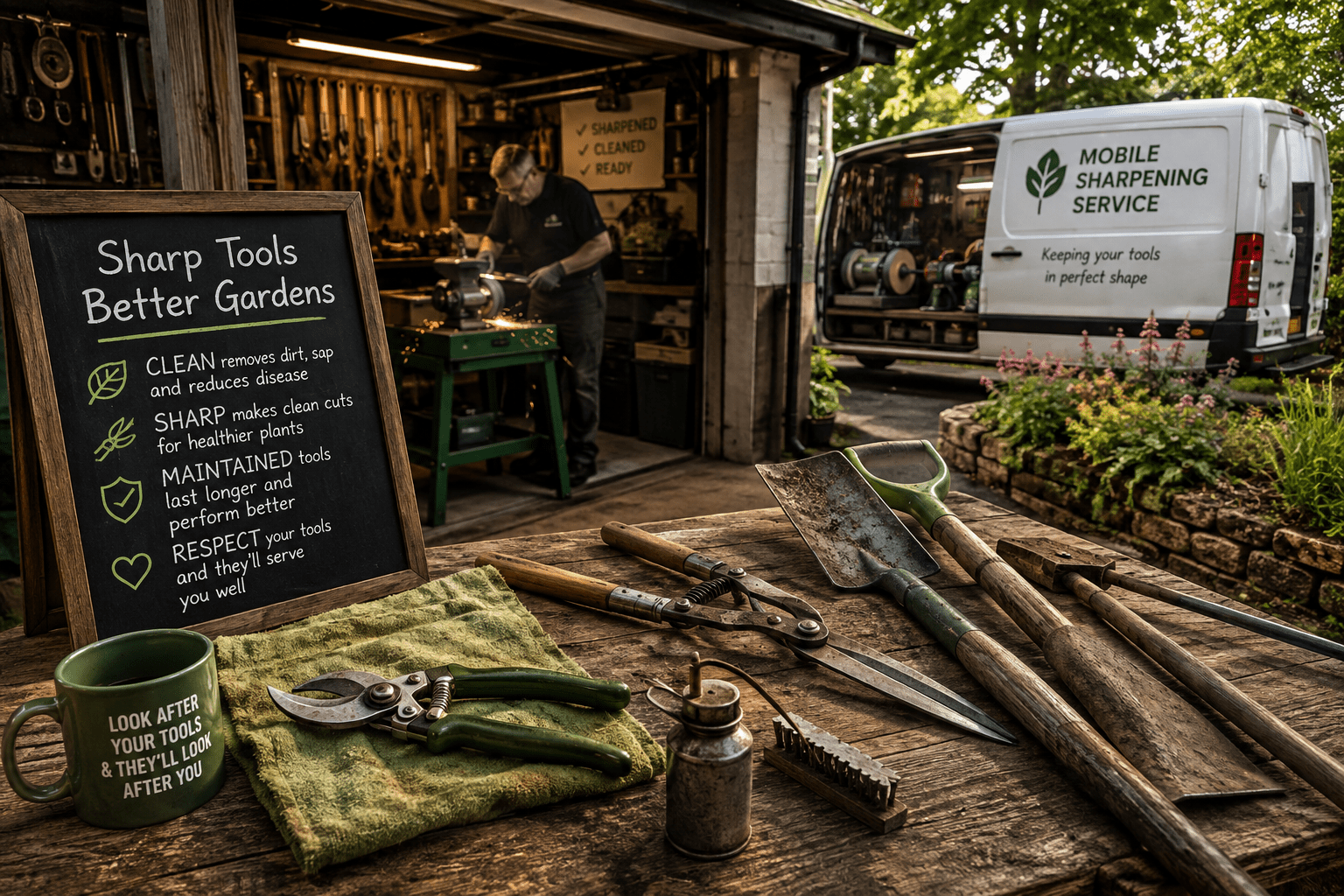
| I know a retired gardener who spent around forty years in the trade, and there is one part of the way I work that continues to baffle him. Every weekend, throughout the entire year — spring, summer, autumn and winter — a mobile sharpening service arrives at the garages where our gardening tools are kept. Not everything is sharpened every week, of course. The tools that have worked during the week are cleaned, checked and maintained, and those that need their edges touched up are sharpened. My retired gardening friend finds this routine rather amusing. Eventually, I challenged him. I asked how often he had sharpened his own tools while running a commercial gardening business. “Erm, maybe once a month to every eight weeks for the smaller tools. Mostly less. Probably once or twice a year for the mowers and bigger tools.” And therein lies an interesting difference between using a tool until it becomes blunt and maintaining a tool so that it doesn’t become blunt in the first place. |
| Sharp Tools Aren’t Just About Making Life Easier A well-maintained garden tool requires less effort from the person using it. Secateurs should cut rather than crush. Shears should slice rather than chew. A mower blade should cut grass cleanly rather than batter its way through it. But there is another reason that matters as much: the plant. A clean, sharp blade generally leaves a cleaner cut. Ragged, crushed or torn plant tissue creates a larger damaged area than necessary and can make recovery more difficult. When we prune a plant, we are deliberately creating a wound; the least we can do is make that wound as clean as reasonably possible. Then there is hygiene. Gardening tools travel from plant to plant and, in a commercial business, from garden to garden. Soil, sap and plant material can remain on blades and working surfaces. Cleaning tools therefore isn’t merely about making them look presentable. It forms part of sensible garden hygiene and helps reduce the possibility of carrying unwanted material between plants and properties. Maintenance Doesn’t Mean Grinding Everything Every Weekend There is an important distinction here. Regular maintenance does not mean attacking every blade with a grinder simply because Saturday has arrived. Over-sharpening unnecessarily removes metal and ultimately shortens a tool’s useful life. The principle is much simpler: Use it. Clean it. Inspect it. Maintain it. Sharpen it when required. Sometimes sharpening means little more than maintaining an existing edge with a few careful passes. Sometimes a mower blade has taken a knock and needs more attention. Sometimes nothing needs to be done at all beyond cleaning and lubrication. The objective isn’t to continually create a new cutting edge. It is to prevent a perfectly good one from deteriorating. Tools Are Part of the Gardener’s Craft This may be where my thinking differs from that of my retired friend. I don’t regard maintenance as something we do when a tool finally stops performing properly. I regard it as part of gardening itself. We expect gardeners to notice when a plant needs water, when a hedge needs shaping or when a lawn needs attention. Why wouldn’t we apply the same observation to the equipment in our hands? A gardener can have decades of experience, but experience wielding blunt secateurs doesn’t make the resulting cut any cleaner. Looking after tools also makes economic sense. Quality gardening equipment isn’t cheap. Cleaning away sap and soil, preventing corrosion, lubricating moving components, checking fixings, and maintaining cutting edges can all help keep equipment serviceable for longer. And there is something rather satisfying about beginning another week of gardening with equipment that is clean, checked, and ready to work. My retired gardener may still chuckle when the sharpening van appears every weekend. That’s fine. Forty years in gardening taught him his habits. My years in gardening have taught me mine. And I would much rather maintain a sharp tool than wait for a blunt one to remind me that I should have done it sooner. |
| About our writing & imagery Most articles reflect our real gardening experience and reflection. Some use AI in drafting or research, but never for voice or authority. Featured images may show our photographs, original AI-generated artwork, or, where stated, credited images shared by others. All content is shaped and edited by Earthly Comforts, expressing our own views. |

