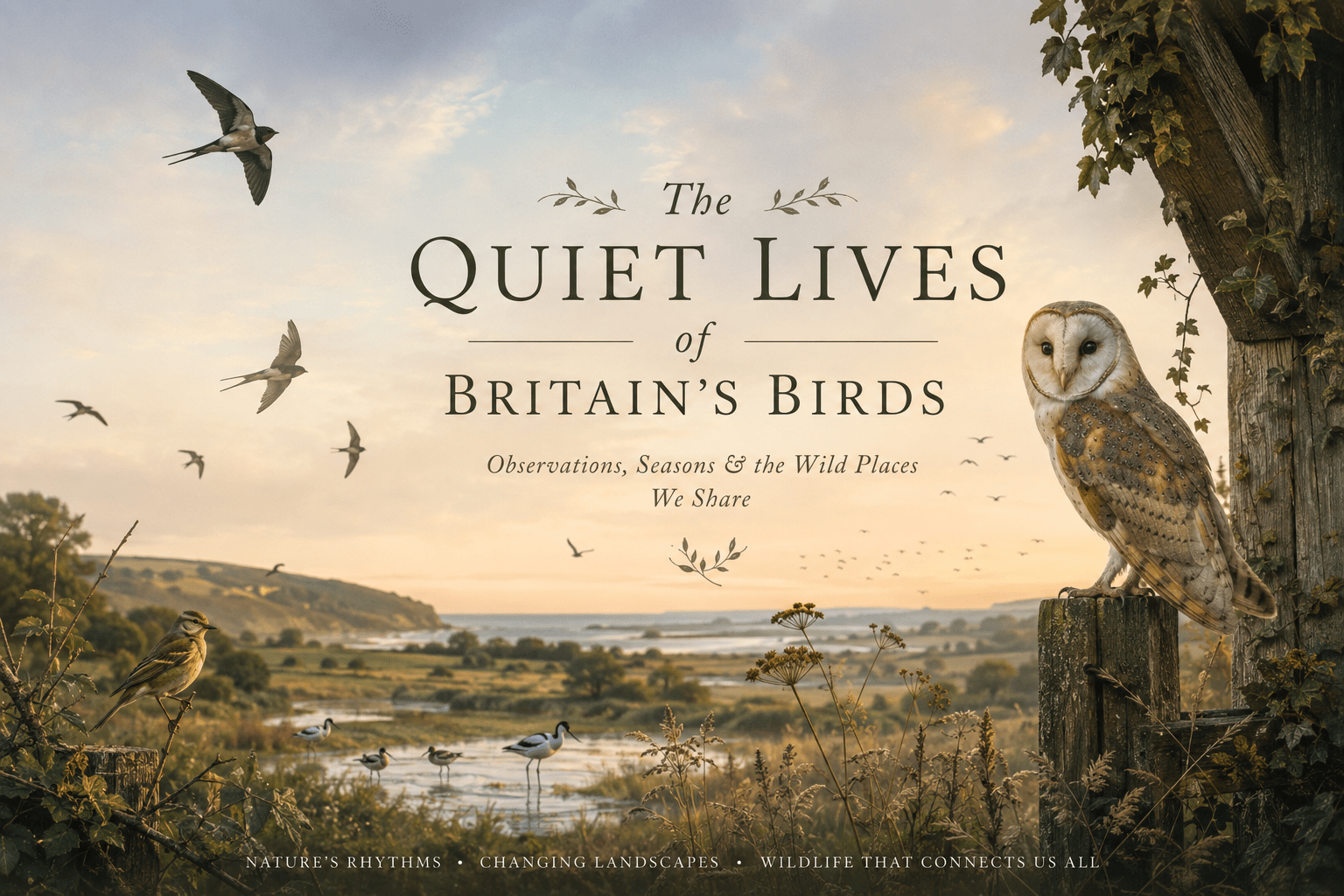
| Episode 1 The Barn Owl: The Bird That Teaches Us to Look More Closely |
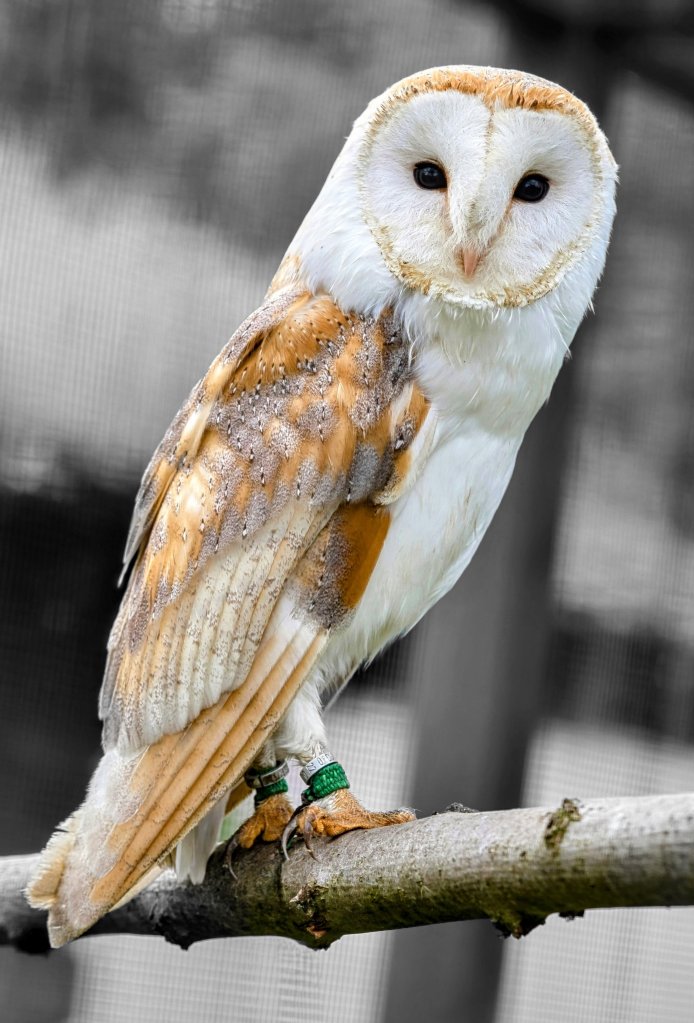
| There is a particular moment towards the end of a working day when a garden begins to belong to something else. The mower has long since fallen silent, the hedge trimmer has been put away, and the last pile of clippings has disappeared into the back of the van. Clients have retreated indoors, kettles have boiled, and curtains begin to glow with the soft light of early evening. It is tempting to think the day is over. In truth, it is simply changing hands. As gardeners, we spend much of our lives watching what happens in daylight. We notice the first buds of spring, the sudden flush of roses in June, and the weeds that somehow appeared overnight despite our best efforts just a few days earlier. Yet another shift takes place almost unnoticed. As daylight fades, an entirely different cast of characters begins to emerge, and perhaps none captures that quiet transition better than the Barn Owl. Unlike many birds, a Barn Owl does not announce its arrival with song. There is no cheerful chorus to alert you, no burst of colour catching your eye amongst the branches. Instead, it appears almost as though it has slipped through a fold in the evening itself. One moment the field is empty; the next, a pale shape is drifting effortlessly across the rough grass, scarcely seeming to flap its wings at all. The first time you witness this properly, it stays with you. Even if you know exactly what you’re looking at, there remains something unexpectedly otherworldly about it. Its pale plumage catches the last available light in a way that almost seems to generate its own glow. It is easy to understand why, for centuries, people wrapped Barn Owls in folklore and superstition. When a silent white bird appears from nowhere at dusk, the imagination quickly gets to work. The reality, however, is no less remarkable than the myths. Everything about a Barn Owl is designed for quiet efficiency. Its heart-shaped face is not simply one of nature’s more attractive designs; it functions like a carefully engineered listening dish, gathering the faintest sounds made by voles and mice beneath dense grass. Those broad wings, so graceful to watch, allow it to fly with astonishing silence. While many birds rely heavily on eyesight alone, the Barn Owl hunts by combining exceptional hearing with remarkably precise flight, often locating prey it cannot even see. That is one reason it continues to fascinate us. It succeeds not through speed or aggression but through patience and precision. As working gardeners, we often talk about creating wildlife-friendly spaces, yet we sometimes overlook what that really means. There is a temptation to believe wildlife responds simply to planting more flowers or installing another bird feeder. Those things certainly have their place, but the Barn Owl reminds us that nature works in longer chains of connection. A Barn Owl is never really looking for a beautifully mown lawn. In fact, the opposite is often true. It depends upon rough grassland where voles can tunnel, where insects thrive, where the entire food web has enough room to function. The owl itself is merely the visible tip of a much larger ecological story. Remove the rough margins, tidy every untidy corner, and simplify every field into perfect uniformity, and eventually the owl disappears too—not because anyone intended it to, but because everything it quietly relied upon vanished first. That thought has stayed with me more than once while working in clients’ gardens. Occasionally someone apologises for a slightly wilder patch tucked away behind a shed or along the back fence, almost embarrassed that it isn’t perfectly manicured. More often than not, that untidy strip turns out to be the busiest part of the entire garden. Beetles disappear beneath fallen leaves. Wrens dart through tangled stems. Hedgehogs investigate after dark. Field mice leave delicate tracks through longer grass. It may not look particularly impressive from the patio, but nature rarely measures success by neatness. Inconveniently for gardeners, wildlife often seems rather fond of what people describe as “mess.” That does not mean every garden should be abandoned to chaos. There is a difference between neglect and thoughtful management. One is simply giving up. The other is understanding that every living landscape benefits from variety. A closely cut lawn has its place. So does a rough edge, an uncut bank, a forgotten corner where grasses sway through summer before finally collapsing beneath winter frost. It is in those quieter places that countless unseen lives continue. The Barn Owl has also become something of a symbol for the changing British countryside. Once closely associated with old barns, church towers and hollow trees, it adapted remarkably well to working landscapes for generations. Modern life, however, has altered much of that familiar world. Older farm buildings have disappeared or been converted, roadside traffic presents new dangers, and increasingly intensive land management leaves fewer hunting opportunities than many people realise. Yet there are encouraging stories too. Farmers, conservation groups and landowners have installed nest boxes where traditional sites have been lost. Rough field margins are once again being valued in some areas, not simply for Barn Owls but for the countless species that depend upon more varied habitats. It is a quiet reminder that conservation is rarely about dramatic interventions. More often, it succeeds because enough people each make small, thoughtful decisions. Perhaps that is something gardeners understand instinctively. We know that a landscape is not transformed in a single afternoon. It changes gradually through hundreds of modest choices, each one almost insignificant on its own but powerful when added together over time. One assumption worth gently questioning is the idea that Barn Owls belong only in remote wilderness. Certainly, they need suitable habitat, but they are often far closer than people imagine. They hunt over meadows beside villages, rough field edges behind housing estates and pockets of farmland that many of us drive past without a second glance. The difficulty is not always that they are absent. More often, we aren’t outside at the right moment to notice them. That is the greatest lesson they offer. Modern life encourages us to finish our day just as the natural world begins another. We close the front door precisely when the evening shift is starting. The blackbird quietens. Bats emerge. Moths begin to move. Foxes become bolder. Somewhere beyond the hedge, if conditions are right, a pale owl may already be drifting silently over the grass while hardly anyone is watching. The Barn Owl asks very little of us. It does not seek admiration or attention. It simply requires a landscape rich enough to support the countless small lives upon which it depends. In return, it offers one of Britain’s most unforgettable wildlife encounters—not with noise or spectacle, but with silence. Perhaps that is why seeing one never really feels like ticking another species off a list. It feels more like being briefly allowed into a world that was already there, carrying on quite happily without us, waiting only for us to slow down enough to notice. Watching For… If you hope to see a Barn Owl, resist the temptation to head for the wildest place you can find. Instead, look for quiet farmland, rough grassland, old pasture or meadow edges as daylight begins to fade. Arrive a little earlier than you think you need to, stand still, and allow your eyes to adjust to the changing light. You may wait half an hour and see nothing at all—or you may witness a pale shape floating silently across the field, reminding you that some of Britain’s most extraordinary wildlife has never really been far away. |
| About our writing & imagery Most articles reflect our real gardening experience and reflection. Some use AI in drafting or research, but never for voice or authority. Featured images may show our photos, original AI-generated visuals, or, where stated, credited images shared by others. All content is shaped and edited by Earthly Comforts, expressing our own views. |

