| Episode 2 The Common Cuckoo: The Bird We Know by Voice |
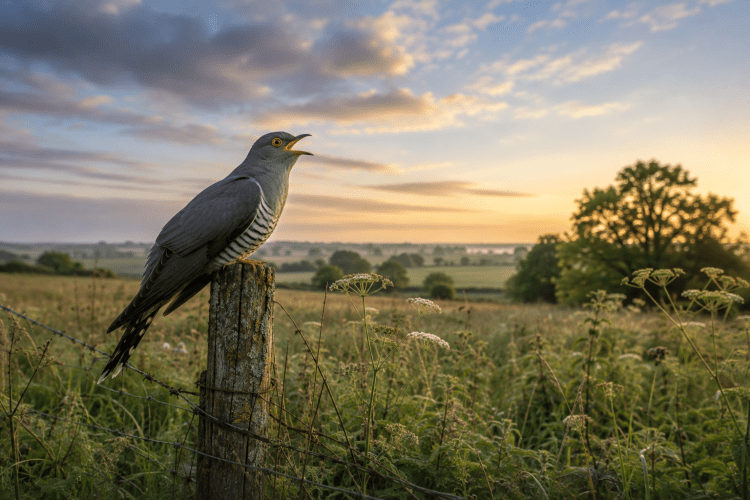
| There comes a point in spring when you stop looking for signs that the season has changed because they are suddenly everywhere. Lawns that seemed reluctant to grow a few weeks earlier need cutting again, hedges are beginning to lose the tidy lines we gave them, and weeds have rediscovered their enthusiasm with quite remarkable speed. You can spend an entire winter waiting for growth to return, only to find yourself wondering by May whether it might occasionally consider slowing down. And then, somewhere beyond the garden, you hear it. Cuckoo. There can be few birds in Britain whose identity is so completely contained within two notes. You do not need binoculars. You do not need to see the bird sitting conveniently on a branch. You may not even know precisely where the sound came from. Yet almost immediately, you know what you have heard. For generations, the Common Cuckoo (Cuculus canorus) has been one of the sounds by which we have measured spring. It has found its way into poetry, folklore, clocks and childhood memory to such an extent that the call sometimes feels more familiar than the bird itself. Ask someone to imitate a cuckoo, and they will probably have a go. Ask them to describe one, and things may become rather less certain. That is partly because cuckoos are surprisingly easy to overlook. They are reasonably large birds, with long tails, pointed wings and greyish plumage, yet their appearance is not particularly flamboyant. In flight, they can even be mistaken at first glance for a small bird of prey. The male gives us the familiar call, while the female makes a quite different bubbling sound. For a bird that has lent its name to one of the most recognisable calls in nature, it has managed to keep quite a lot about itself comparatively private. That may be appropriate, because the cuckoo lives one of the strangest lives of any bird visiting Britain. A Rather Unusual Arrangement Most birds spend spring doing what we expect birds to do. They find a mate, establish a territory, build a nest, lay eggs and then spend an exhausting few weeks feeding offspring that appear capable of swallowing considerably more food than their own body weight ought reasonably to allow. The cuckoo has arrived at a different arrangement. Rather than building a nest and raising her own chicks, the female lays her eggs in the nests of other birds. Meadow Pipits, Dunnocks and Reed Warblers are among the species commonly used in Britain, although different female cuckoos tend to specialise in particular host species. Remarkably, their eggs can resemble those of the birds that use their nests. This behaviour is known as brood parasitism, although the clinical term hardly conveys what follows. Once hatched, the young cuckoo instinctively pushes the host’s eggs or chicks from the nest. The foster parents are then left raising an offspring that rapidly becomes considerably larger than they are. There is something almost absurd about seeing a tiny Reed Warbler feeding an enormous cuckoo chick which, by any sensible assessment of the situation, ought to have raised suspicions some time ago. It is tempting to regard this as cruel. Human beings are very good at applying human morality to wildlife, particularly when one animal behaves in a way that would make for an uncomfortable conversation around our own dinner table. But nature isn’t cruel in the human sense. Nor is it kind. The cuckoo is simply following a reproductive strategy that has evolved over an extraordinary length of time, while the host species have evolved their own countermeasures. Some birds recognise and reject cuckoo eggs. Cuckoos, in turn, have evolved increasingly convincing imitations. It is an evolutionary contest that has been continuing quietly in hedgerows and reedbeds long before anyone thought to describe it. And it reminds us of something we occasionally forget when gardening for wildlife: nature is not always harmonious. A wildlife-friendly garden does not become a small sanctuary where every creature politely cooperates with everything else. Caterpillars eat plants. Birds eat caterpillars. Sparrowhawks eat birds. Wasps take insects. Foxes take whatever opportunities present themselves. The living garden works precisely because all these relationships exist together, even if some of them may appear uncomfortable when viewed individually. Nature has never promised to behave according to our preferences. A Bird That Doesn’t Stay There is another remarkable part of the cuckoo’s story that its familiar call gives little hint of. The bird calling from somewhere across a British field in May has travelled thousands of miles to get here. Our cuckoos spend the winter in Africa. Adults generally return to Britain from April onwards, with males typically arriving first. They breed here and then begin leaving remarkably early. Some adults may already be heading south again in July, when most of us still consider ourselves in the middle of summer. The young birds follow later. That presents one of those questions about migration that becomes more astonishing the longer you think about it. A young cuckoo has not been raised by its biological parents. No experienced adult is waiting beside the nest to show it the route to Africa. Its foster parents certainly cannot help; they may never travel anything like that distance themselves. Yet the young cuckoo eventually leaves and undertakes that journey. Somewhere within this bird is an inherited navigational programme sufficiently sophisticated to send it across continents towards wintering grounds it has never seen. We sometimes talk about animal instinct as though giving it a name would explain it. It doesn’t. Occasionally it merely gives us a convenient word for something extraordinary. The Silence We Notice There is, however, another reason the cuckoo deserves a place near the beginning of this series. For many people, it isn’t hearing one that has become remarkable. It is not hearing one. Older readers will sometimes tell you that cuckoos once seemed to be everywhere. Memory needs to be treated carefully—we tend to remember unusual moments more vividly than ordinary ones, and childhood landscapes often acquire an abundance that may not withstand closer examination. Nevertheless, in the case of the cuckoo, the broader evidence supports the sense that something has really changed. The Common Cuckoo has undergone a substantial long-term decline in the UK, although the picture is complicated. Numbers and trends vary by region, and there are still places where the call remains a familiar part of spring. But across much of the country, particularly in parts of southern Britain, hearing a cuckoo is no longer something we can assume will happen. The reasons are equally complicated. A bird migrating between Britain and sub-Saharan Africa does not depend on a single habitat or even a single country. Conditions on its wintering grounds matter. So do the landscapes it crosses during migration. Here in Britain, it needs healthy populations of suitable host birds, but it also requires abundant food. Cuckoos have a particular liking for large caterpillars, including hairy species that many other birds avoid. That immediately connects their fortunes with something gardeners encounter every year: insects. We often think about insects individually. A caterpillar eating the leaves of a prized plant is a pest. An aphid colony on a rose is a problem. A moth fluttering around the porch light is perhaps tolerated provided it doesn’t come indoors. From the cuckoo’s perspective, however, insects are not gardening problems. They are food. And when insect abundance changes, the effects do not stop with the insects. What Gardens Have to Do With It Few of us are going to attract a cuckoo into an ordinary suburban garden simply by allowing the grass to grow a little longer. It would be misleading to suggest otherwise. Cuckoo conservation operates at a landscape scale, involving woodland, heathland, wetlands, farmland and the wider countryside. But gardens are part of landscapes. The choices we make within them contribute to the overall abundance—or scarcity—of insect life. A garden containing varied plantings, native and non-native flowers, shrubs, grasses, trees, and a few places where nature is permitted some freedom will usually support considerably more life than one reduced to paving, artificial grass, and a handful of ornamental plants. Even our attitude towards caterpillars matters. Not every chewed leaf requires intervention. One of the practical lessons gardening teaches eventually—usually after considerable resistance—is that a plant does not need to look perfect to be healthy. A few holes in leaves are often evidence that the garden is functioning rather than failing. The same applies to tidiness. Leaving some stems standing through winter provides shelter. Allowing a patch of grass to grow longer creates habitat. Avoiding unnecessary pesticide use protects far more creatures than the particular insect we happened to notice. None of these actions will single-handedly save the cuckoo. That is not really the point. They help maintain the lower layers of the ecological pyramid upon which birds ultimately depend. Conservation sometimes becomes so focused on charismatic species that we forget the less glamorous organisms underneath them. Yet without caterpillars, beetles, moths and other invertebrates, much of the birdlife we treasure cannot exist. The cuckoo is therefore connected to our gardens even when it never visits them. Listening for Spring That may be why its call has acquired a slightly different meaning. For generations, hearing the first cuckoo was simply an announcement that spring had arrived. People wrote down the date. Newspapers received letters reporting the first call. Children learned the sound before they ever saw the bird that made it. Today, hearing one can feel more like an encounter. You stop. You listen again. Was that really a cuckoo? And when the call comes a second time from somewhere beyond the trees, there is a peculiar satisfaction in knowing that this bird has crossed continents and somehow ended up within earshot of where you happen to be standing. We should resist turning every such moment into a gloomy meditation on decline. Wildlife deserves to be enjoyed as well as worried about. Conservation that consists entirely of bad news eventually leaves people feeling powerless, and powerless people tend to turn away. The cuckoo is still coming. Every spring, birds leave Africa and make the journey north. Males return to familiar landscapes and call across woodland edges, heathland, marshes and open countryside. Females begin their extraordinary search for host nests. Young cuckoos will hatch beneath birds that are not their parents and, months later, somehow set off towards a continent they have never visited. All of that is still happening around us. But we should listen more carefully than we once did. Because one of the strange things about changes in nature is that we don’t always notice the moment something begins to disappear. There is rarely a final announcement. No one tells us that the bird we heard this spring might be one we don’t hear next spring. Usually, the countryside becomes a little quieter. And eventually someone notices. Watching For… Listen for cuckoos from April into early summer, particularly around woodland edges, heathland, wetlands, reedbeds and open countryside. Early morning can be especially rewarding, although the familiar call may carry considerable distances at other times of day. If you hear one, don’t immediately rush towards the sound. Stop and watch the skyline, fence posts and exposed branches instead. You may eventually see a long-tailed, pointed-winged bird crossing the landscape with a flight that can look surprisingly hawk-like. And if you only hear it, that is enough. With the cuckoo, the voice has always been half the encounter. |
| About our writing & imagery Most articles reflect our real gardening experience and reflection. Some use AI in drafting or research, but never for voice or authority. Featured images may show our photos, original AI-generated visuals, or, where stated, credited images shared by others. All content is shaped and edited by Earthly Comforts, expressing our own views. |

