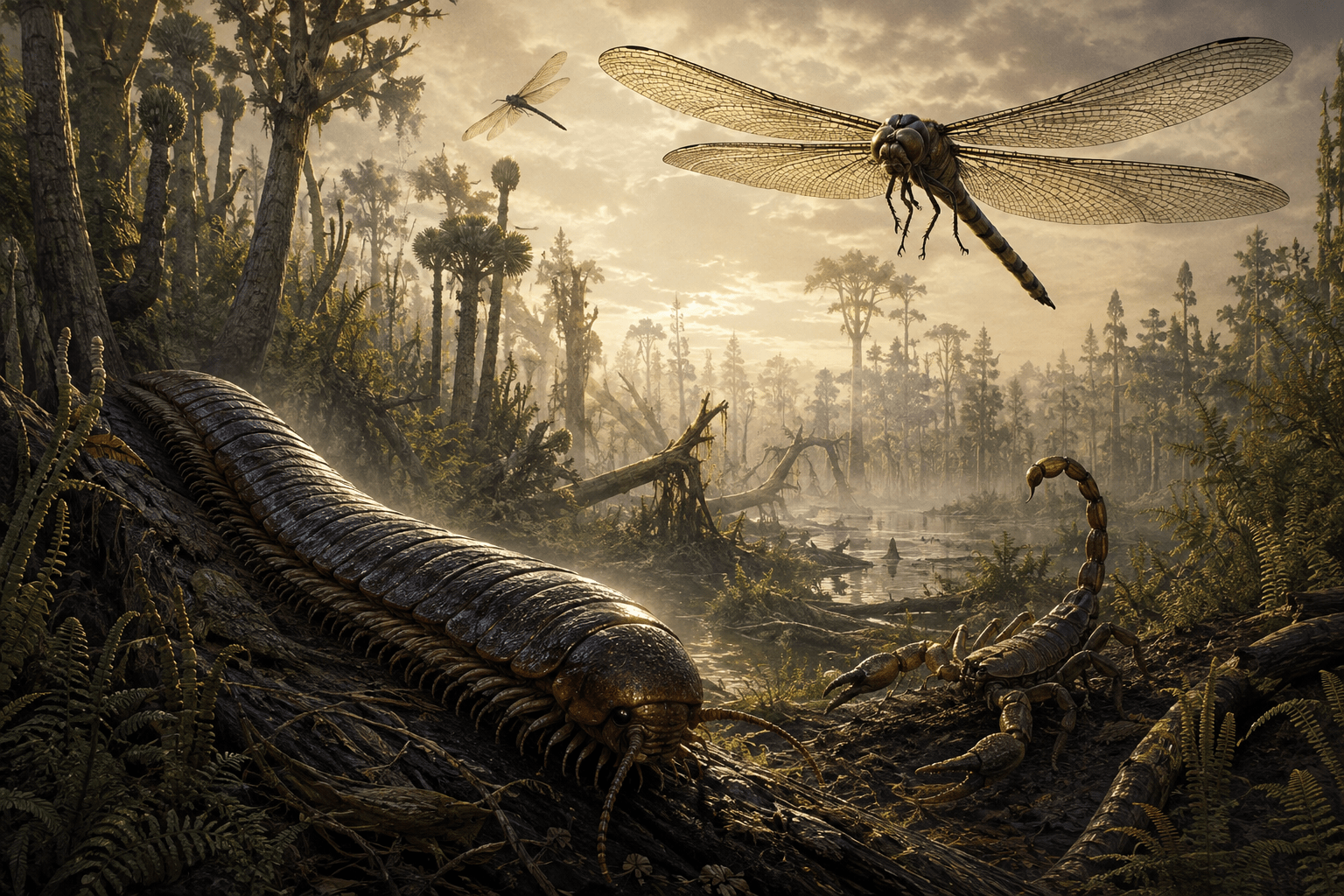
| We once imagined insects the size of buses. It was supposed to be ridiculous. The fossil record, however, has other ideas. If Insects Became the Size of Buses |
| A little while ago I wrote one of our less serious What If pieces and wondered what gardening might be like if insects became the size of buses. It was deliberately ridiculous. Bumblebees became large enough to make the patio an unsuitable place for tea, dragonflies reached dimensions that would presumably require some understanding with air traffic control, and a beetle of sufficient size could make getting the van off the drive more complicated than it already is. There are perfectly good biological reasons why none of this is going to happen, which was rather the point. But afterwards I found myself thinking about the question from the opposite direction. Instead of asking how large insects might become in an imaginary future, how large had they actually become in the past? I have been fascinated by insects since childhood, and one of the things I have always loved about them is their ability to make a perfectly sensible question lead somewhere unexpected. This one certainly does, because while nature never managed the bus-sized beetle, there was a time when some of the arthropods moving around on land and through the air were genuinely enormous. To find them we have to go back roughly 300 million years, to a world that would be difficult to recognise even if we were somehow able to stand in it. Much of the land around the equator supported extensive forests and wetlands dominated not by the flowering plants we know today, but by enormous clubmosses, horsetails, ferns and other ancient vegetation. There were no birds overhead, no flowering meadows full of bees, and certainly no gardener standing nearby wondering whether something needed pruning. Yet arthropods were already extraordinarily successful, and some had reached proportions unlike almost anything we encounter on land today. Something rather large in Northumberland The best place for us to begin is surprisingly close to home. In 2018, a large block of sandstone fell from a cliff at Howick Bay in Northumberland. Inside was part of an animal that had lived more than 300 million years earlier. The fossil was not an entire creature but a substantial section of the exoskeleton of Arthropleura, an extinct millipede-like arthropod whose remains had long been known to science. What made the Northumberland specimen extraordinary was its size. From the fossil, researchers estimated that the complete animal could have reached about 2.6 metres in length and perhaps weighed around 50 kilograms. That takes a moment to absorb. We are talking about a land-dwelling arthropod approximately the length of a small car. It is tempting to reconstruct Arthropleura simply as an enormous modern millipede, but recent discoveries have made the animal considerably more interesting than that. Fossils described in 2024 finally revealed important details of its head. Its body possessed features associated with millipedes, including two pairs of legs on many body segments, while parts of the head also showed characteristics associated with centipedes. The discovery has helped scientists investigate the early evolutionary relationship between those two great groups of many-legged arthropods. We still don’t know everything about Arthropleura—even something as apparently straightforward as what an animal that size ate remains uncertain. Various diets have been proposed over the years. Still, the evidence isn’t sufficient to confidently turn it into either a gigantic vegetarian quietly processing the Carboniferous equivalent of leaf litter or a huge predator roaming the forest floor. Sometimes the scientifically correct answer really is simply that we don’t yet know. I rather like that. A creature can leave tracks, pieces of armour and eventually parts of its head behind for us, and 300 million years later still refuse to tell us what it had for lunch. The dragonfly that wasn’t quite a dragonfly The skies contained their own giants. One of the names often encountered in popular accounts is Meganeura, and it is almost inevitably described as a giant dragonfly. That gives us a useful mental picture, but it isn’t quite accurate. Meganeura and its enormous relatives belonged to an extinct group called the Meganisoptera, often referred to as griffinflies. They were more closely related to dragonflies and damselflies than to simply oversized versions of the dragonflies flying around our ponds today. And some became enormous. The champion species is usually cited as Meganeuropsis permiana, from the early Permian of what is now North America. Its estimated wingspan reached approximately 71 centimetres. That is not an insect one would casually fail to notice as it passed. These animals were aerial predators, and their resemblance to dragonflies gives us some idea of the ecological role they probably occupied. Long before swallows, bats or dragonflies as we know them were pursuing insects through the air, large predatory insects were already doing something broadly comparable. There is something wonderfully humbling about that. We tend to think of sophisticated aerial hunting as belonging to the later chapters of animal evolution. Yet insects had taken to the air hundreds of millions of years ago and were already evolving into formidable flying predators. The garden dragonfly passing over a pond today is not some unchanged Carboniferous survivor, of course. Evolution does not work like that. But when you watch one accelerate, turn and intercept another insect in flight, you are watching a style of existence with extraordinarily deep evolutionary roots. Scotland had something under the stones too. If a 70-centimetre flying insect isn’t enough, prehistoric Britain can offer something else. At East Kirkton in West Lothian, Scotland, fossils have revealed an extraordinary Carboniferous terrestrial ecosystem. Among its inhabitants was Pulmonoscorpius kirktonensis, a prehistoric scorpion known from beautifully preserved cuticle fragments as well as more complete specimens. Reconstructions of the largest material have produced estimates of around 70 centimetres for particularly large individuals. Modern British gardeners are not accustomed to finding scorpions beneath pots, which is probably just as well. A scorpion approaching the length of an adult human arm would make lifting an old paving slab considerably more contemplative. Yet there is a danger here of allowing size to become the whole story. Pulmonoscorpius is interesting not merely because it was enormous. Fossil evidence from these ancient scorpions contributes to our understanding of how arachnids adapted to terrestrial life. Book lungs allowed scorpions to breathe air, and the East Kirkton material is part of a much bigger evolutionary story about arthropods moving into and exploiting life on land. The monster is what catches our attention. The adaptation is what makes it interesting. So was everything enormous? This is where the familiar picture of the Carboniferous can become misleading. It is easy to imagine a prehistoric landscape in which every beetle required a saddle and every spider needed its own postcode. That wasn’t the case. Giant species existed alongside much smaller animals, just as elephants exist today without requiring every mammal to weigh several tonnes. And spiders provide a particularly good warning against assuming that everything prehistoric must have been bigger. For years there appeared to be a spectacular exception. A fossil from Argentina, Megarachne servinei, was described in 1980 as an enormous prehistoric spider, with reconstructions suggesting a leg span of roughly half a metre. Museum casts and illustrations helped establish the idea of a genuinely gigantic spider living hundreds of millions of years ago. There was just one difficulty. It wasn’t a spider. When Megarachne was re-examined using better-preserved material, researchers concluded that it was actually a eurypterid, belonging to the extinct group popularly known as sea scorpions. One of the most famous giant prehistoric spiders disappeared without the animal itself changing at all. Our interpretation had changed. That is one of the things I particularly enjoy about natural history. Science doesn’t lose something when an old identification proves wrong. Usually the story becomes better. Megarachne went from being evidence for gigantic spiders to an excellent demonstration of how palaeontology actually works: fossils are incomplete, interpretations are provisional and occasionally an animal that has spent years being a spider turns out not to have been one in the first place. Perhaps surprisingly, the largest securely known spiders are not prehistoric monsters at all. Some of the largest spiders we know are living alongside us today, particularly the great tarantulas and huntsman spiders. The fossil record for spiders is incomplete, so we should be careful about declaring that enormous prehistoric spiders never existed, but there is currently no convincing fossil equivalent of the half-metre spider once imagined for Megarachne. Was it simply the oxygen? Whenever giant prehistoric insects are discussed, one explanation usually arrives almost immediately: there was more oxygen. There is good science behind that idea. Modern insects do not breathe with lungs in the way we do. Oxygen reaches their tissues through a network of tubes called the tracheal system. As an insect becomes larger, supplying tissues efficiently becomes increasingly demanding. Experimental work and studies of insect physiology support the idea that atmospheric oxygen can influence body size, and estimates suggest that oxygen concentrations during parts of the late Palaeozoic were substantially higher than today’s roughly 21 per cent. Higher oxygen levels have therefore helped make enormous insects physiologically possible. But possible is not the same as inevitable, and this is where the simple explanation begins to wobble. Research comparing more than 10,000 fossil insect wing measurements found a relationship between atmospheric oxygen and maximum insect size during much of early insect evolution. Later, however, that relationship weakened. Insects became smaller even during periods when oxygen alone might have allowed larger forms to exist. Something else had entered the skies. Flying vertebrates. As birds evolved and became increasingly capable aerial predators, enormous flying insects faced ecological pressures their distant ancestors had never encountered. Later still came bats. Competition and predation have joined physiology in determining how large flying insects could profitably become. Even Arthropleura complicates the neat oxygen story. The enormous Northumberland specimen came from a period when atmospheric oxygen may not have been at the exceptional levels once assumed necessary for such gigantism. Food availability, ecology, evolutionary history, climate, and the presence or absence of competitors and predators all play a role. Nature is rarely kind enough to provide one cause when six will do. Why did the giants disappear? There wasn’t a morning when the world’s enormous insects collectively discovered they were too large and down sized. Their decline spanned immense stretches of geological time and involved different groups responding to distinct environmental and ecological changes. Atmospheric oxygen changed. Climate changed. Habitats changed. New predators appeared. Entire ecosystems were reorganised, and the Permian ended with the greatest mass extinction currently known in Earth’s history. The useful lesson is not that prehistoric arthropods became enormous because of one peculiar Carboniferous trick and then vanished when someone turned the oxygen down. It is that size exists within an ecological bargain. Being large can provide advantages: protection from some predators, access to different prey, greater reserves and perhaps advantages in reproduction or competition. It also carries costs. A larger animal needs more resources, must support and oxygenate more tissue and may become more conspicuous or less manoeuvrable. Change the environment and yesterday’s advantage can become tomorrow’s liability. That isn’t peculiar to prehistoric insects. It is one of the recurring themes of evolution. Could they become giants again? This was perhaps inevitable once I started thinking about our imaginary bus-sized insects. Could something like Meganeuropsis evolve again? In principle, evolution can produce outcomes that surprise us, so I hesitate to say never. But recreating the Carboniferous giants would require considerably more than simply increasing atmospheric oxygen. Modern insects exist in ecosystems that contain birds, bats, and other highly effective predators and competitors. Their respiratory systems, developmental biology, food supplies, habitats and evolutionary histories all impose constraints. And the bus-sized beetle remains safely on the fictional side of the garden gate. The laws of scaling become increasingly troublesome as an animal grows. Structures become heavier, support becomes more difficult, respiratory and circulatory demands change, and an insect body plan that works beautifully at a few centimetres cannot simply be enlarged to several metres like a photograph on a photocopier. That is why the genuine animals are ultimately more satisfying than the imaginary ones. We don’t need a dragonfly the size of a car. A flying predatory insect with a 71-centimetre wingspan is quite enough. We don’t need a millipede the size of a bus. A 2.6-metre arthropod wandering through what eventually became northern England will do nicely. And we don’t need to invent a giant prehistoric spider, because science already gave us the rather better story of one that turned out not to be a spider at all. I began this by wondering whether our silly article about insects the size of buses contained the tiniest grain of truth. It didn’t, really. Nothing in the fossil record suggests that insects ever approached anything remotely like those dimensions. What it did contain was a useful question. Once you start looking at the animals that genuinely existed, the joke becomes unnecessary. Hundreds of millions of years before there were gardeners, garden centres, pesticides, bee hotels or arguments about whether something had eaten the dahlias, arthropods were already experimenting with flight, armour, predation, terrestrial life and extraordinary size. Most of the giants eventually disappeared. The arthropods did not. They adapted, diversified and continued, which explains why I have remained fascinated by insects for most of my life. Size catches the eye, but it is their resilience and adaptability that hold my attention. The enormous creatures of the Carboniferous and Permian are spectacular precisely because they are gone; the small creatures outside the back door are perhaps more remarkable because, after hundreds of millions of years of change, they are still here. |
| Scientific sources & further reading The Natural History Museum’s account of the giant Northumberland Arthropleura fossil explains the approximately 2.6-metre size estimate, its geological setting and why the discovery complicated the simple relationship between atmospheric oxygen and gigantism. The Museum’s 2024 coverage of newly described Arthropleura head fossils discusses the surprising combination of millipede- and centipede-like characteristics and the continuing uncertainty surrounding the animal’s biology. Research by Matthew Clapham and Jered Karr in the Proceedings of the National Academy of Sciences, based on more than 10,500 fossil insect wing measurements, examines the changing relationships among oxygen, insect size, and the emergence of flying vertebrate predators. Research published by the Royal Society reassessed Megarachne servinei and demonstrated that the supposed giant prehistoric spider was actually a eurypterid. Andrew Jeram’s work on Pulmonoscorpius kirktonensis describes the Carboniferous scorpion material from East Kirkton, Scotland, and its significance for understanding early terrestrial scorpions. |
| Verification links Natural History Museum — the 2.6-metre Northumberland Arthropleura discovery (Natural History Museum) Natural History Museum — the newly discovered Arthropleura head anatomy (2024) (Natural History Museum) Natural History Museum — griffinflies and giant prehistoric flying insects (Natural History Museum) PNAS — Environmental and biotic controls on insect body size — particularly valuable because the analysis used more than 10,500 fossil wing measurements and found that oxygen alone cannot explain the later history of maximum insect size. (PubMed Central (PMC)) Royal Society research — the true identity of Megarachne — the paper establishing that the celebrated “giant spider” was actually a eurypterid. (PubMed Central (PMC)) Cambridge University Press — Pulmonoscorpius and the East Kirkton scorpions (Cambridge University Press) |
| About our writing & imagery Most articles reflect our real gardening experience and reflection. Some use AI in drafting or research, but never for voice or authority. Featured images may show our photos, original AI-generated visuals, or, where stated, images credited to others. All content is shaped and edited by Earthly Comforts, expressing our own views. |

